
MAPS Intelligence
Resources/Creative Methods
Creative Methods · 10 min read

From brief to concept: how a campaign concept is developed

The brief, the analysis, the concepts, the development, the test: the path from a communication objective to a campaign idea ready for production.

Updated October 6, 2026 · MAPS editorial team
In brief

A campaign concept is the central idea from which all the content flows: a title, the idea in a few lines, a headline, the channels it lives in. You get there in five steps: a clear brief, an analysis done with a method, several alternative concepts to compare, the development of the chosen one — copy, art direction, channels, execution — and a test with the audience before production.

1. The brief

The brief says what the campaign has to achieve. Part of it comes from what is already known about the brand — industry, positioning, values, target, competitors —; another part is specific to the campaign:

  • Objective, and how it is measured.
  • Target: who has to change their mind or behavior.
  • Key message: the single thing that has to stick.
  • Channels, budget and constraints: where, with how much, within what limits.

A brief that asks for everything asks for nothing: if the key message is five messages, the concept will have no center.

2. The analysis, with a method

The same brief can be looked at in different ways, and each method leads to different ideas: the customer’s job, the benefit ladder, a cultural tension, the category’s codes through semiotics, an insight, another industry, several futures, a mix of communication archetypes. Choosing the method is already a creative choice.

3. The concepts: more than one, and different

A single concept can’t be judged: you need something to compare it with. But six variations of the same message don’t help either: the concepts have to cover the space of possibilities — from cautious to bold, from one corner of the method to the other.

Each concept has a title, the idea in a few lines, a headline, the channels. And it has to be assessed on two axes that pull in opposite directions: differentiation (how much it stands out) and risk (how much can go wrong).

4. The development

The chosen concept becomes a campaign. Full development covers five areas:

  • The copy: big idea, rationale, tone, who it speaks to, which barriers it removes; then headlines with alternatives, body copy, tagline, call to action, proof points.
  • The channels: for each channel, the copy, the format, the visual.
  • The art direction: the visual concept, palette, typography, photography, mood.
  • The method: what the chosen method adds — the job story, the tension, the climb up the ladder.
  • The execution: budget, timing, technical and legal challenges, KPIs, testing.

5. The test

Before production, the concept should be shown to the people who have to buy it: a test, a listening group, a trial with synthetic users. Validation costs far less than a campaign that misses.

An example. “Ardenti”, menswear tailoring, wants to speak to young professionals. Brief: be the choice for the first important suit. Method: the customer’s job. Concepts: “Promotion coming up? Dress for the future” (on the moment), “From doubt to second skin” (on the transformation), “The code of the elite” (on belonging). The first one is developed, tested with the audience, then rolled out to the channels.

The most common mistakes

  • A brief with too many messages. The concept inherits the confusion.
  • Skipping the analysis. Ideas still come, but they tend to look like the category’s.
  • A single concept. Without alternatives, you don’t choose: you approve.
  • Developing before testing. Finding out late that the audience doesn’t get the idea costs the whole development.
How MAPS does it

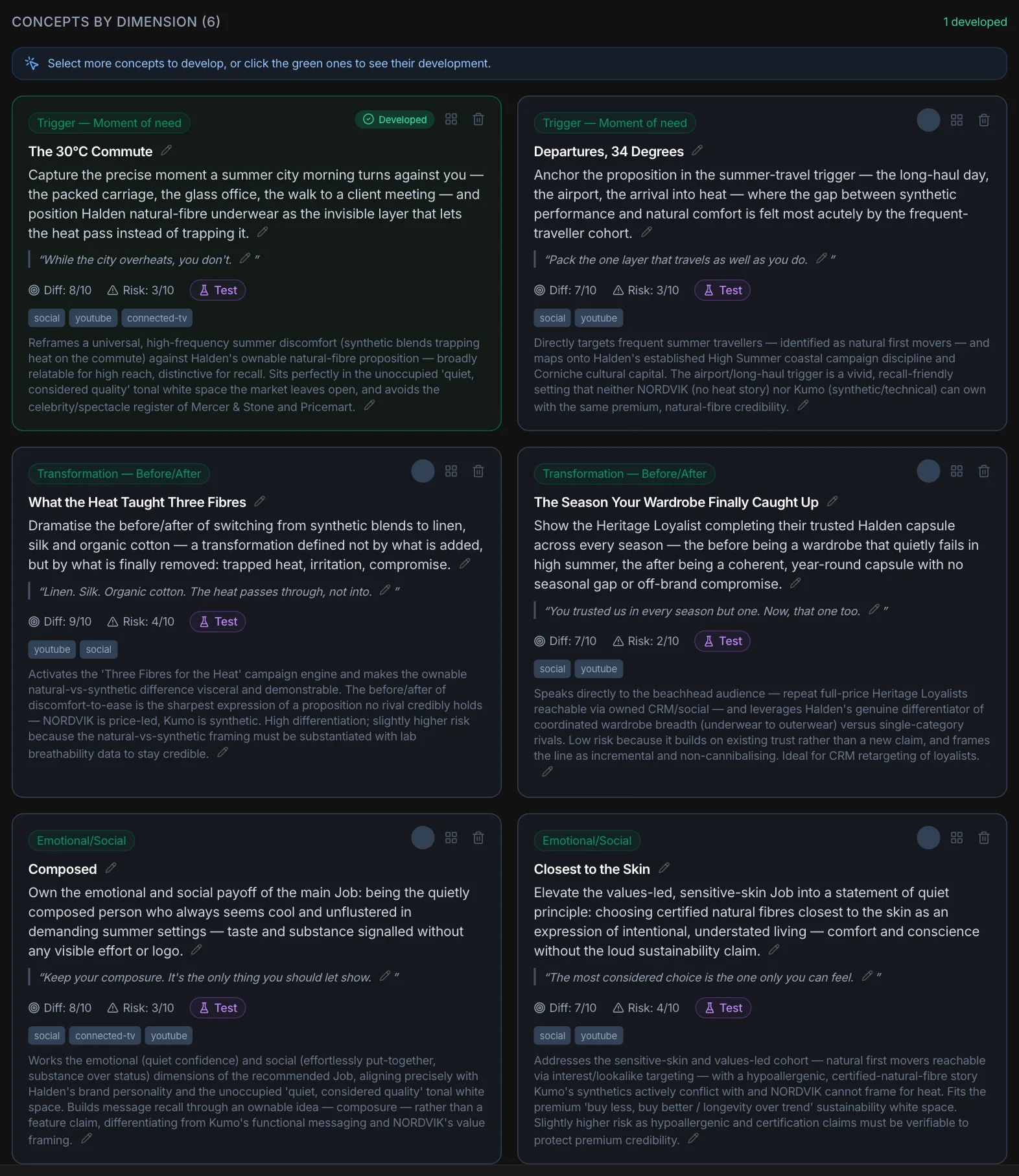
The MAPS Campaign Lab follows this path — brief, analysis, concepts, development, production — with eight methodologies. The brief starts pre-filled from the project (industry, positioning, values, target, competitors); you complete it, or upload a PDF or Word file, or paste the text, and the AI extracts the information. Each method has its own analysis: in Jobs to Be Done, for example, MAPS recommends a focus and you can choose another, and the concepts follow your choice. The concepts come out with a deliberate distribution, each with a title, idea, headline, channels and scores for differentiation and risk. The development has five tabs — Master Copy, Channels, Art Direction, Methodology, Execution —; you work on it with “Collaborate”, creating new versions, and test it with synthetic users. With Full AI, the analysis, the concepts and the development of the first concept run in the background; with step-by-step you stop at every stage.

Six concepts by dimension with differentiation, risk and Test

Frequently asked questions

What is a campaign concept?

It is the central idea from which all the campaign’s content flows: a title, the idea in a few lines, a headline and the channels it lives in.

What should a creative brief contain?

The objective and how to measure it, the target, the key message, the channels, the budget and the constraints. Plus the brand context: industry, positioning, values, competitors.

How many concepts should you develop?

It pays to generate several — six is a good number — covering different approaches, and to fully develop one or two after comparing them.

How do you choose between several concepts?

By comparing differentiation and risk, fit with the brief and the audience’s reaction. A test before full development keeps you from investing in the wrong idea.

Written by the MAPS editorial team with the help of AI, checked and reviewed by the team.

Related articles
Creative Methods·9 min di lettura

Communication archetypes: how the brand speaks, and to whom

Nine communication archetypes in three families — voice, value, receiver — each with six tactical variants: what they are, how they differ from Jung’s archetypes, how to build a mix.

Read →
Creative Methods·9 min di lettura

Insight-led campaigns: from insight to idea

What an insight is (and isn’t), how to find one in the data, how to put it to the test, and the three ways to turn it into a campaign: say it, show it, provoke.

Read →
Methodology·10 min di lettura

Strategic validation: putting an idea to the test before you invest

Find the riskiest assumptions, choose the right test, decide up front what counts as evidence: a method for failing small instead of failing big.

Read →