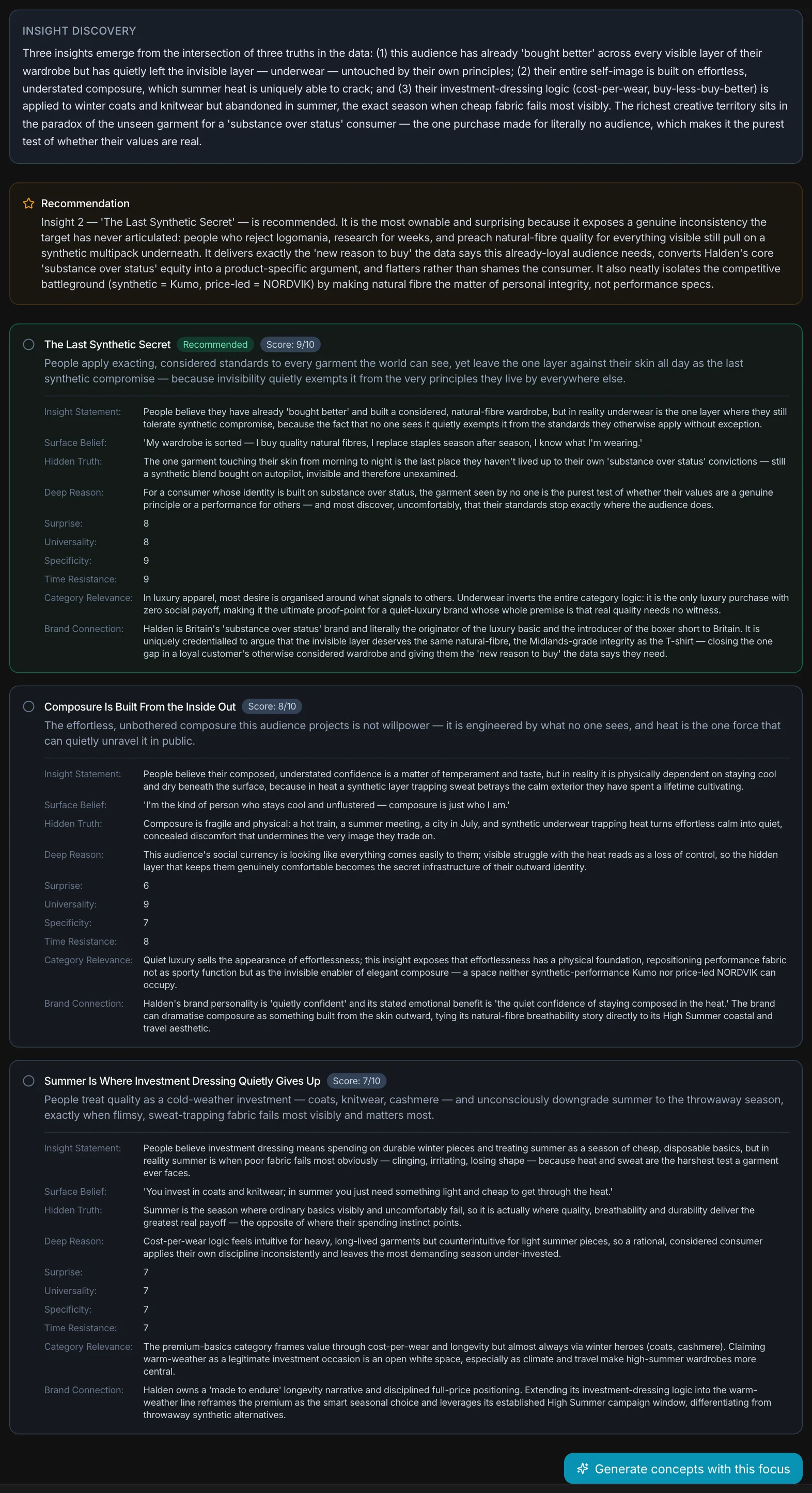
What an insight is, and what it isn’t
- It isn’t a data point. “60% of young professionals buy suits online” is a data point.
- It isn’t an obvious observation. “People want to dress well” is true, but surprises no one.
- It is a hidden truth. “For a young professional, a suit isn’t a status symbol: it’s a way to accelerate their career, and they buy it anxious about getting it wrong” — this explains a behavior, and opens up a campaign.
A useful structure: the surface belief (what people say), the hidden truth (what really happens), the deeper reason (why).
How to find one
1. Start from behaviors
Contradictions are the gold mine: between what people say and what they do, between what they want and what they choose. The Empathy Map is designed precisely to bring them out.
2. Dig underneath
For each contradiction, ask yourself why, several times, as in the 5 Whys. You stop when you find a motivation that explains the behavior.
3. Put it to the test
Three questions. Is it surprising — does it say something that goes unsaid? Is it universal — does most of the audience recognize it? Is it specific — does it hold for this audience and this category, or would it fit anyone? An insight that passes all three tests is rare, and valuable.
4. Choose how to use it
The same insight can be said (the audience sees itself), shown (it is staged in real life) or used to provoke (the audience is challenged to think about it). They are three different campaigns.
5. Get ready to validate it
Before launch, the insight has to be tested with the audience: an A/B test of the messages, a listening group, and after the campaign the measures that show whether it was recognized.
The most common mistakes
- Calling a data point an insight. A number explains nothing on its own.
- Made-up insights. A clever line written in a meeting, with no evidence in behavior, is not an insight.
- Generic insights. If it works for any category, it isn’t specific enough.
- Not validating it. Audience recognition is the test: seek it before investing.