
Six concepts,
three ways to use an insight.
The same insight can be said, shown or used to provoke. The concepts do all three.
Recognition
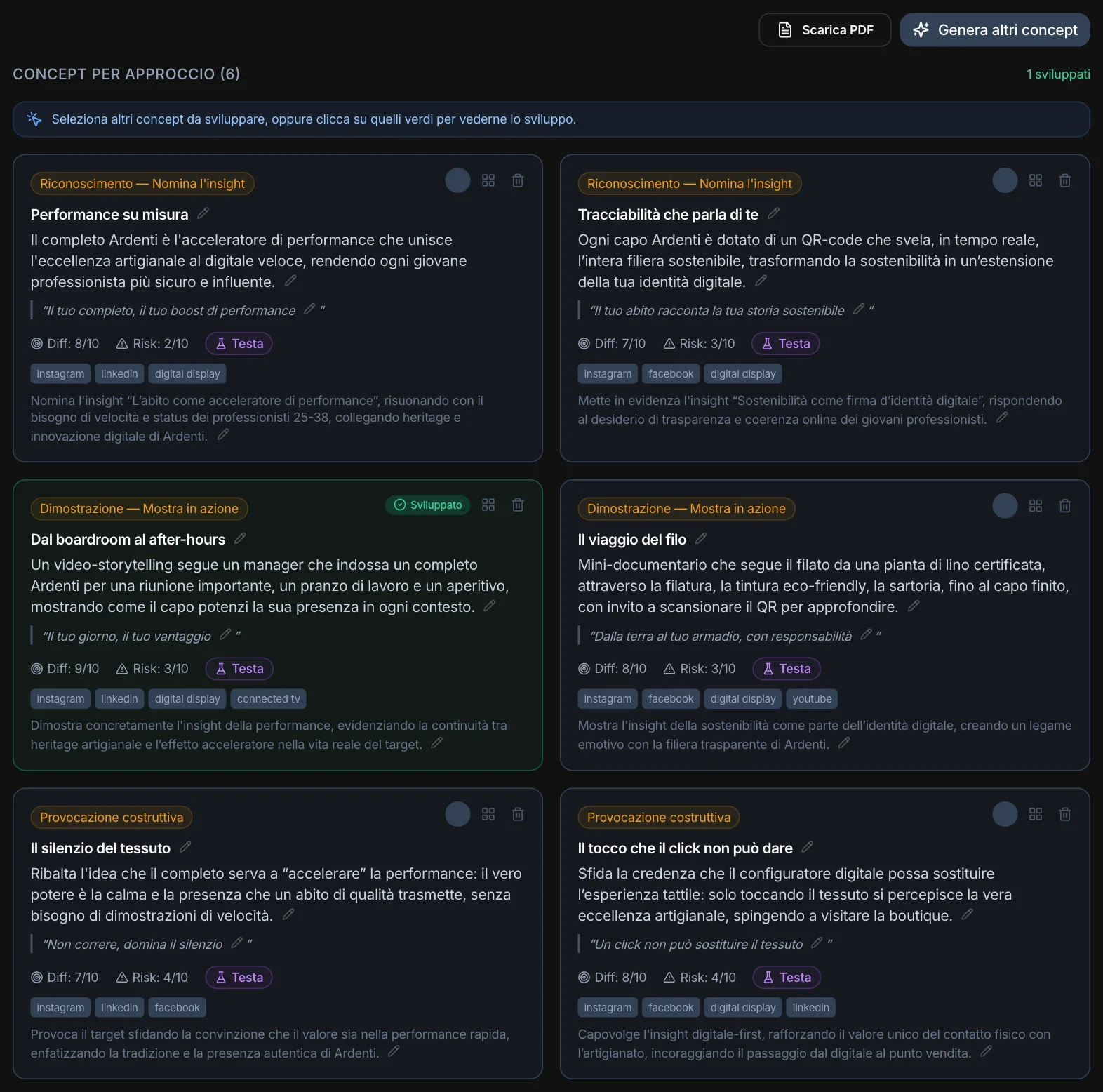
They name the insight and the audience sees itself: “Tailored performance”.
Demonstration
They show it in action, in real life: “From the boardroom to after-hours”.
Constructive provocation
They challenge the audience to think about it: “The touch a click can’t give”.
When to use it
- When you want a campaign with strong emotional resonance that builds an authentic connection.
- When the project’s data already says a lot about the audience — and the sentence that sums it up is missing.
- In B2B the insight is a truth about the decision-maker’s work: the downtime, the safety stock kept out of anxiety, the supplier who disappears.
The insights,
dug up and measured.
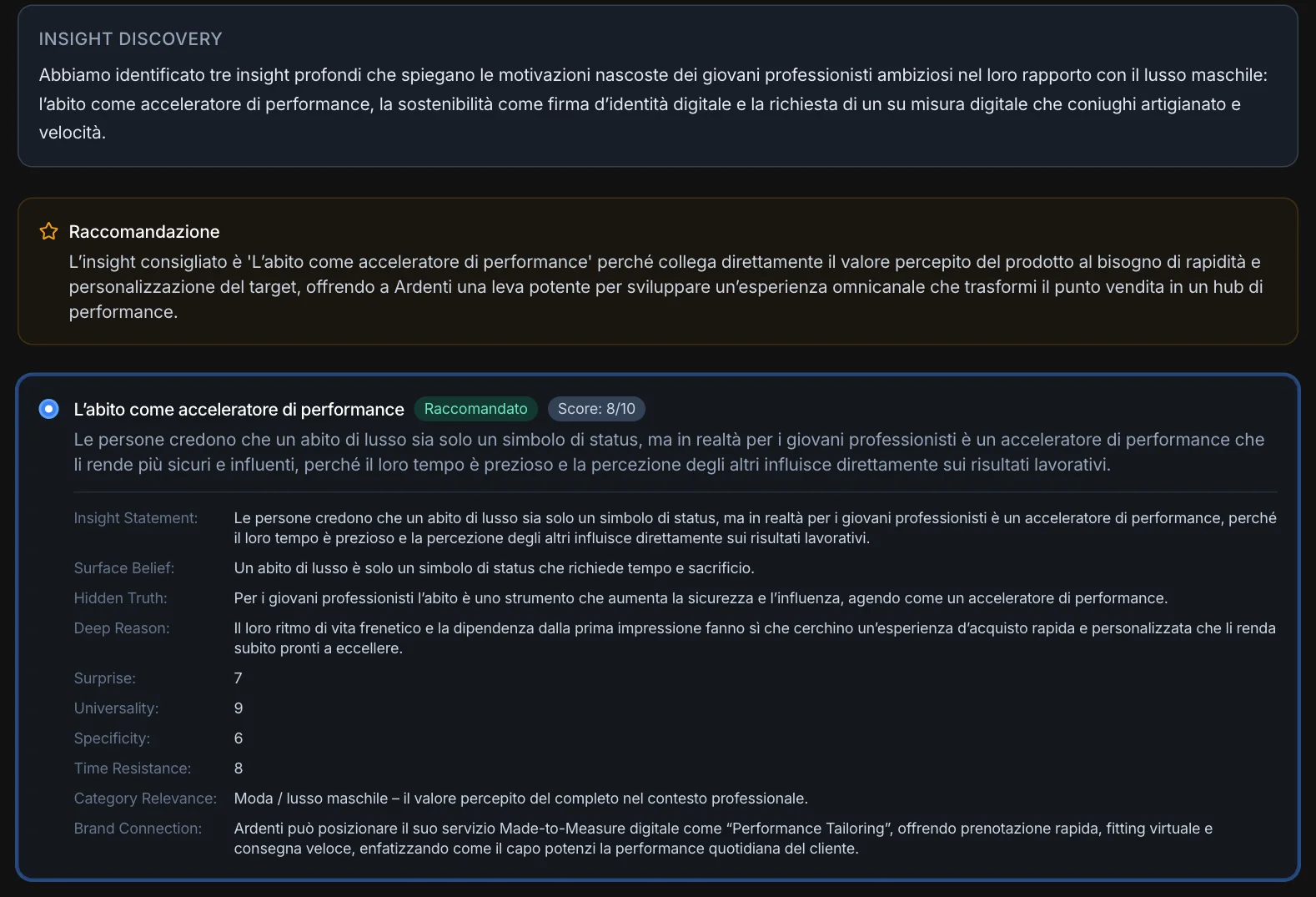
For each insight: the surface belief (“a luxury suit is a status symbol”), the hidden truth (“for a young professional it’s a performance accelerator”), the deeper reason, and scores for surprise, universality and specificity. One is recommended; you choose the focus.
Say it, show it,
provoke.
On the insight “the suit as a performance accelerator”: two concepts that name it, two that stage it — from the meeting to the evening drink, the journey of the thread —, two that catch you off guard, like “The silence of fabric”.
The insight, put to the test,
in the Methodology tab.
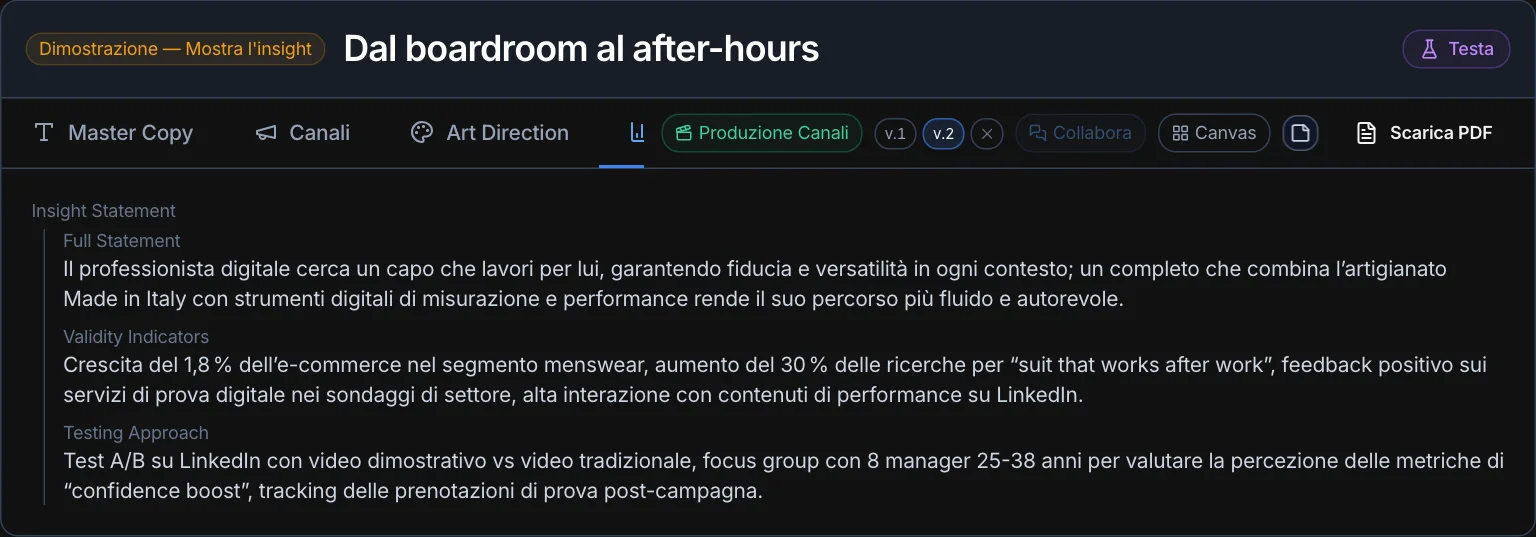
The development carries the full insight statement, the indicators that make it credible and how to test it: an A/B test, a focus group, what to measure after the campaign.
Alongside, the other tabs of every development: Master Copy, Channels, Art Direction, Execution.
An insight gets debated,
before you buy it.
On “From the boardroom to after-hours”: first the question every creative director asks — why would the audience recognize itself? —, then a more intimate rewrite of the body copy.
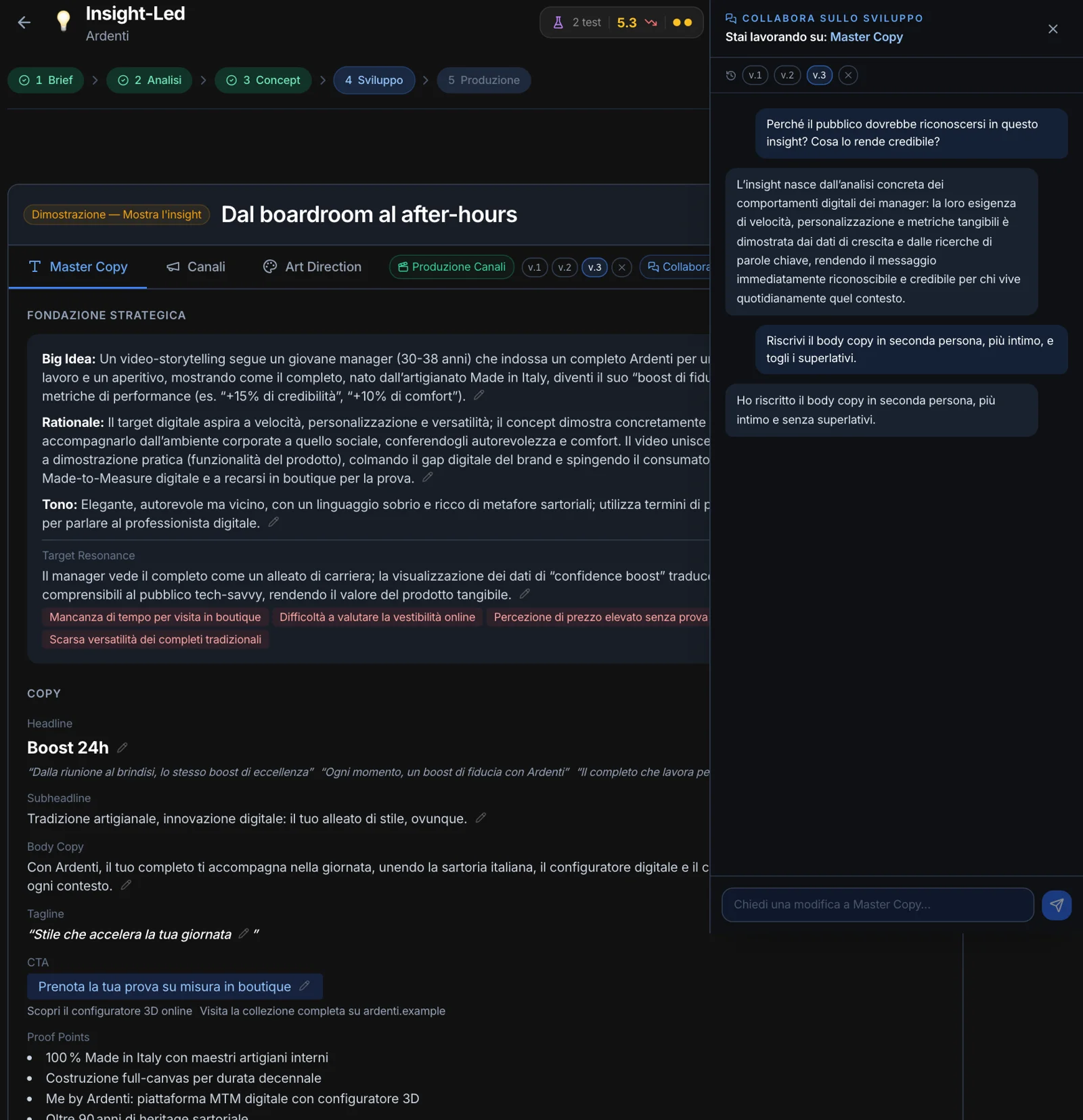
A question gets an answer and the document stays as it is. A change request touches only the open tab and creates a new version: the earlier ones stay, and you can go back with one click.
Test, production, prototype.
As with every method.
Test →
Every concept and every development in front of the project’s synthetic users, with the test history.
Channel Production →
The Strategic Direction by channel and the content: posts, storyboards, radio spots, out of home.
Prototype →
Mockups by channel on the Brand Kit and the simulated campaign, before you decide.