Six concepts,
three distances from the category.
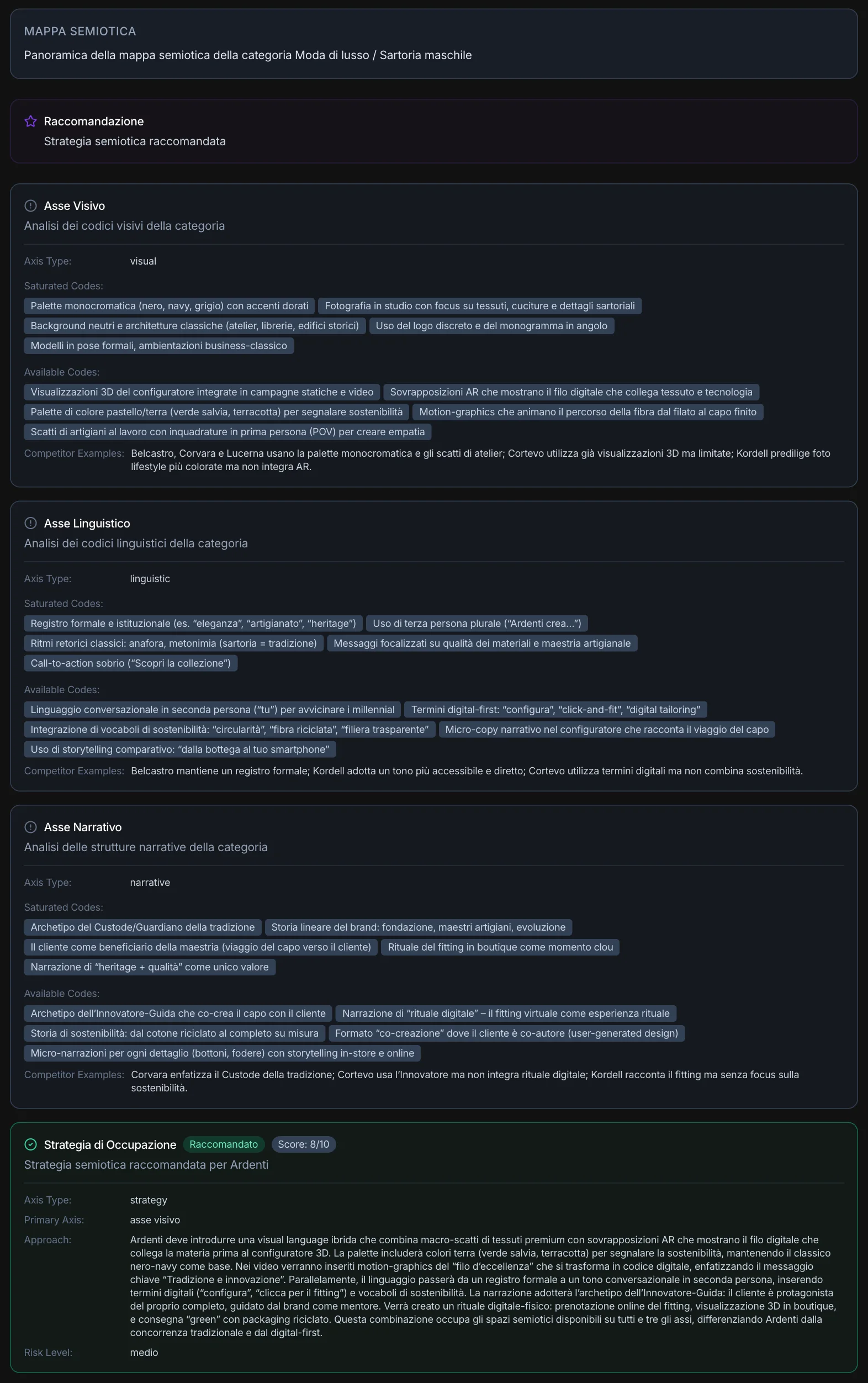
Being recognizable and standing out pull in opposite directions. The concepts cover the whole scale, from the code respected to the code broken on every axis.
Credibility
They use the category’s codes to be instantly recognizable: “A Legacy of Elegance”.
Controlled differentiation
They break one code, just one, chosen with care: “Your Suit, Your Story”.
White space
They step outside the category’s language on every axis: “The Sound of Fabric”.
When to use it
- When all your competitors look alike and you need a visual and verbal language that stands out.
- Before a rebrand or a new campaign, to know where the open space is.
- When you want to decide how much to risk, code by code, instead of “being bold” in the abstract.
The map of codes,
axis by axis.
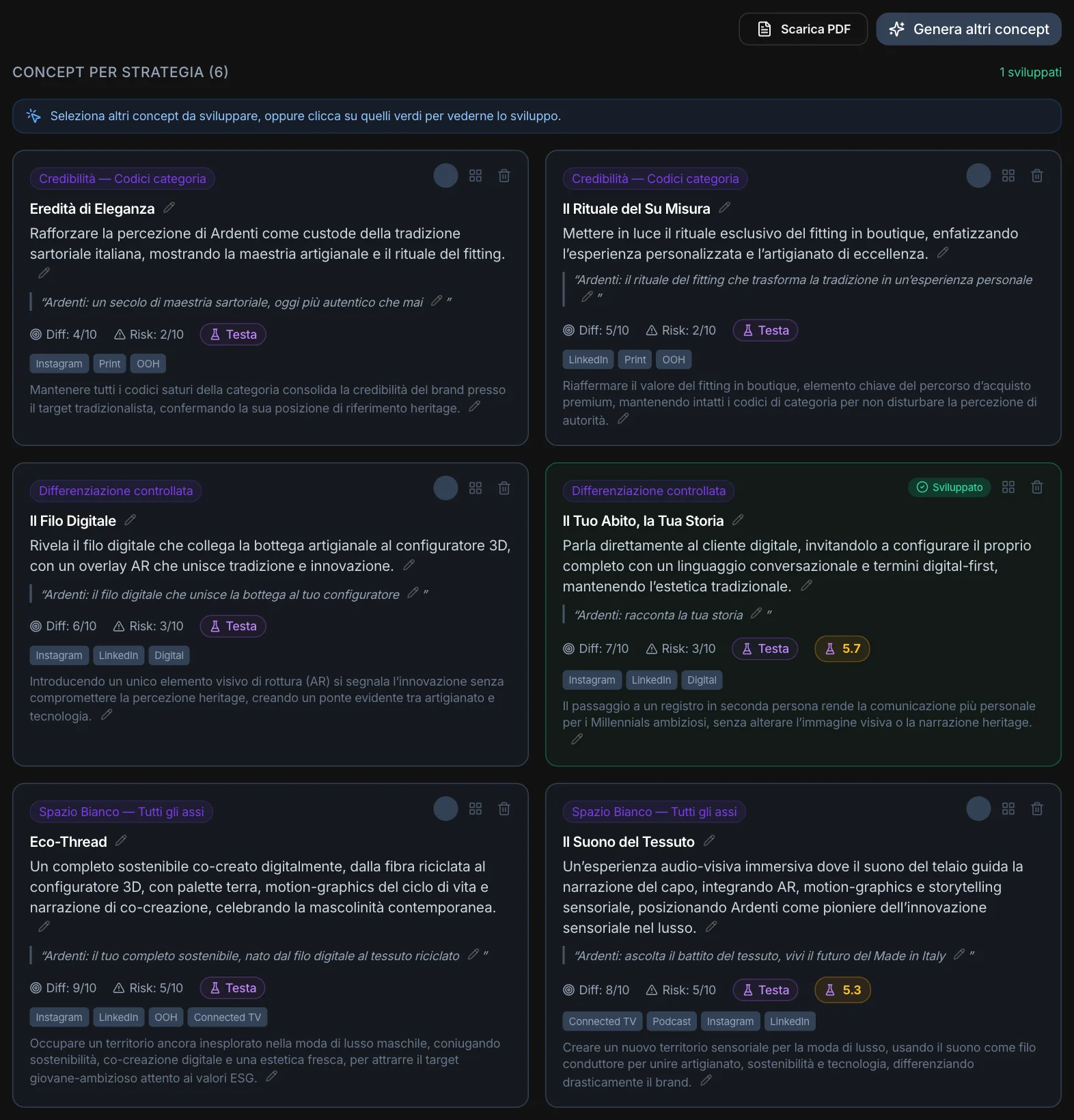
For each axis, the saturated codes — the ones everyone uses — and the open codes, with examples of how competitors communicate. At the end, the recommended occupation strategy: which codes to keep, which to break, and why.
From the code respected
to white space.
Two concepts speak the language of tailoring — heritage, the made-to-measure ritual —; two break a single code, like the second-person story of the customer co-creating their suit; two step out entirely, up to a concept built on the sound of the fabric.
The semiotic direction,
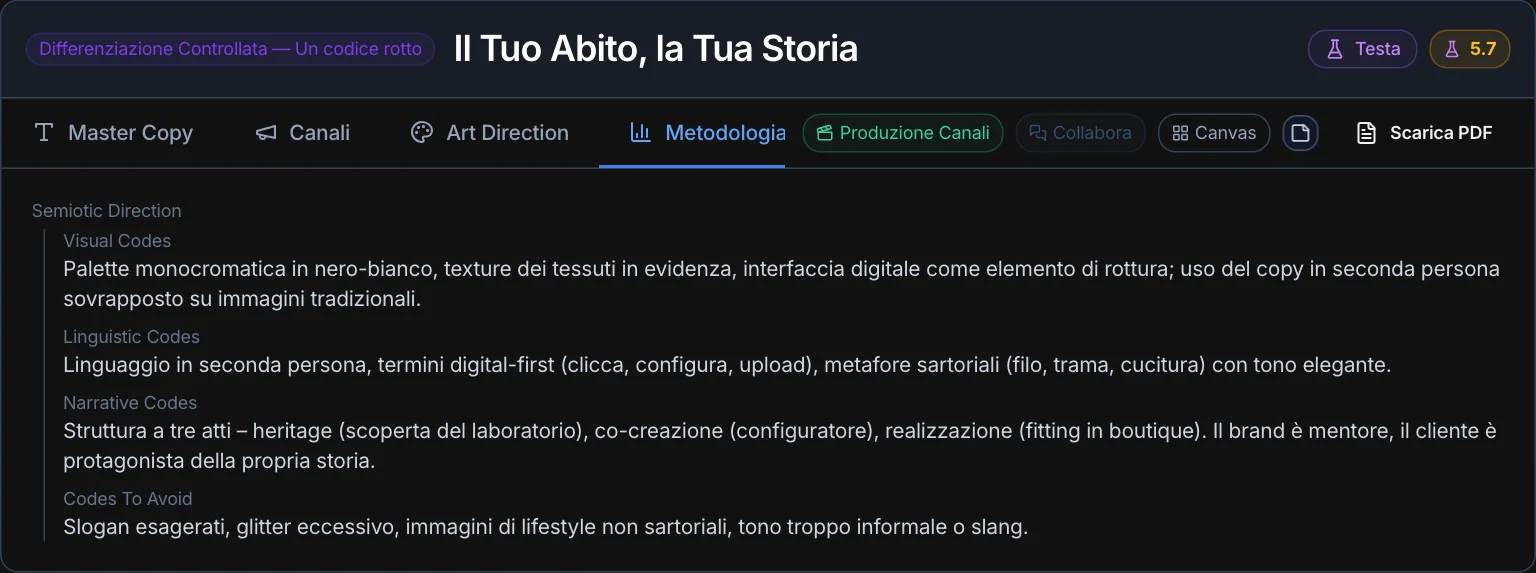
in the Methodology tab.
The development states its visual, linguistic and narrative codes — and the ones to avoid. It is a spec the creative team can use as is.
Alongside, the other tabs of every development: Master Copy, Channels, Art Direction, Execution.
Which code to break,
you choose together.
On “Your Suit, Your Story”, a controlled differentiation concept: first you ask to move away from the category’s palette — and the AI uses only the Brand Kit colors —, then you check which codes remain and which one breaks.
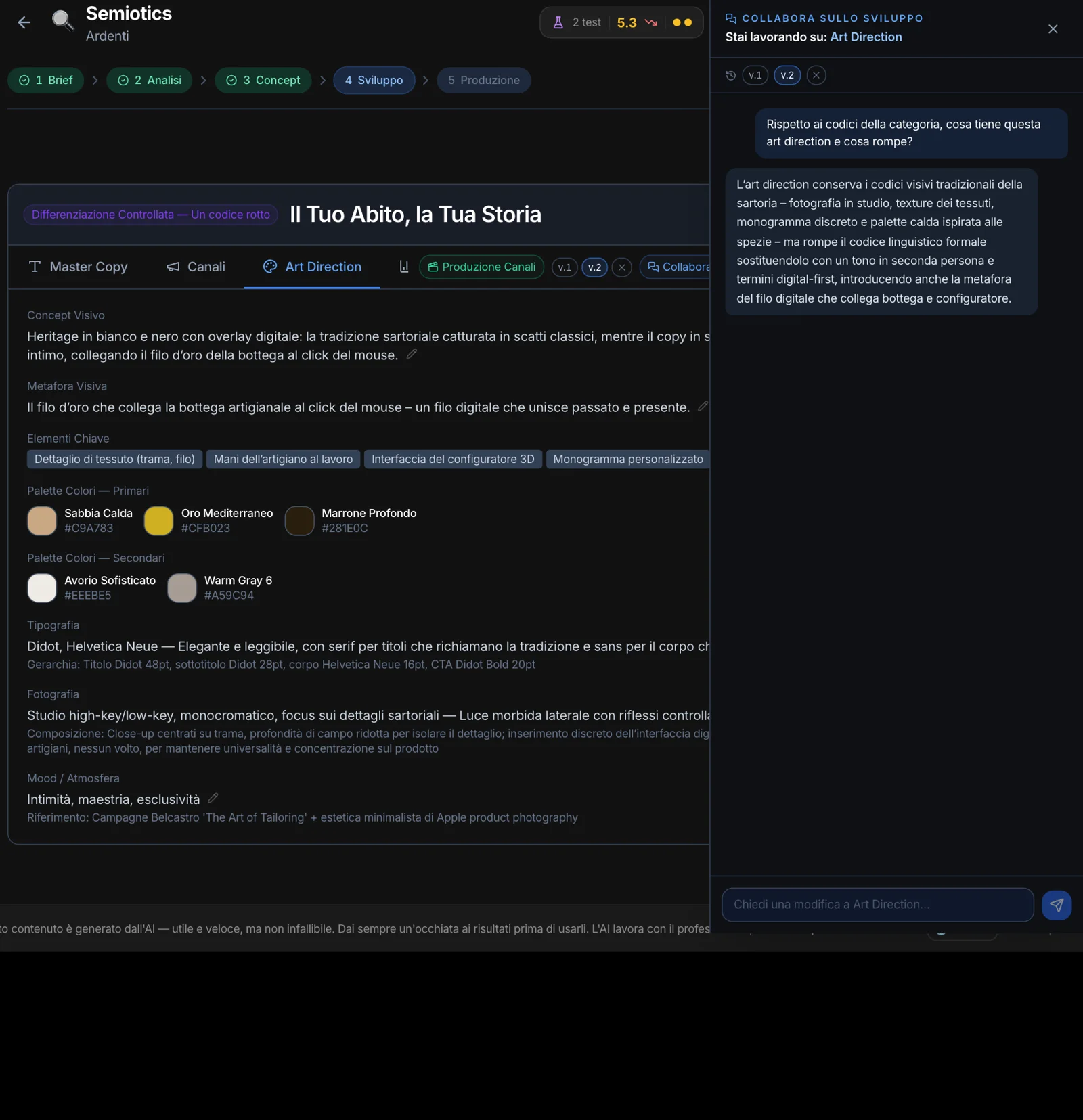
A question gets an answer and the document stays as it is. A change request touches only the open tab and creates a new version: the earlier ones stay, and you can go back with one click.
Test, production, prototype.
As with every method.
Test →
Every concept and every development in front of the project’s synthetic users, with the test history.
Channel Production →
The Strategic Direction by channel and the content: posts, storyboards, radio spots, out of home.
Prototype →
Mockups by channel on the Brand Kit and the simulated campaign, before you decide.