
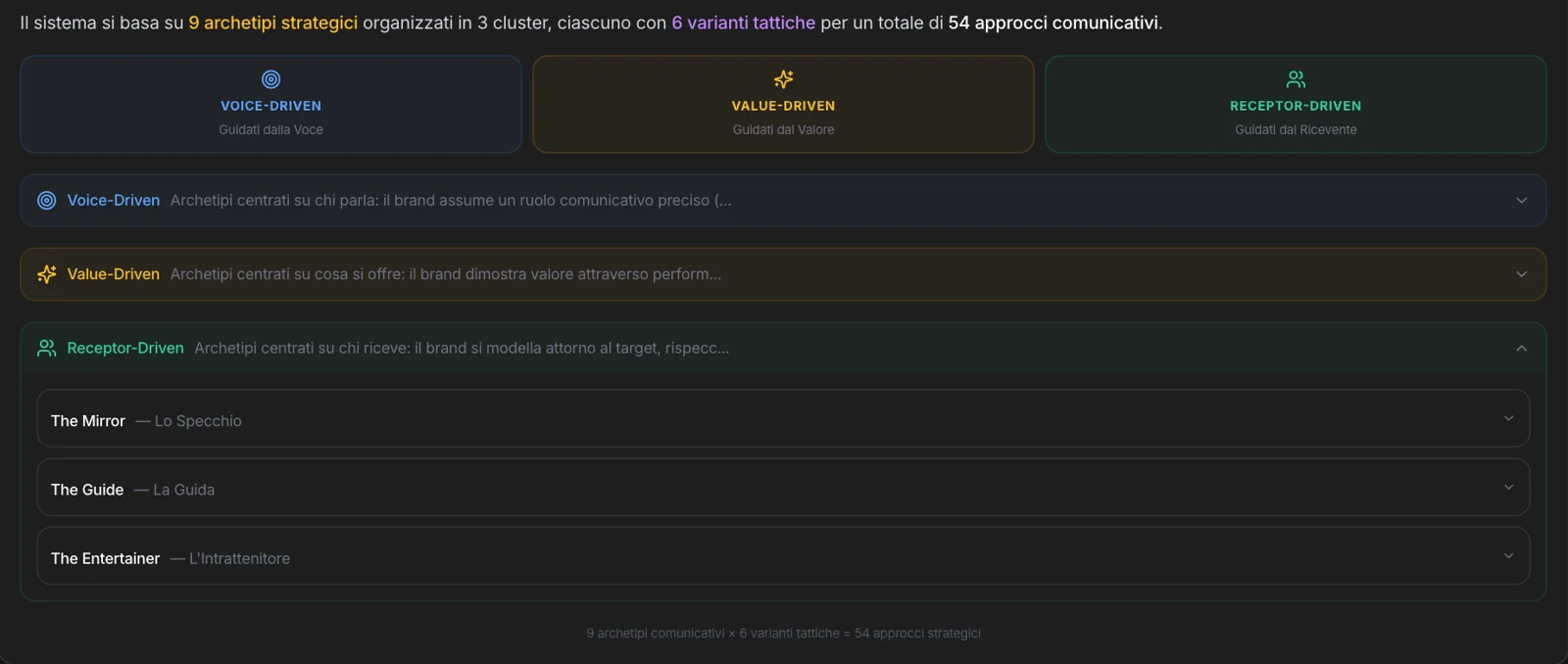
Nine archetypes.
Three families, fifty-four variants.
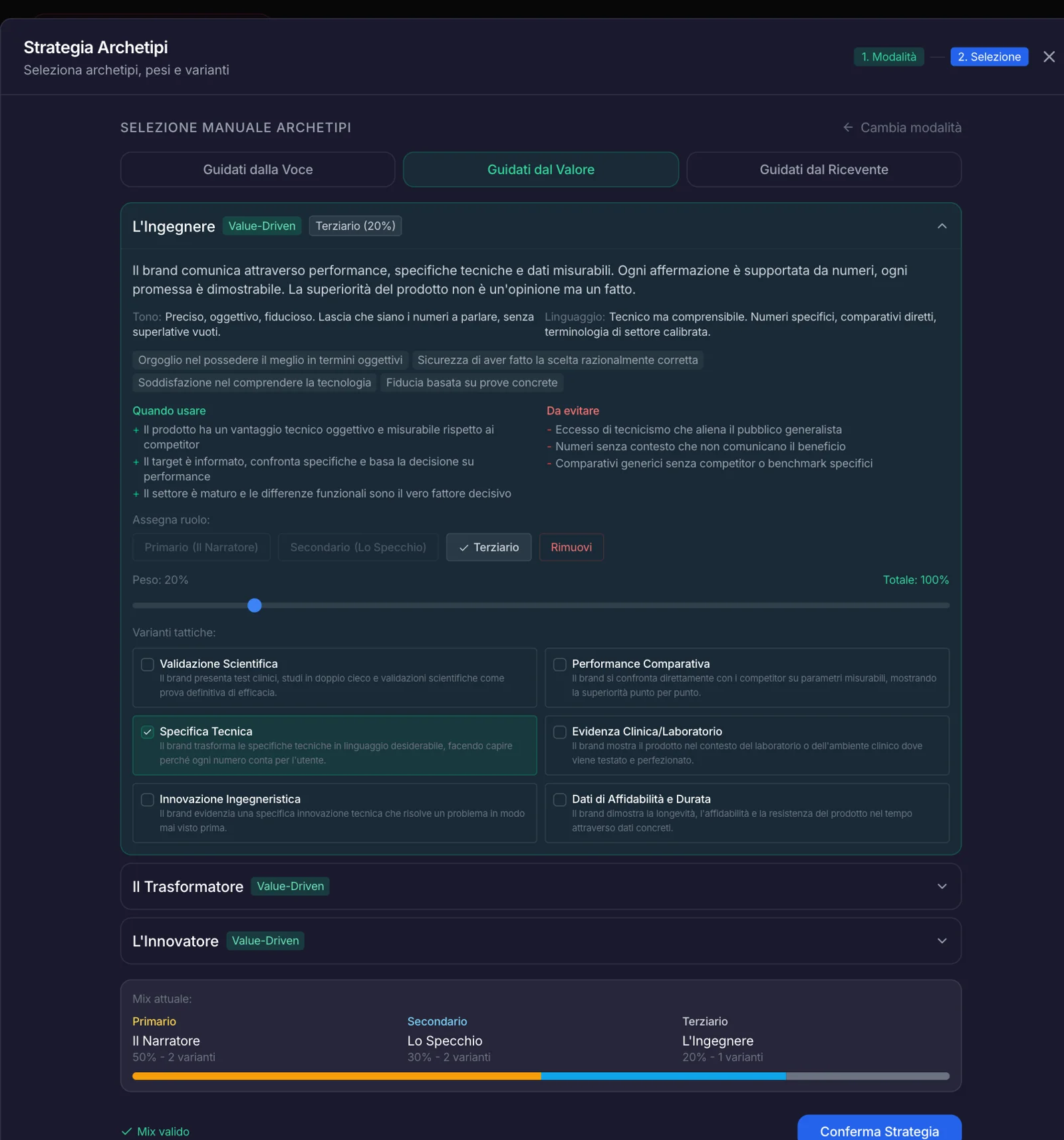
Each archetype has its essence, when to use it, its tone, its language, typical sectors, what to avoid — and six tactical variants, each with an example. The Engineer, for instance, can speak through technical specification, scientific validation or comparative performance.
Voice-Driven
- The Authority
The recognized expert: trust built on expertise, credentials, data. - The Storyteller
Stories that create connection: not a product, a meaning. - The Provocateur
Challenges the category’s conventions and looks for those who share the vision.
Value-Driven
- The Engineer
Performance and numbers: superiority isn’t an opinion, it’s a fact. - The Transformer
Before and after: who you were and who you can become. - The Innovator
The novelty that changes the category’s rules.
Receptor-Driven
- The Mirror
Reflects the audience’s identity: not “buy me”, but “you’re one of us”. - The Guide
The mentor who walks alongside, not the protagonist. - The Entertainer
Engages through memorable experiences.
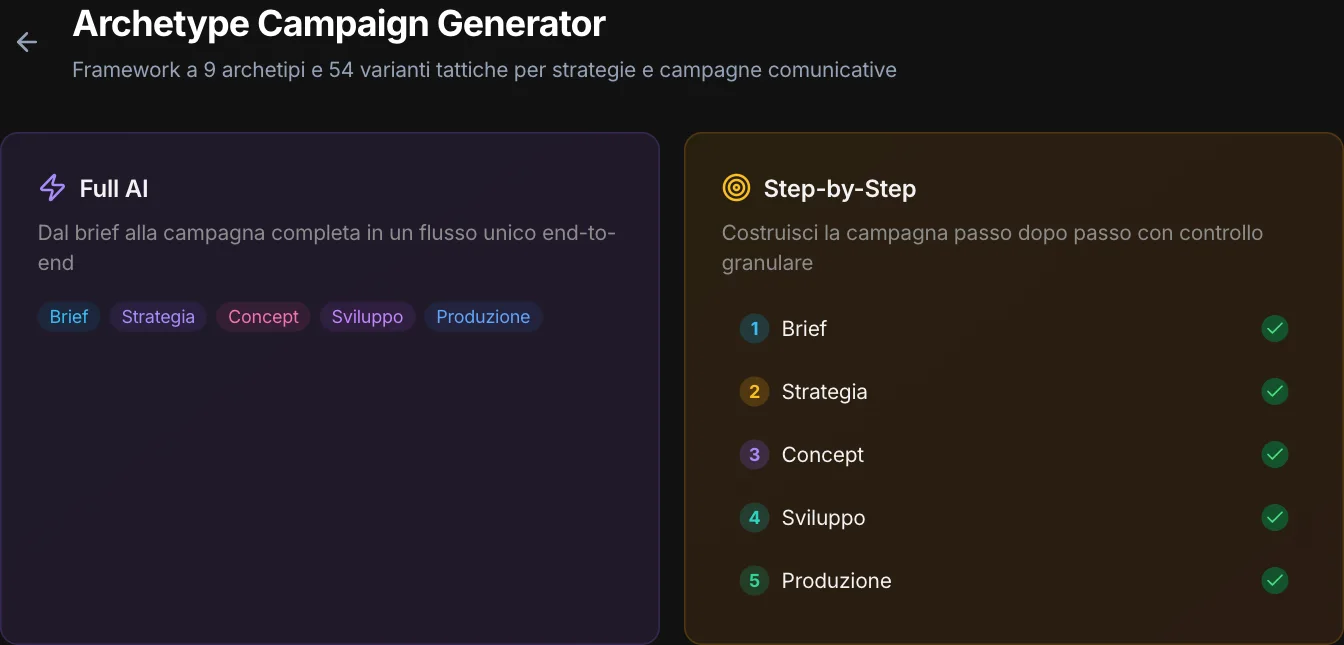
All at once,
or one step at a time.
Full AI: from the brief to the complete campaign in a single flow, in the background — you can leave and get a notification at the end. Step-by-step: you build the campaign with control over every step, and you can choose the archetype mix yourself.
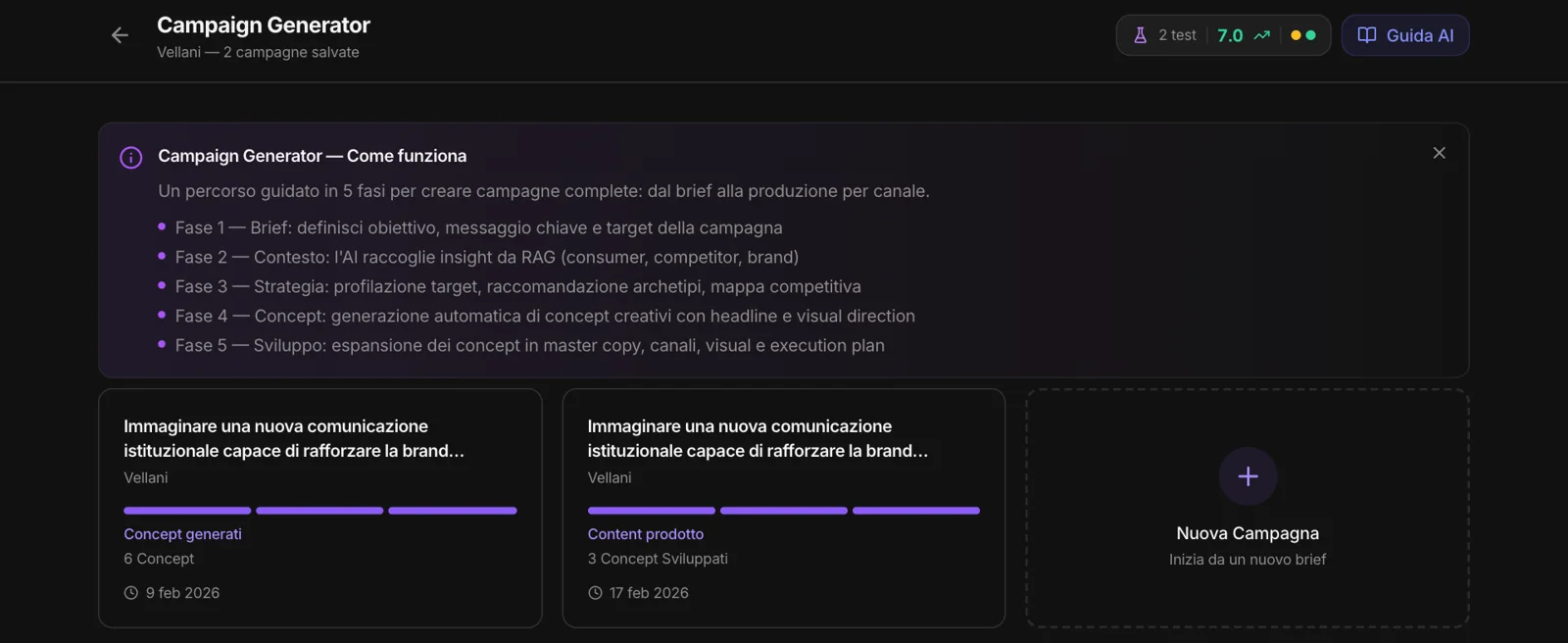
From brief to campaign,
in a single flow.
The example: a pet food brand that wants new corporate communication, to make its value system clearer and more memorable. Five phases — brief, context from the project, strategy, concepts, development — and the campaigns stay saved, each with its status.
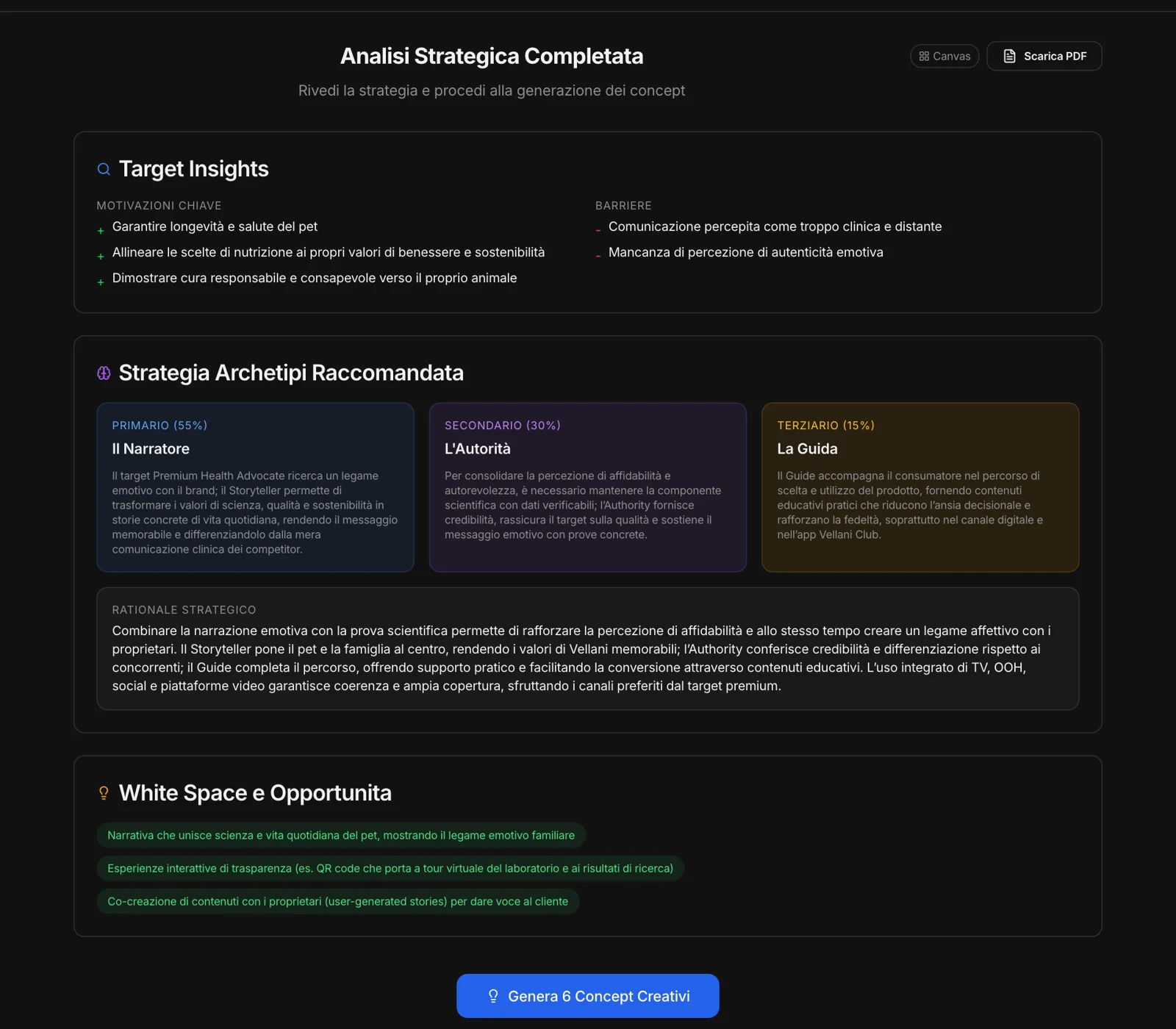
The strategy.
The target’s motivations and barriers — here: communication perceived as too clinical, little emotional authenticity. Then the mix: the Storyteller at 55% for the emotional bond, the Authority at 30% for scientific credibility, the Guide at 15% to help with the choice. With the reason behind each weight and the white space between competitors.
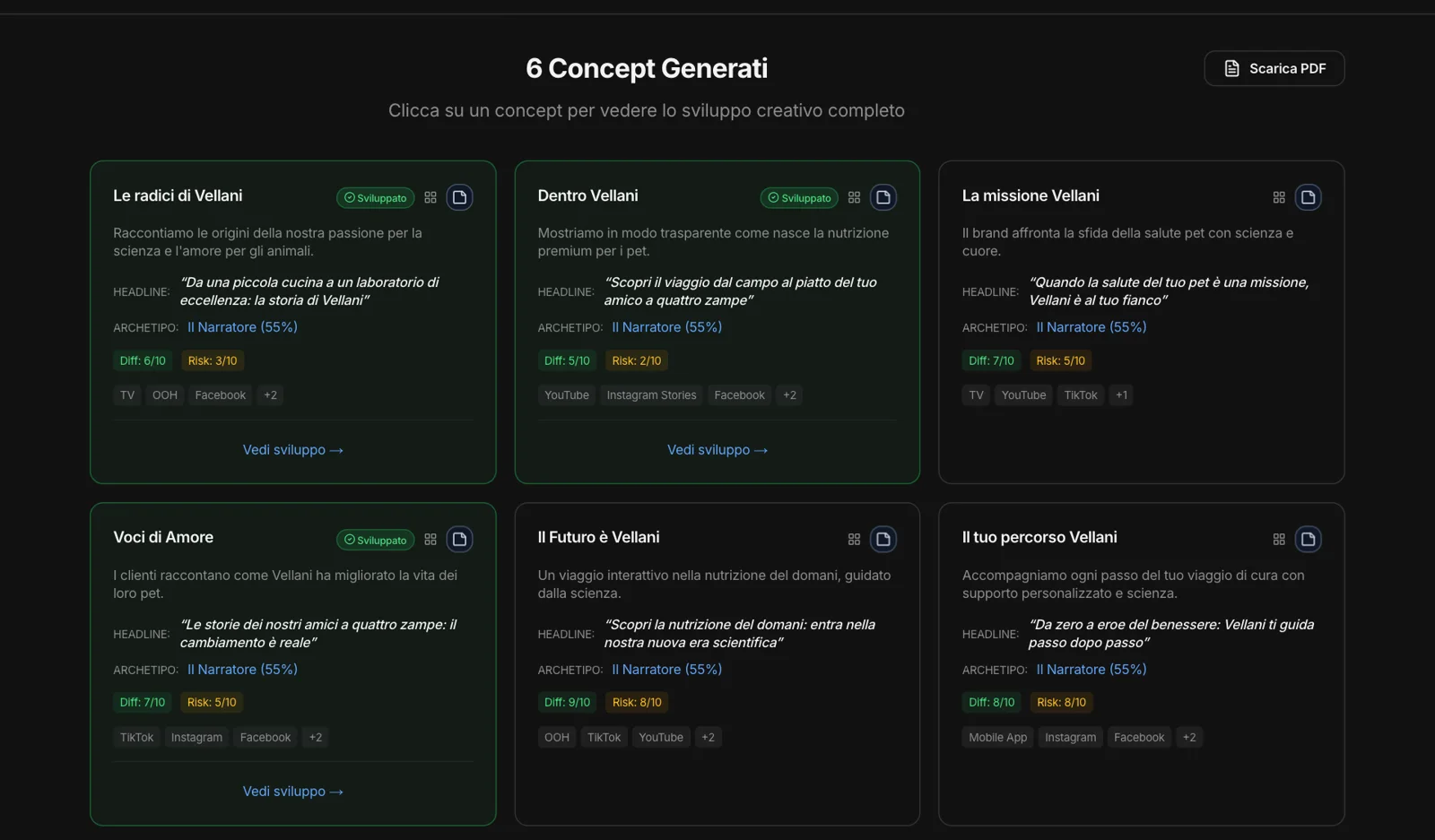
The concepts, and their development.
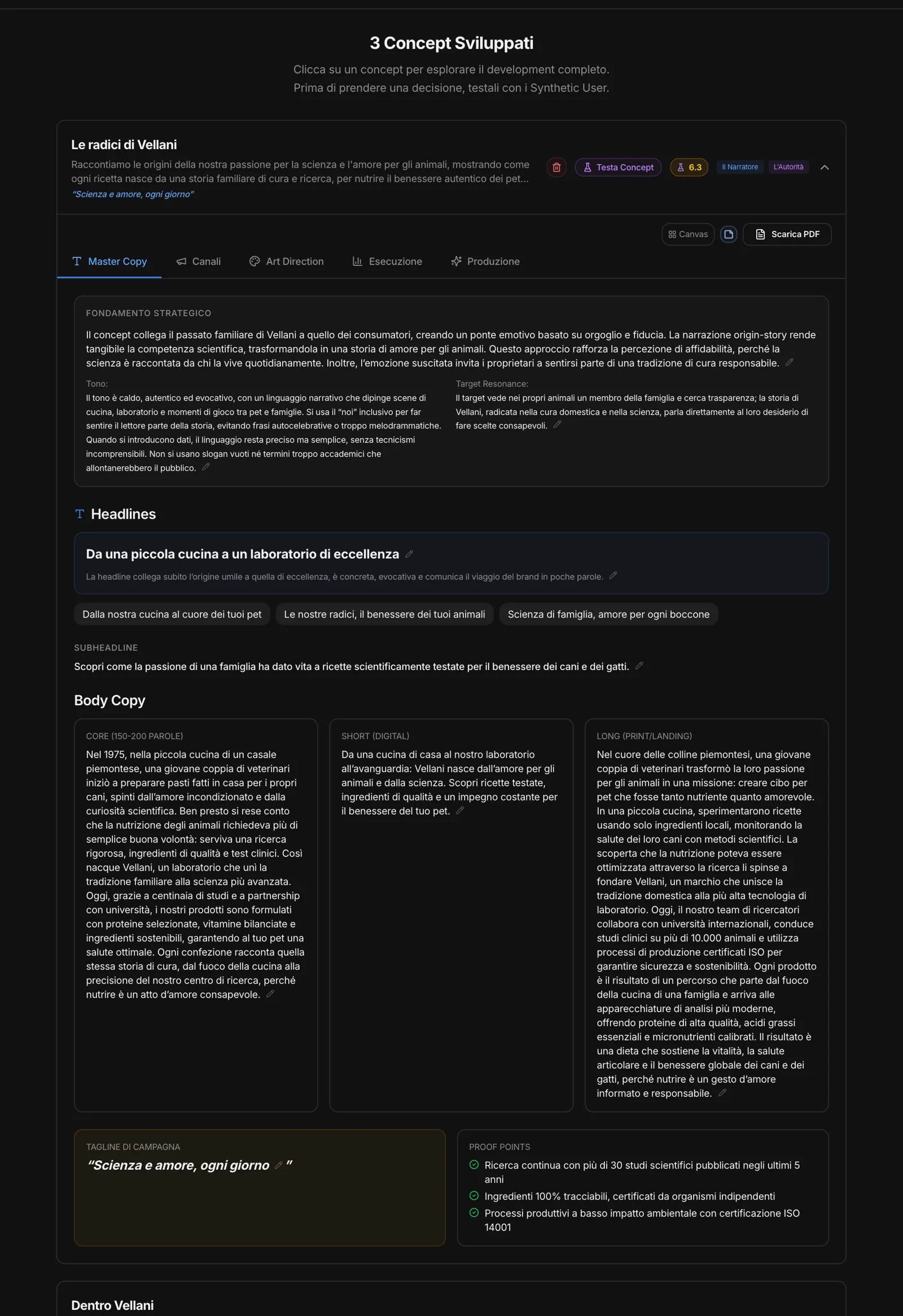
Six concepts from the mix — the brand’s roots, the journey from field to bowl, customers’ voices —, each with archetype, differentiation and risk. The developed ones become campaigns: strategic foundation, headlines with the why, body copy in three lengths (core, digital, print), tagline and proof points. And before choosing, you test them with synthetic users.
One brief,
several strategies to compare.
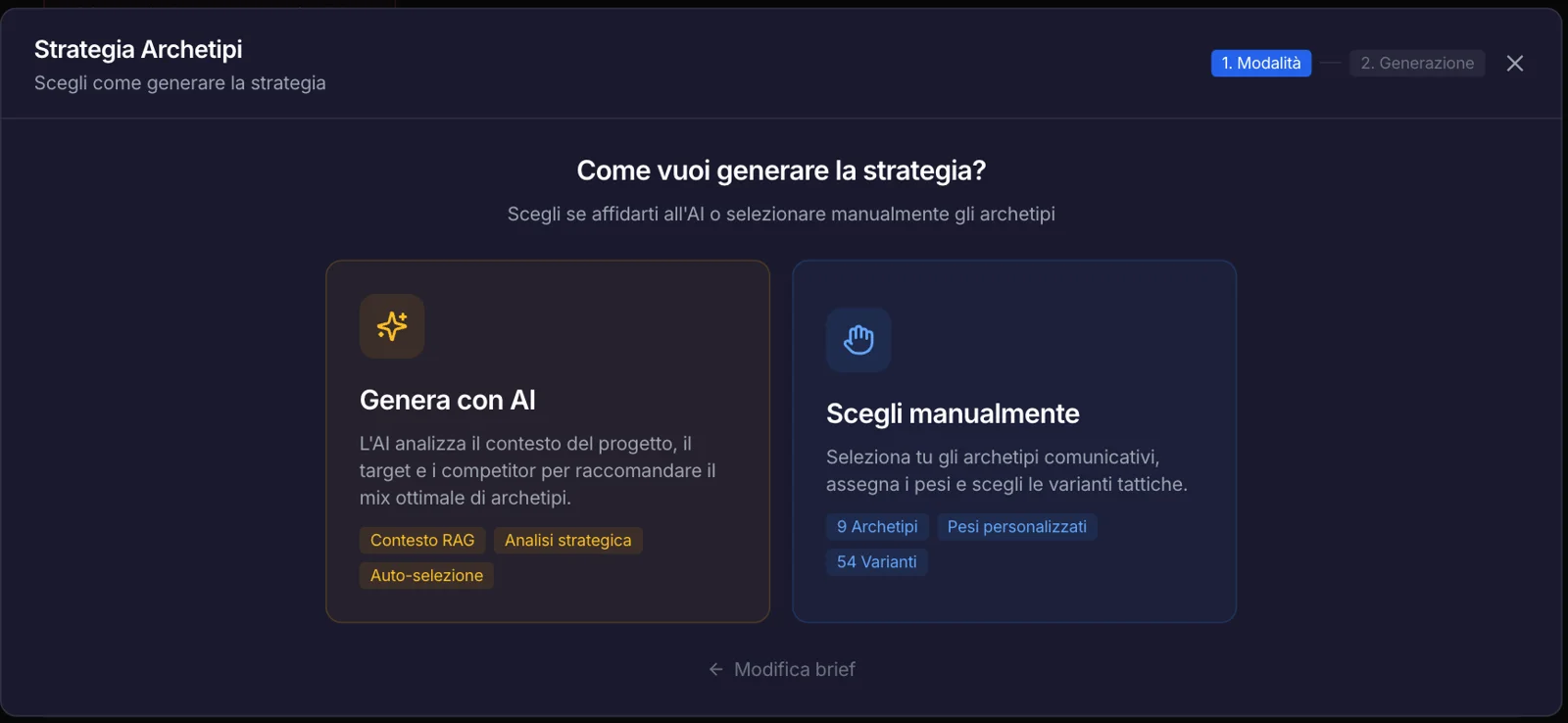
Each brief is a communication objective — a launch, a repositioning. For each brief you generate several strategies and compare them. And for each new strategy you choose: the AI generates it, analyzing the context, the target and the competitors — or you build it yourself.
The mix, by hand.
You browse the archetypes family by family: for each one, when to use it and what to avoid. You assign the role — primary, secondary, tertiary —, adjust the weight and pick the tactical variants. MAPS keeps count: the total must add up to a hundred, and the mix is valid when there is at least a primary and a secondary.
Here, for the tailoring brand: Storyteller at 50% with the origin story and behind the scenes, Mirror at 30%, Engineer at 20% with the technical specification.
The mix,
with its reasons.
Whether the AI chooses it or you do, the strategy starts from the analysis: the target’s motivations and barriers, white space between competitors, risks and opportunities. Then the approved mix, with each archetype’s variants and the rationale.
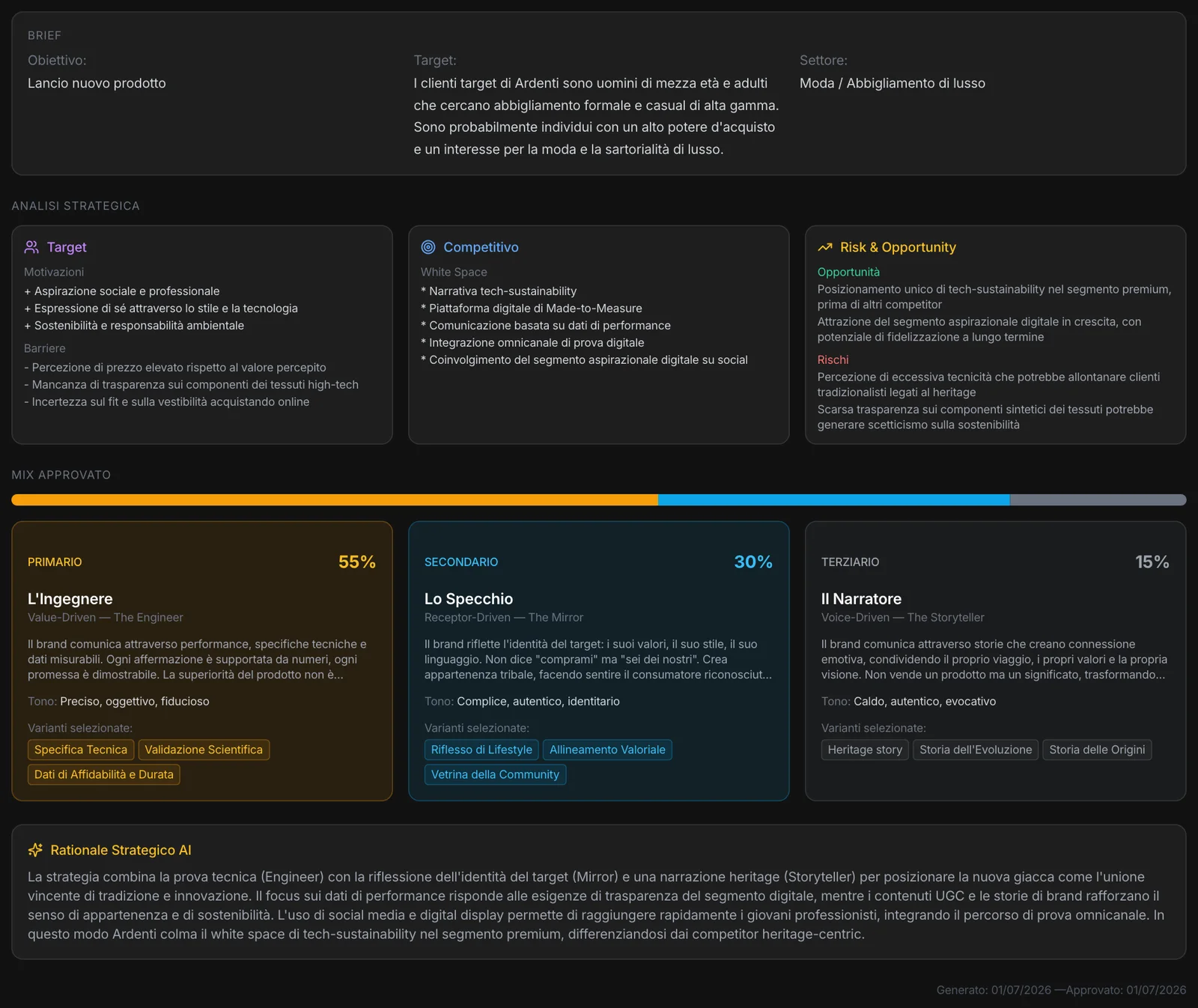
Six concepts
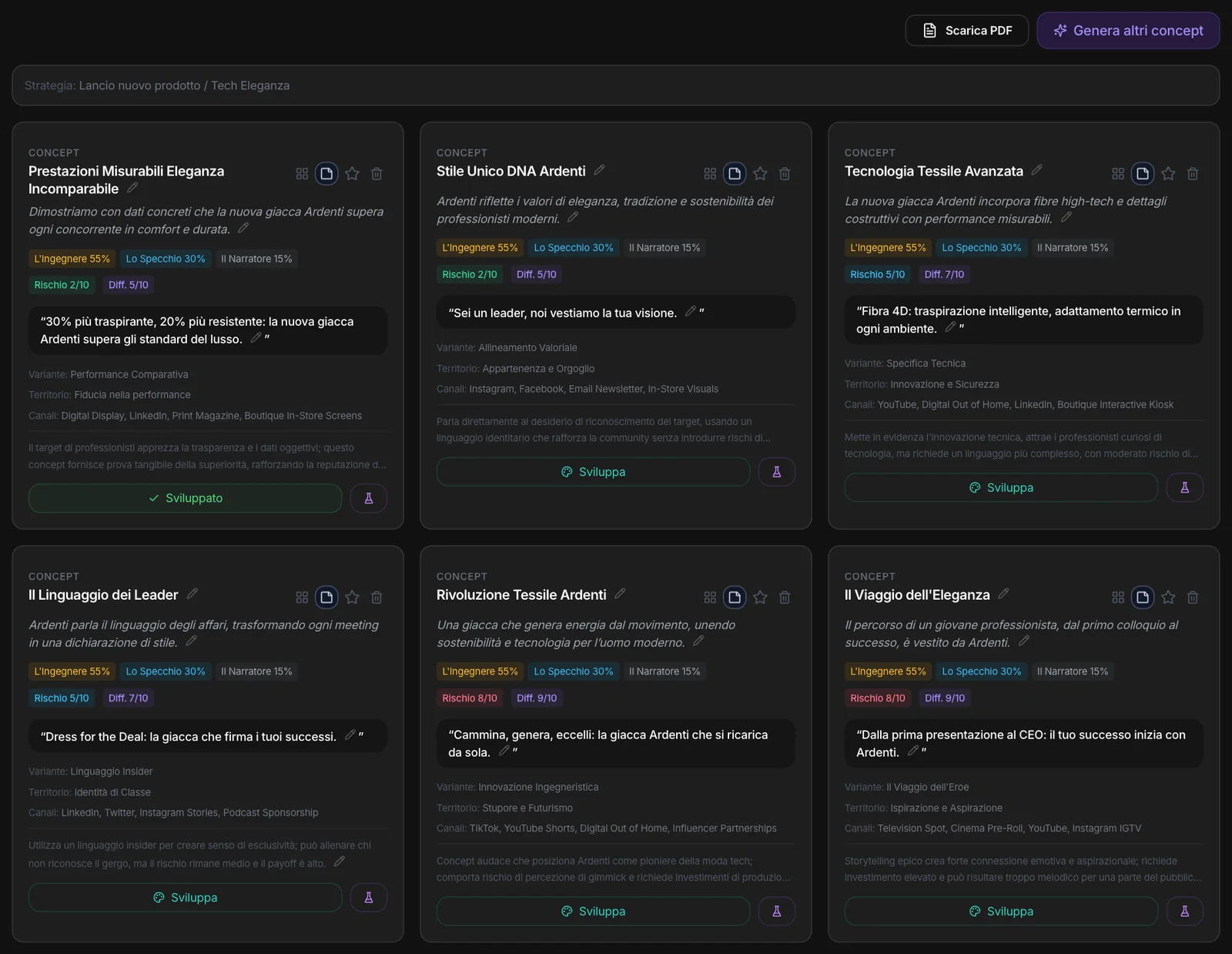
from a single mix.
Each concept states how it uses the mix: which variant drives it, the emotional territory, the channels, the headline. And the two scores, from the most cautious to the boldest: “comparative performance” with risk 2, the jacket that charges as you walk with risk 8 and differentiation 9.
Development
Copy, channels, art direction, execution — with the Collaborate chat and versions, as in the other methods.
Testing
Every concept can be tested with synthetic users before you decide.
Production
The Channel Strategic Direction and the content for each channel, then the Prototype.