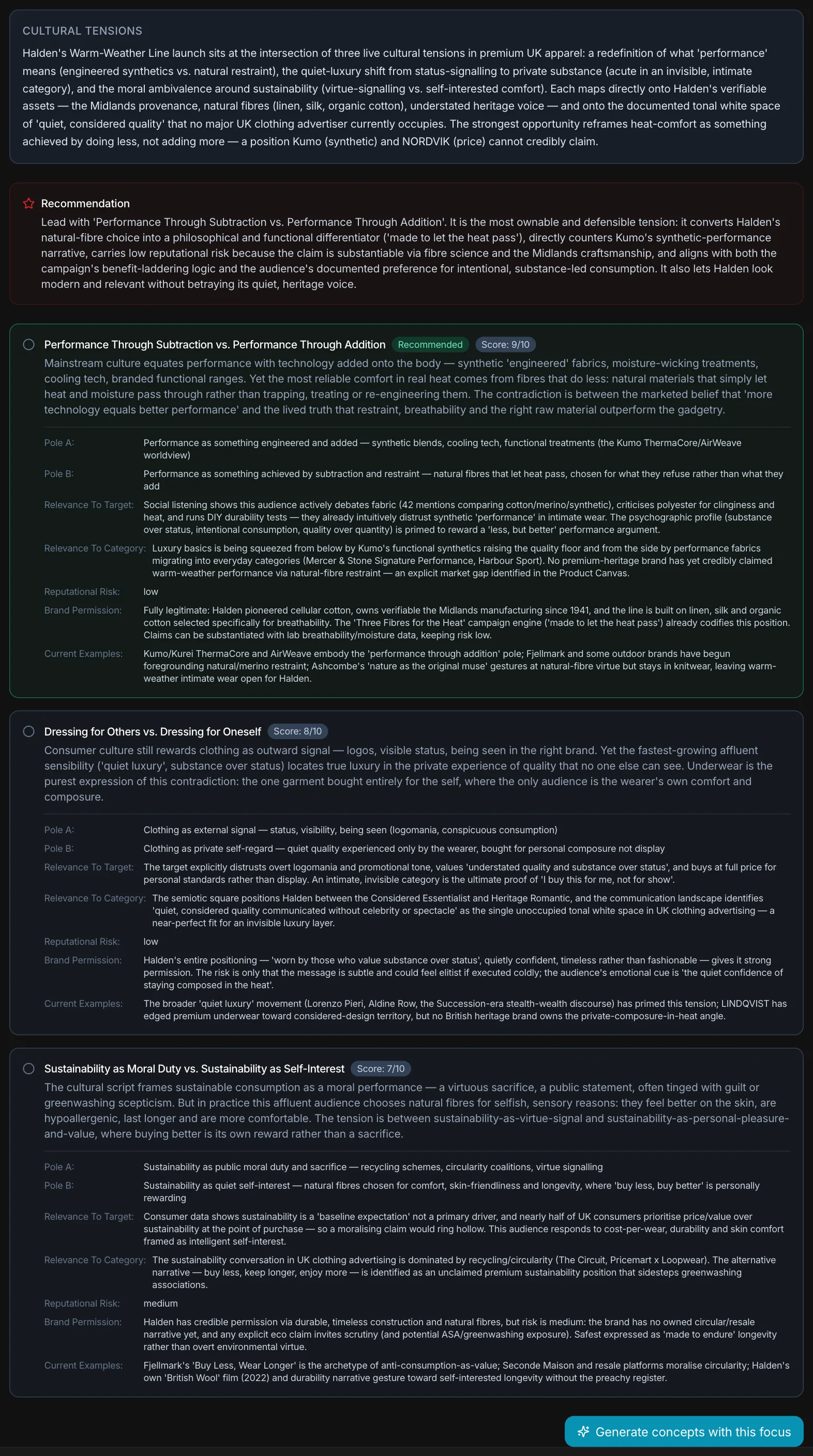
What a tension is
A tension always has two poles pulling in opposite directions: “I want quality” versus “quality costs too much”; “I want to be sustainable” versus “I don’t trust anyone who claims to be”. People haven’t resolved it, which is why they talk about it, take sides, get angry. A brand that steps into the tension steps into a conversation that already exists.
It is different from an insight: an insight is a truth about an audience’s behavior; a tension is a conflict within the culture, cutting across the audience and the category.
When to use it
- When the brand wants a recognizable voice in the wider debate, not just in the category.
- When the whole category communicates the same way and a point of view is needed.
- When there is a values conflict the audience feels — and the brand has something true to say.
How to do it
1. Find the tensions
Tensions live in conversations: reviews, forums, social media, the press. Social listening is the most direct tool; look for contradictions, the “I’d like to, but”, the topics that divide people.
2. Write down the two poles
A tension you can’t write as “A versus B” isn’t clear yet. The poles should be phrased in people’s words, not the brand’s.
3. Weigh it
Four questions. How much does it matter to the target? How much to the category? What is the reputational risk? And above all: does the brand have permission to talk about it — a history, a product, behaviors that make it credible? It also matters who is already using it.
4. Choose the intensity
The same tension can be approached in three ways: naming it without taking sides, taking a stand on one pole in a balanced way, flipping it forcefully. Differentiation and risk rise together. Seeing the three versions side by side helps the client decide how far to go, instead of choosing “bold” or “safe” sight unseen.
5. Prepare the mitigation
Taking a stand means exposure. You need verifiable data, a tone that doesn’t judge people who make different choices, and a plan for listening to the reactions.
The most common mistakes
- Speaking without permission. A position the brand can’t back up with facts backfires.
- Trendy tensions. A tension chosen because “everyone’s talking about it”, rather than because it touches your audience, sounds opportunistic.
- Judging the audience. You can take a stand on an issue without making people who think differently feel guilty.
- Ignoring duration. Some tensions last for years, others for a season: assess this before building a platform on it.