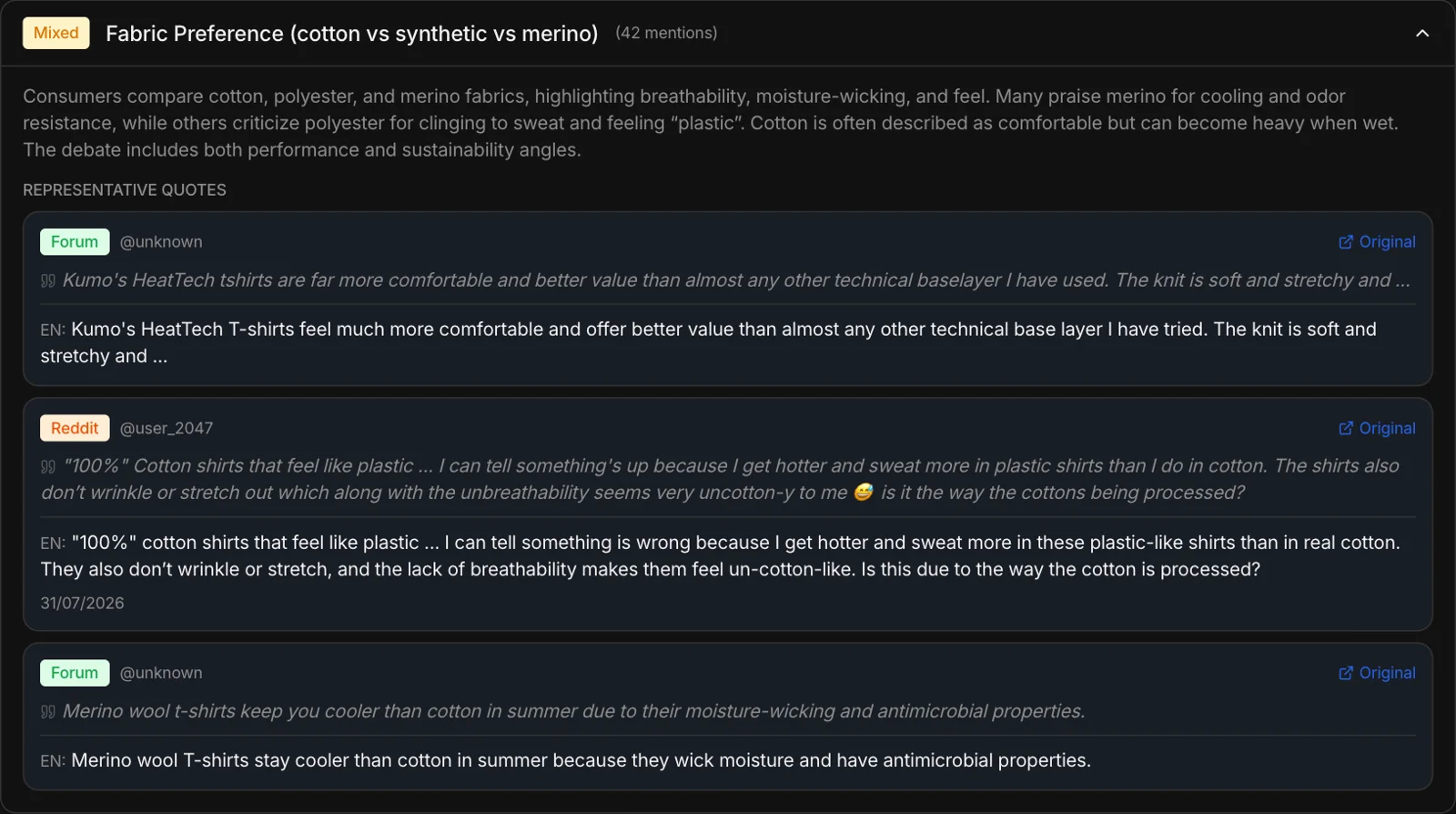
Monitoring vs. listening
Monitoring answers “how much are people talking about us, and where?”: mentions, volumes, spikes. Listening answers “what are they telling us?”: the themes, the recurring questions, the frustrations, the expectations, the words people use to describe the category. The first helps you react; the second helps you understand.
How to set it up
1. Start from the questions
What do you want to understand? How a launch is perceived, what holds back online purchases, what competitors’ customers are looking for. The questions determine the searches and the platforms.
2. Search in the market’s language
People talk in their own words, in their own language: searches should be written the same way, not mechanically translated. A search in Italian about the Japanese market mostly finds Italians talking about Japan.
3. Choose the market’s platforms
Every market and every audience has its own places: in some countries forums matter more than social media, and in B2B what counts is LinkedIn, professional forums and the trade press. Looking only at the platforms you know skews the sample.
4. Read themes, not just sentiment
A sentiment of “62% positive” tells you little. You need the themes, with their weight and tone, and the quotes behind them, linked to the source: that is where you figure out what to do.
5. Cross-reference with search data
Conversations tell you what people think; Google searches tell you what they’re looking for, with what seasonality, and what is growing. Together they give a more solid picture.
6. Look at who shapes the conversation
Creators, experts, communities: who steers opinion in the category, on which topics, and how good a fit they are for the brand.
The most common mistakes
- Counting instead of understanding. Mention volume doesn’t tell you what to do.
- Searches translated from your own language. You lose the way the market actually talks.
- A skewed sample. A single platform reflects a single audience.
- Sentiment without explanation. A number without the themes behind it is unusable.
- Quotes without a source. Without a link to the original, nothing can be verified.