
A full team,
in one system.
Think of the roles in a large agency or a full marketing department: research, strategy, testing, creative, production, the media centre, the foreign network, client service. MAPS has them all, connected to the same memory. It doesn’t take people away from a large team: it gives a small team the reach of a large one.
Everything a large agency keeps in separate departments, available to your team: to offer clients research, strategy, testing, production and foreign markets you couldn’t before.
Nothing starts
from scratch.
Take a spot. The cast comes from the Studio Set, the font, colours and logo from the Brand Kit, the idea from the campaign, which in turn comes from the market analysis. Once done, the spot goes to the client in Review and back into the project memory.
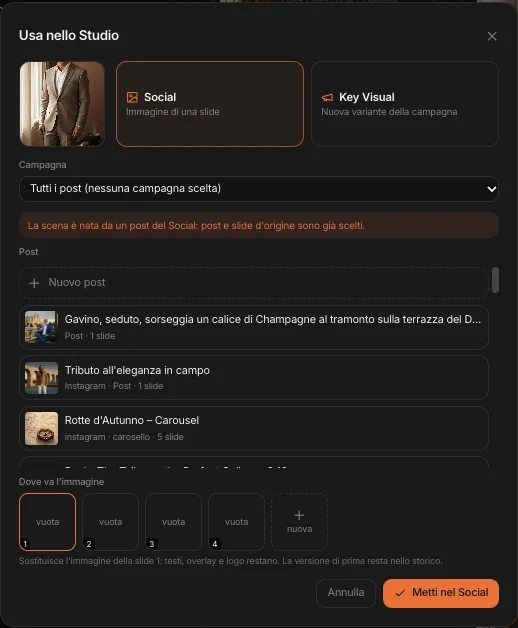
The same goes for a Studio Set image: with “Use in the Studio” it becomes the slide of a post, the key visual of a campaign, an email block, a page section, the first frame of a video. The modules don’t pass files around: they share the same project.
What you do today,
you find tomorrow.
Every analysis, every decision, every piece of content goes into the project memory: the sources with their dates, and a graph linking brand, competitors, people, themes and decisions. The chat and the modules read it, and reason on what the project actually knows, not on what a model remembers in general.
Ask “which spots have we made for this campaign?” and the answer also tells you where they stand: edited, in review, not released yet. Making something and publishing it are not the same thing, and the memory knows it.
The same engine,
for every market.
MAPS isn’t built for one industry. The project profile — consumer or B2B, company or startup, retail and hospitality, the market, the countries, the language — changes the questions it asks the web, the way it reasons and the modules that appear: an ABM & Sales Studio for those who sell to companies, a pitch deck for those raising money.
Consumer and B2B
The same project talks about end customers or buying committees, depending on the profile: analyses, personas, campaigns and Studios change with it.
Startups
Research starts from the pitch deck and reasons on hypotheses and investors, not on market shares that don’t exist yet.
Every market, every language
Research is done in the market’s language; you work in yours; you present in the reader’s. Several countries together, with their differences.
A new module
is born in days.
The Studio Set and the Spot Studio were built in a few days. Not because they are simple, but because they found everything ready: the brand, the campaigns, the cast, client review, AI content labelling, the memory. A new module doesn’t start from scratch: it plugs in.
Think, for example, of a packaging module: it would be born with the market, the competitors, the target personas and the Brand Kit already inside. That is the point of the architecture: every extra module is worth more, because it uses everything that is there.
It grows with
the people using it.
The modules improve with use. The requests of the people working — “a match cut would help here”, “I’d like to see the move before choosing it” — become features for everyone. In the Spot Studio the match between blocks, the camera move diagrams and the edit transitions were born this way, while the first spot was being shot.
A tool can be copied.
A system, much less so.
Today, with AI, a spreadsheet or an image editor can be rebuilt in a few days. Features get copied. What doesn’t get copied is an architecture in which every module enriches the others, and the knowledge your project accumulates about your market, day after day.
The connections
The value lies between the modules: a Monitor insight reaches a campaign, the campaign a spot, the spot the memory.
The memory
After six months on a market, the project knows things a newly born tool cannot know.
The profile
The same system adapts to different markets, industries and languages without changing tool.
Every extra module
Makes the system more useful and harder to replicate: every new connection multiplies the existing ones.