MAPS Intelligence
Resources/Methodology
Methodology · 9 min read

Competitive Intelligence: a method for gathering data that matters

From questions to decisions: how to plan, gather, verify and interpret information on competitors and the market — ethically, with sources and dates.

Updated October 6, 2026 · MAPS editorial team
In brief

Competitive intelligence is the process by which a company gathers, verifies and interprets public, lawfully obtained information about competitors, customers and the market in order to make better decisions. It isn’t a news archive: it starts from specific questions and ends in recommendations on what to do.

The cycle, in four steps

1. Start from the questions

What decision do you need to make? Enter a channel, respond to a competitor, revisit pricing? The questions drive everything else: without them, you collect a lot and understand little. Good questions are specific: “how have competitors’ made-to-measure prices changed over the last twelve months?” rather than “what are competitors doing?”.

2. Gather from a range of sources

Websites and catalogs, press releases and annual reports, trade press, job postings, reviews, social media, live ads, trade shows, search data. Sources should be searched in the market’s language: a German competitor is best understood through the German press.

3. Verify and date every piece of information

Every data point needs its source and its date. Cross-check sources when you can, separate facts from estimates, and when a figure isn’t public, say so: a “not available” is more useful than a plausible-looking number.

4. From information to decision

The analysis answers the original question: what it means for us, what the competitor is likely to do, what we should do. This is where competitive intelligence meets strategy tools such as the SWOT or the positioning map.

What to watch

  • Offering and pricing — range, price tiers, promotions, new launches.
  • Channels — where they sell, through which retailers and platforms, and how much each one weighs.
  • Communication — what they promise, in what tone, on which channels, with how much advertising pressure.
  • Customers — who buys from them, what they say in reviews, what they can’t find.
  • Moves — openings, acquisitions, partnerships, hires, investments.
  • Weak signals — small changes that foreshadow a strategy.

Ethics

Competitive intelligence works with information that is public or obtained lawfully and transparently. No false identities, no confidential information obtained from former employees, no unauthorized access. Beyond being wrong, it is a legal and reputational risk.

The most common mistakes

  • Gathering without questions. Plenty of data, no decisions.
  • Undated sources. Information from two years ago may describe a different market.
  • Made-up numbers to fill the gaps. An estimate must be labeled as one.
  • Looking only at direct competitors. The threat often comes from whoever meets the same need in a different way.
  • A single snapshot. Competitive intelligence pays off when it is updated and compared with the previous reading.
How MAPS does it

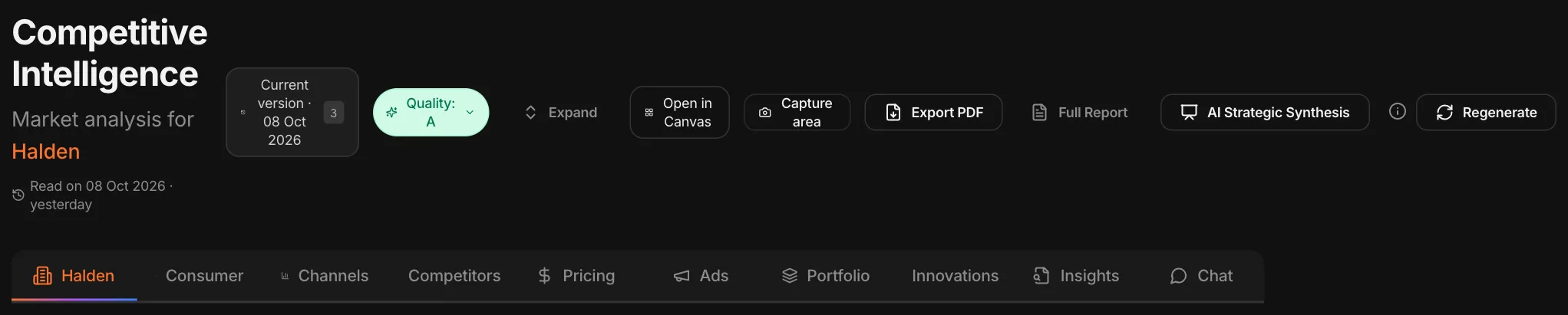
In MAPS, Competitive Intelligence starts on its own when you create the project: eight analysis reports on the brand and its market, written in the market’s language and built on sources you can see. Each analysis has a quality score and its date; when a figure isn’t public MAPS writes N/A, and estimates are marked as estimates. Right-click a sentence to find out where it comes from. A chat answers questions about the market and, with “Compare with the past”, tells you what has changed since the previous reading; when the project isn’t enough, “Go deeper” searches the web and cites every fact with its source and date.

Competitive Intelligence in MAPS: the quality score, the date of the reading and the reports

Frequently asked questions

Is competitive intelligence legal?

Yes, when it uses information that is public or obtained lawfully and transparently. It isn’t when it relies on deception, unauthorized access or confidential information.

How is it different from competitor analysis?

Competitor analysis is one part of competitive intelligence. Competitive intelligence also looks at customers, channels, context and market signals, and it always starts from a decision to be made.

How often should it be updated?

It depends on how fast the market moves: in fast categories, every month; in others, at every planning cycle. What matters most is comparing each reading with the previous one.

Which sources are most reliable?

Verifiable, dated ones: annual reports, press releases, catalogs, observed prices, search data. The press and social media are valuable for signals, but they need to be cross-checked.

Origin and references

The classic framework for competitor analysis is in Michael E. Porter, Competitive Strategy (1980). The leading professional association, SCIP (Strategic and Competitive Intelligence Professionals), has its own code of ethics.

Written by the MAPS editorial team with the help of AI, checked and reviewed by the team.

Related articles
Methodology·9 min di lettura

Social Listening: how to listen to the market and turn it into insight

Don’t count mentions: understand what the market is saying, in which language, on which platforms. How to set up your searches, read themes and sentiment, and put what you find to use.

Read →
Strategic Tools·9 min di lettura

SWOT analysis and the TOWS matrix: how to do it right

Strengths, weaknesses, opportunities and threats: how to gather them with evidence, tell internal from external, and turn the SWOT into action with the TOWS matrix.

Read →
Methodology·9 min di lettura

Market research with AI: speed without losing depth

What AI does well in market research, where it goes wrong, and the rules for using it without being fooled: sources, dates, the market’s language, estimates flagged as estimates.

Read →