When to use it
- At the start of a strategy project, to organize what you know before you choose.
- Before an annual plan or a launch, to see what to lean on and what to protect.
- When you enter a new market, to compare what you have with what the market demands.
- To align a team: a well-made SWOT makes explicit the assumptions everyone is reasoning from.
How to do it, in six steps
1. Define the scope
A SWOT applies to an object (a brand, a product line, a company), a market and a time horizon. The same trait can be a strength in Italy and a weakness in Germany: without a scope, the quadrants fill up with statements that can’t be compared.
2. Start from evidence, not opinions
Gather the facts first: market shares, prices, reviews, sales data, consumer research, competitors’ moves. Every item in the SWOT should be able to answer the question “how do we know?” A strength that no data supports is a hypothesis to test, not a strength.
3. Separate internal from external
The test is simple: can you control it? If yes, it’s internal (strength or weakness). If not, it’s external (opportunity or threat). “E-commerce growth in the category” is an opportunity; “our e-commerce site converts poorly” is a weakness.
4. Measure every strength against competitors
A strength is only a strength relative to someone. “Artisanal quality” isn’t a strength if every competitor claims it and delivers it. Ask yourself: do customers see it as a reason to choose us?
5. Weight and cut
Rank items by impact and by strength of evidence, and keep the most important ones: three to five per quadrant is usually enough. A SWOT with twenty items per quadrant doesn’t help anyone choose.
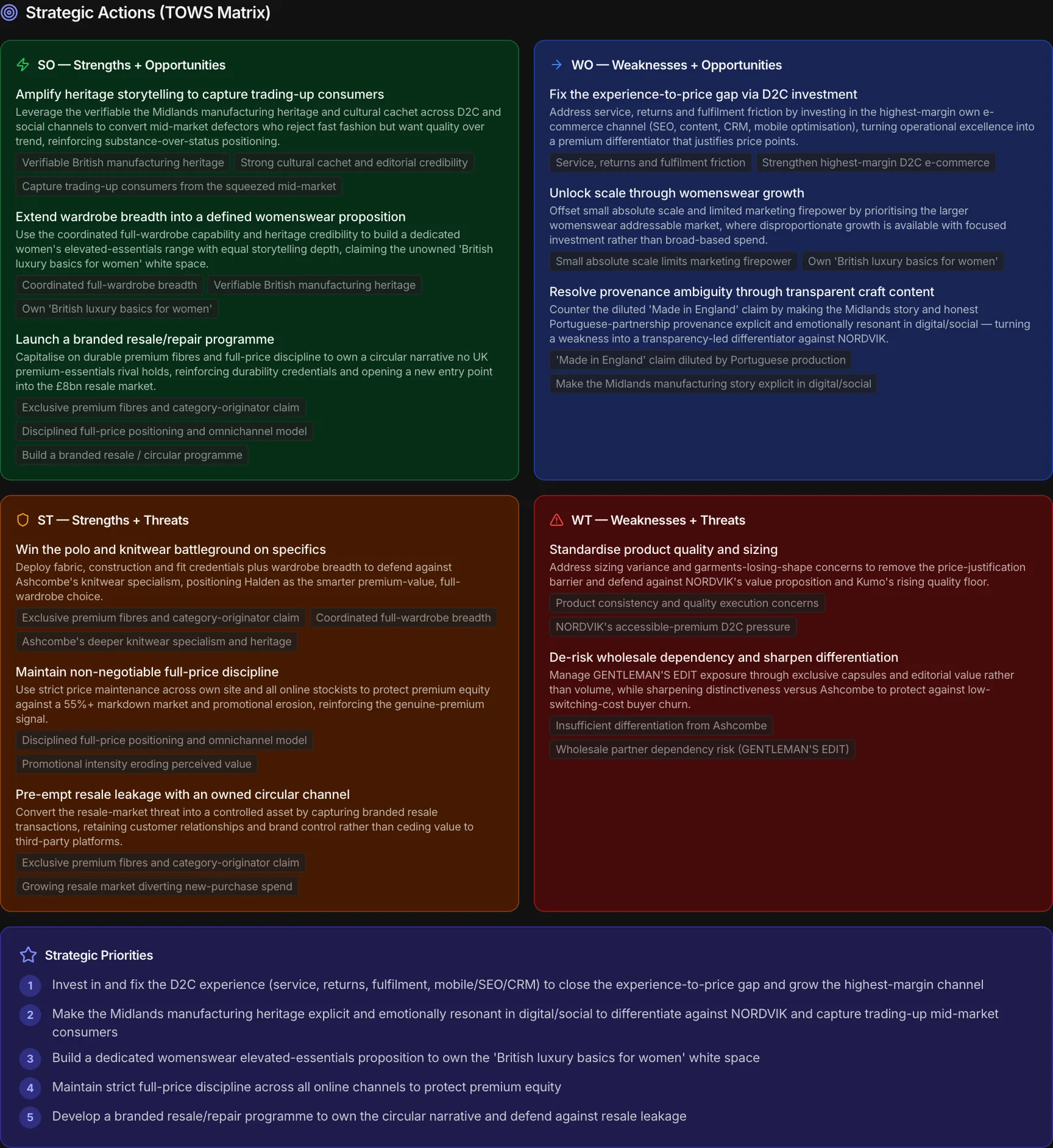
6. Cross them with the TOWS matrix
TOWS relates the quadrants to each other and produces four families of moves:
- Strengths × Opportunities (SO) — use what you do best to seize what the market is opening up.
- Weaknesses × Opportunities (WO) — fix a limitation so you don’t miss an opening.
- Strengths × Threats (ST) — use an advantage to defend against a risk.
- Weaknesses × Threats (WT) — reduce your exposure where you’re most vulnerable.
The most common mistakes
- Writing actions instead of opportunities. “Launch an e-commerce site” is a move, not an opportunity: the opportunity is the demand that justifies the move.
- Confusing internal and external. An internal weakness filed under threats stops being something you can act on.
- Strengths with no comparison. If it doesn’t set you apart from competitors, it isn’t a strength.
- Items with no evidence. A SWOT made of opinions confirms what the team already thought.
- Stopping at the SWOT. Without TOWS, the four quadrants stay a list.
- Never updating it. Markets change: a SWOT from a year ago describes a different market.
SWOT, PEST and competitor analysis
A SWOT doesn’t replace other analyses: it summarizes them. Analysis of the environment (such as PEST: political, economic, social and technological factors) feeds opportunities and threats; competitor analysis tells you which strengths really are strengths. That’s why a good SWOT comes after the research, not in place of it.