MAPS Intelligence
Resources/Methodology
Methodology · 10 min read

Brand positioning: a four-phase process

Understand, choose, test, activate: how to arrive at a defensible positioning, capture it in one sentence and turn it into concrete choices.

Updated October 6, 2026 · MAPS editorial team
In brief

Positioning is the place a brand wants to occupy in the mind of a specific audience, relative to its competitors: who it is for, which category it competes in, what sets it apart and why to believe it. It is built in four phases — understand, choose, test, activate — and summed up in a positioning statement.

Phase 1 · Understand

Three lenses: the market (where the category is heading), customers (what they look for, what holds them back, how they choose) and competitors (what they promise, where they are strong, where they leave room). The tools: competitive intelligence, social listening, empathy map, positioning maps.

Phase 2 · Choose

Positioning means giving things up: an audience, a promise, a way of competing. There are four choices:

  • The audience — who it is for, first and foremost.
  • The frame of reference — who you want to be compared with: the category the customer places you in.
  • Points of parity — what you need to have to stay in the game, on par with competitors.
  • Points of difference — what sets you apart, matters to the customer and can be sustained.

On top of these come the reasons to believe: the proof that makes the difference credible.

The positioning statement. One sentence that holds everything together, for example: “For professionals who dress formally every day, [brand] is the tailoring house that brings made-to-measure to wherever you are, without giving up the fitting in the boutique, because [reasons to believe].” It isn’t a slogan: it is the internal reference point for every choice.

Phase 3 · Test

A positioning is a hypothesis. Before investing, it needs to be tested: does the audience understand it? Find it credible? Tell it apart from competitors? Conversations, message tests, trials with different concepts. See strategic validation.

Phase 4 · Activate

Positioning becomes choices: product, price, channels, communication, experience. If nothing about what the brand does changes, it has stayed on paper. Every campaign and every piece of content should be able to answer “does this strengthen our positioning?”.

The most common mistakes

  • Trying to please everyone. A positioning with no trade-offs doesn’t position anything.
  • Differences the customer doesn’t notice. What counts is what matters to the buyer, not to the maker.
  • Forgetting points of parity. A brilliant difference won’t save a brand that lacks the basics.
  • No proof. A promise without reasons to believe isn’t credible.
  • Not activating it. Positioning is worth something when it guides everyday choices.
How MAPS does it

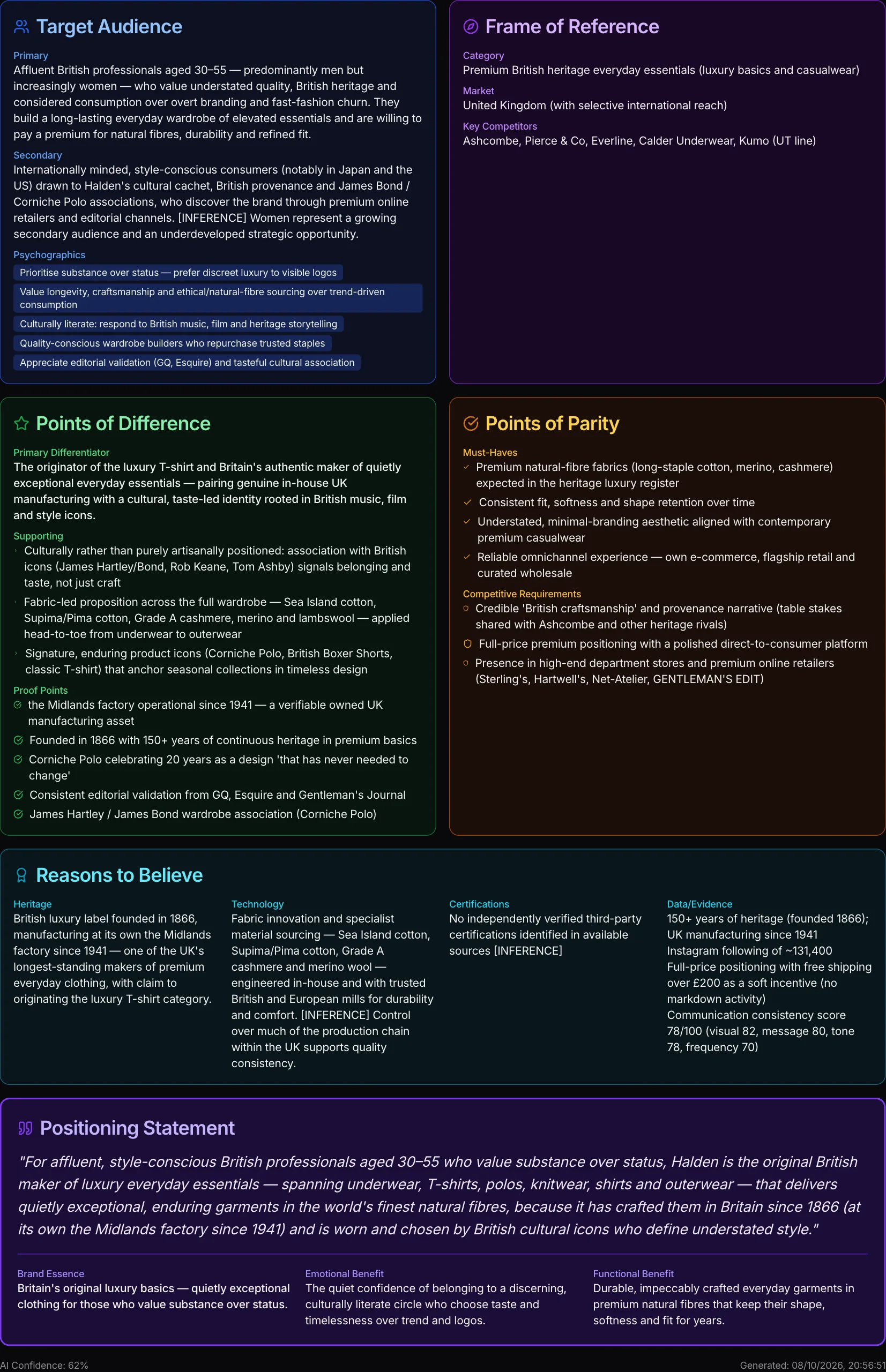
In MAPS, positioning runs through all four phases. Monitor does the work of understanding. In Analyze, the Brand Positioning Canvas lays out audience, frame of reference, what sets you apart and what you need to stay in the game, the reasons to believe, and closes with the positioning statement; the Positioning Map shows the target position and the white spaces, and scenarios let you explore different routes. In Prove, every positioning can be tested with synthetic users; in Scale it becomes campaigns and content.

The Brand Positioning Canvas in MAPS: audience, frame of reference, differences, reasons to believe and positioning statement

Frequently asked questions

What’s the difference between positioning and brand identity?

Identity says who the brand is: values, personality, tone. Positioning says where it sits in an audience’s mind relative to competitors. Identity provides consistency; positioning provides a competitive direction.

What are points of parity and points of difference?

Points of parity are what it takes to be considered in the category; points of difference are what make the brand preferable. You need both: without the first you aren’t in the game, without the second you don’t win.

How do you write a positioning statement?

In one sentence: who the brand is for, which category it belongs to, what it offers that is distinctive and why to believe it. It is an internal document, not an advertising slogan.

How often should positioning be revisited?

Rarely, because changing it often confuses the audience. Revisit it when the market, the competitors or the company’s strategy change substantially.

Origin and references

The concept was made famous by Al Ries and Jack Trout (Positioning: The Battle for Your Mind, 1981). Points of parity and points of difference: Kevin Lane Keller, Brian Sternthal and Alice Tybout, “Three Questions You Need to Ask About Your Brand”, Harvard Business Review (2002).

Written by the MAPS editorial team with the help of AI, checked and reviewed by the team.

Related articles
Strategic Tools·9 min di lettura

Positioning map: how to build it and read it

The brand and its competitors on two perceived axes: how to choose the right axes, find the white spaces and tell whether they’re worth it.

Read →
Strategic Tools·10 min di lettura

Brand identity: mission, values, personality and archetypes

What makes up a brand’s identity, how archetypes help give it a consistent voice, and how to evolve it without losing who you are.

Read →
Methodology·10 min di lettura

Strategic validation: putting an idea to the test before you invest

Find the riskiest assumptions, choose the right test, decide up front what counts as evidence: a method for failing small instead of failing big.

Read →