MAPS Intelligence
Resources/Strategic Tools
Strategic Tools · 10 min read

Brand identity: mission, values, personality and archetypes

What makes up a brand’s identity, how archetypes help give it a consistent voice, and how to evolve it without losing who you are.

Updated October 6, 2026 · MAPS editorial team
In brief

Brand identity is everything a brand is and wants to be: mission (why it exists), vision (where it wants to go), values, personality and tone of voice. Archetypes — universal figures such as the Hero, the Sage or the Explorer — help give it a recognizable, consistent character. A clear identity is the reference point for every communication choice.

The elements

  • Mission — why the brand exists, what it does for whom.
  • Vision — the future it wants to help create.
  • Values — the principles that guide choices, even when they come at a cost.
  • Personality — what the brand would be like if it were a person.
  • Tone of voice — how it speaks: register, rhythm, the words it uses and the ones it avoids.
  • Archetype — the underlying character that gives consistency to everything else.

Archetypes

The idea comes from Carl Gustav Jung: recurring figures we all recognize, in the stories of every culture. In branding, the most widespread version counts twelve: the Innocent, the Explorer, the Sage, the Hero, the Outlaw, the Magician, the Everyman, the Lover, the Jester, the Caregiver, the Creator and the Ruler.

An archetype isn’t a label to pin on: it’s an aid to being consistent. A brand that calls itself an Explorer but talks like a Ruler confuses its audience. There’s often a primary archetype and a secondary one that softens it.

Brand archetypes and communication archetypes. The twelve archetypes describe a brand’s character. To build campaigns, MAPS also uses its own taxonomy, different from the Jungian one: nine communication archetypes in three families, each with six tactical variants, which describe how a message speaks and to whom. The first says who you are; the second, how you tell it in a campaign.

How to build it

1. Start from what the brand already is

History, products, behaviors, how customers describe it, how it communicates today. Identity is discovered before it’s invented: an identity that’s declared but not lived doesn’t hold up.

2. Distinguish facts from inferences

Some elements can be read in documents and behaviors; others are interpretations. Flagging what’s inferred avoids building a strategy on a hypothesis presented as a certainty.

3. Check for consistency

What the brand says it is must match what the market sees and what the company does. Where they don’t match, that’s where the work lies.

4. Imagine how it can evolve

An identity isn’t static. It pays to imagine evolutions of different scope — from the most cautious to the most radical — and for each one ask what changes in communication, what to do and what to avoid.

5. Put it into words

A tagline, a few guiding sentences for the tone of voice, examples of dos and don’ts. If the identity doesn’t translate into concrete guidance, the people writing content won’t know how to use it.

The most common mistakes

  • Generic values. “Quality, passion, innovation” — everyone claims them: they don’t set you apart.
  • A purely aspirational identity. If it isn’t lived through the products and the people, the market notices.
  • The archetype as a costume. It should be used to create consistency, not to imitate a famous brand.
  • No operational translation. A document nobody uses to write a post is not an identity.
How MAPS does it

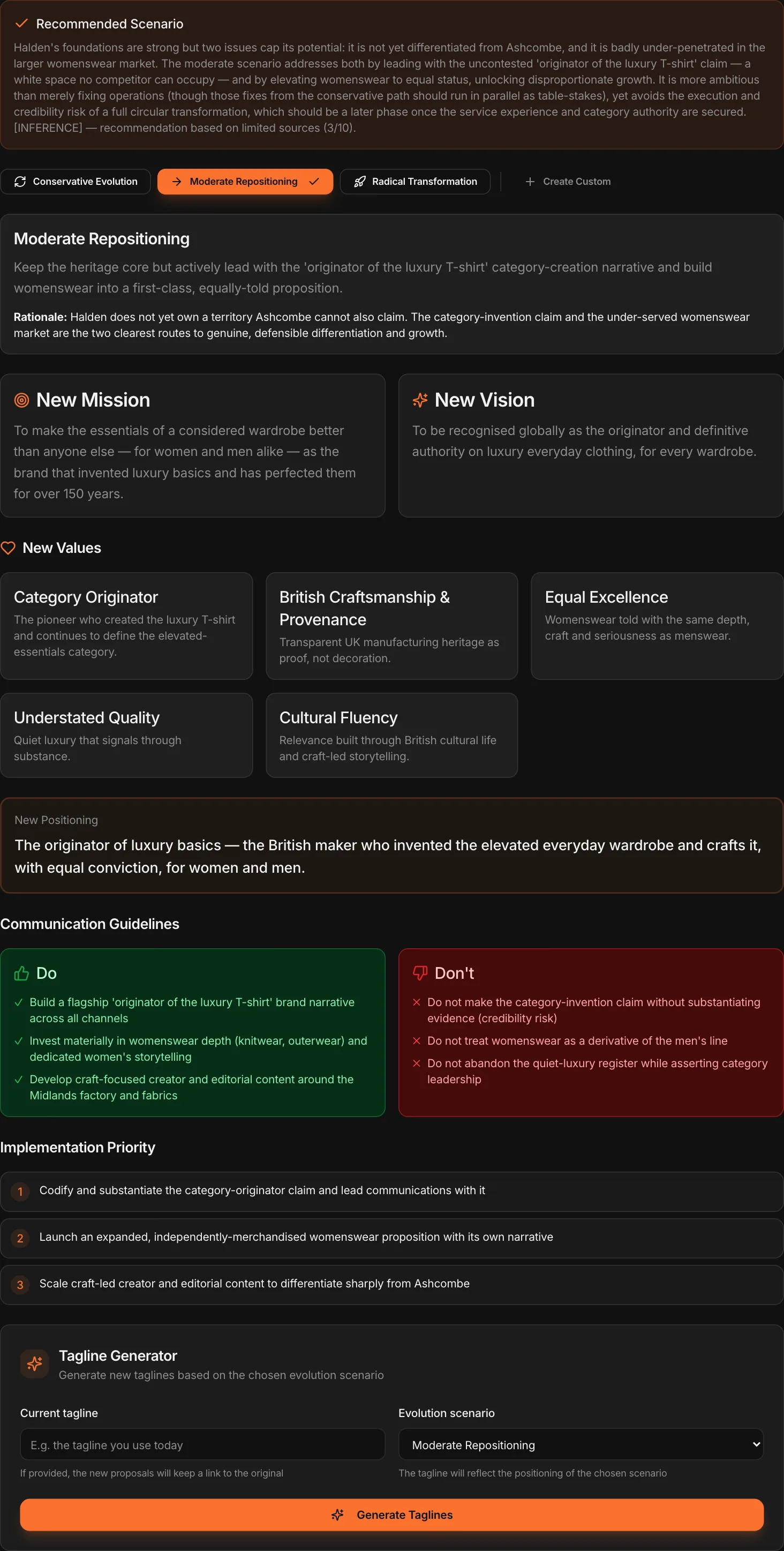
In MAPS the Brand Identity is generated from Analyze: mission, vision, values, personality and tone of voice, the archetypes. Every value carries the source it was drawn from, and whatever is inferred is flagged as such. Then three evolution scenarios, from the most cautious to the most radical, with the recommended one: for each, a new mission and vision, values, positioning, and what to do and avoid in communication. From the scenario, five tagline proposals with their reasoning. A nine-element matrix then assesses how aligned the identity is, inside and outside the company. And when you move on to campaigns, Campaign Lab translates the identity into a mix of its communication archetypes — primary, secondary, tertiary.

Brand Identity in MAPS: three evolution scenarios, from the most cautious to the most radical

Frequently asked questions

What’s the difference between brand identity and brand image?

Identity is what the brand is and wants to be, defined by the company. Image is how the market actually perceives it. Marketing work often consists of narrowing the gap between the two.

What are the 12 brand archetypes?

In the most widespread classification: Innocent, Explorer, Sage, Hero, Outlaw, Magician, Everyman, Lover, Jester, Caregiver, Creator and Ruler.

Can a brand have more than one archetype?

It usually has a primary one and a secondary one that softens it. More than two tend to make the character confusing.

How often should a brand’s identity be revisited?

The core identity changes slowly; it’s revisited when strategy, audience or market change. The tone of voice and how it’s applied are updated more often.

Origin and references

Archetypes come from the psychology of Carl Gustav Jung; their application to branding was popularized by Margaret Mark and Carol S. Pearson (The Hero and the Outlaw, 2001).

Written by the MAPS editorial team with the help of AI, checked and reviewed by the team.

Related articles
Strategic Tools·9 min di lettura

Positioning map: how to build it and read it

The brand and its competitors on two perceived axes: how to choose the right axes, find the white spaces and tell whether they’re worth it.

Read →
Methodology·10 min di lettura

Brand positioning: a four-phase process

Understand, choose, test, activate: how to arrive at a defensible positioning, capture it in one sentence and turn it into concrete choices.

Read →
Glossary·9 min di lettura

Glossary of brand and positioning

Identity, image, archetypes, points of parity and points of difference: the vocabulary of brand, with links to the tools for working on it.

Read →