MAPS Intelligence
Resources/Methodology
Methodology · 9 min read

Market research with AI: speed without losing depth

What AI does well in market research, where it goes wrong, and the rules for using it without being fooled: sources, dates, the market’s language, estimates flagged as estimates.

Updated October 6, 2026 · MAPS editorial team
In brief

AI makes desk market research much faster: it reads and summarizes sources in many languages, compares competitors and organizes what it finds. But it can also be confidently wrong: inventing data, using outdated information, losing track of sources. Using it well takes rules: sources and dates on every piece of information, searches in the market’s language, estimates labeled as such, and the judgment of whoever makes the decision.

What AI does well

  • Reading a lot, fast. Dozens of sources in a few minutes, even in languages the team doesn’t speak.
  • Summarizing and organizing. From scattered material to a structured picture by theme, competitor and channel.
  • Comparing. Putting offerings, prices and communication side by side.
  • Keeping pace. Redoing the reading when the market changes, and saying what’s different.

Where it goes wrong

  • It invents with confidence. A language model can produce plausible but false numbers and names if it isn’t anchored to sources.
  • It uses outdated knowledge. What the model “knows” stops at the date of its training.
  • It loses sources. A summary without references can’t be verified.
  • It generalizes. It tends to describe “the market” as an average, losing the differences between countries, channels and segments.

The rules for using it well

1. Separate research from reasoning

First you find the sources — articles, data, pages —, then the model reasons on those. A model answering “from memory” isn’t research.

2. A source and a date on every piece of information

Every fact must be able to say where it comes from and when it dates from. That’s the difference between an analysis and a convincing piece of text.

3. Search in the market’s language

A market is read through its own words and its own sources: local press, local forums, local reviews.

4. Flag estimates and gaps

When a figure isn’t public, say so. When a number is an estimate, label it. A “not available” is information; an invented number is a risk.

5. Have the work checked

A second pass that looks for weak points, a score on the quality of the summary, cross-checking multiple sources: checks cost little compared with a wrong decision.

6. Keep people where they’re needed

AI does the gathering and summarizing; the judgment — what matters, what to do — stays with those who know the business. And when you need representative primary data, you still need research with real people.
How MAPS does it

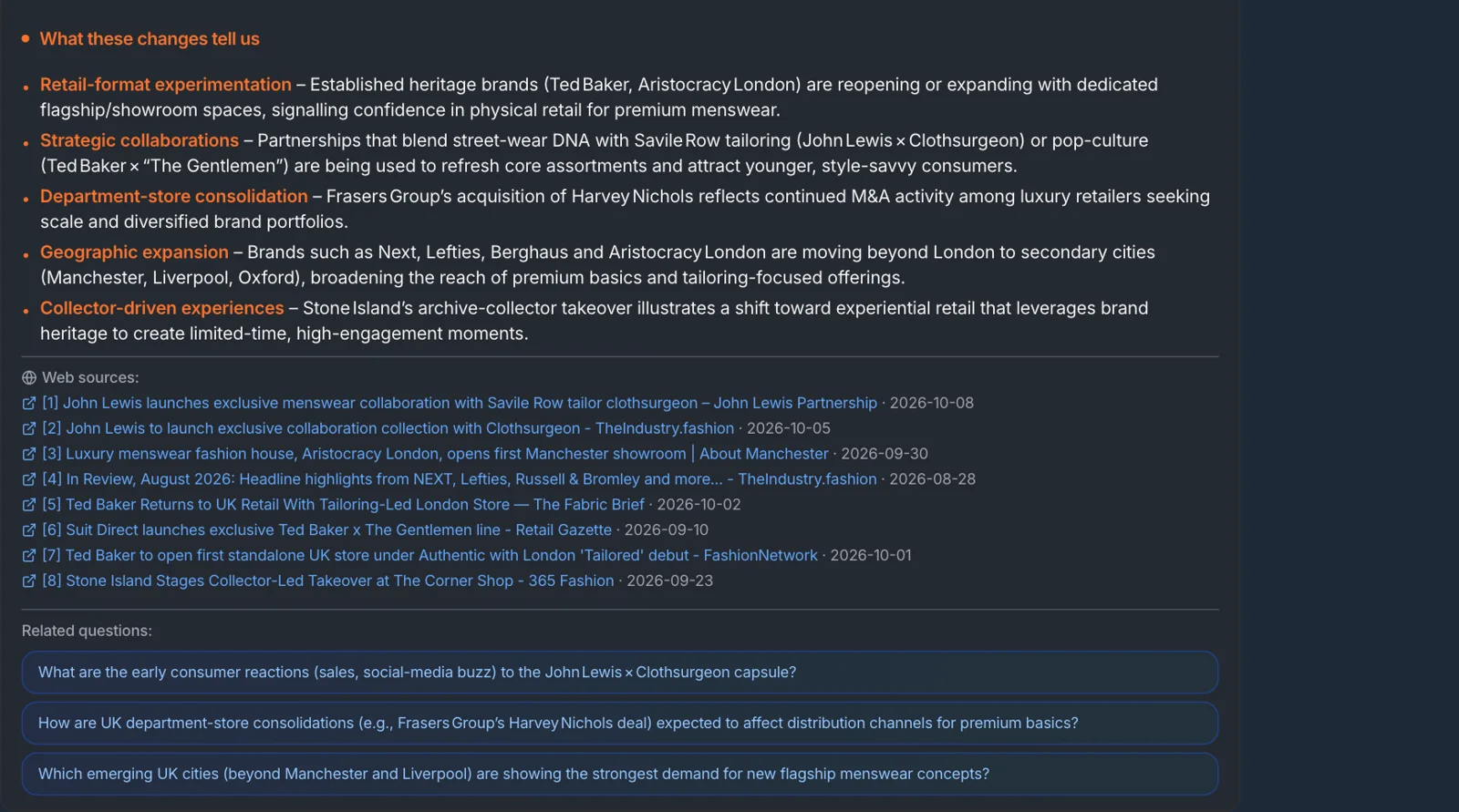
MAPS is built on these rules. When you create a project, Monitor starts on its own and fills in the reports in about 15-20 minutes: the research uses search engines and agents that find the sources, in the market’s language, and then the models reason on them. Every reading has its date, every analysis a quality score; non-public data is marked N/A and estimates are marked as estimates. In the Focus modules, a verification agent rereads the work and launches targeted searches on the weak points. And the chat answers by citing, for every piece of information, where it comes from and when it dates from.

In MAPS, the answer from the web: the summary, the sources with their dates, follow-up questions

Frequently asked questions

Can AI replace market research?

It can replace much of desk research: reading, comparing and summarizing public sources. It doesn’t replace primary research with real people when you need representative data.

How do you avoid “hallucinations”?

By anchoring the model to sources found beforehand, requiring a source and a date for every fact, having it flag estimates and missing data, and adding verification steps.

Why search in the market’s language?

Because the best sources on a market are almost always local, and people describe products in their own words. Translated searches find something else.

How long does it take?

A first complete reading of a market can take tens of minutes instead of weeks. The time saved should be reinvested in judgment and verification.

Written by the MAPS editorial team with the help of AI, checked and reviewed by the team.

Related articles
Methodology·9 min di lettura

Competitive Intelligence: a method for gathering data that matters

From questions to decisions: how to plan, gather, verify and interpret information on competitors and the market — ethically, with sources and dates.

Read →
AI & Marketing·9 min di lettura

RAG and Graph RAG in marketing: what they are and why they matter

How an AI answers from your documents instead of “from memory”, why classic RAG falls short when the answer lies in the connections, and what a graph adds.

Read →
GEO & AI Search·10 min di lettura

What GEO (Generative Engine Optimization) is and how to do it

Getting found, cited and accurately described by AI assistants: how it differs from SEO, what the research says, what to do in practice and how to measure it.

Read →