Why it matters
More and more people ask an AI assistant which product to choose, which vendor to contact, how to solve a problem. The answer comes ready-made: a few names, a summary, sometimes the sources. If your brand isn’t in that answer, then for that person it doesn’t exist; if it’s there but described poorly, the damage is much the same.
SEO vs. GEO: what changes
- The outcome. SEO aims for a position in a list of links; GEO aims for a mention, a citation or a recommendation inside a generated text.
- The measurement. In SEO you measure rankings and clicks; in GEO, how often you’re cited, where you appear in the answer, how you’re described, and which sources are used to talk about you.
- The sources. An assistant doesn’t just read your website: it pulls together reviews, articles, forums, comparison pages. What others write about you weighs as much as what you write yourself.
- The continuity. The fundamentals stay the same: useful, clear, trustworthy content serves both. GEO doesn’t replace SEO; it extends it.
What the research says
The term comes from a 2023 study by researchers at Princeton, Georgia Tech, the Allen Institute for AI and IIT Delhi (“GEO: Generative Engine Optimization,” presented at KDD 2024). Comparing different ways of rewriting a piece of content, the authors found that adding source citations, quotations and statistics increased the content’s visibility in generated answers — by up to about 40% in some cases — while keyword stuffing did little.
How to do it, in practice
1. Answer up front, in a quotable way
Open every page with the answer to the main question, in two or three sentences that stand on their own. Assistants tend to pick up short, self-contained passages.
2. Bring evidence: data, sources, dates
Numbers with their source, attributed quotes, last-updated dates. A verifiable claim is easier to cite than a slogan.
3. Structure around questions
Headings that echo customers’ real questions, FAQ sections, clear lists and comparisons. Add structured data (schema.org) where it fits: articles, FAQs, products, organization.
4. Be consistent as an entity
The brand’s name, description, category and features should be the same everywhere: website, listings, profiles, press. An assistant that finds conflicting descriptions struggles to say who you are.
5. Get cited by others
Reviews, trade articles, independent comparisons, listings in directories and communities: these are often the sources an assistant builds its answer from.
6. Cover the questions where you’re missing
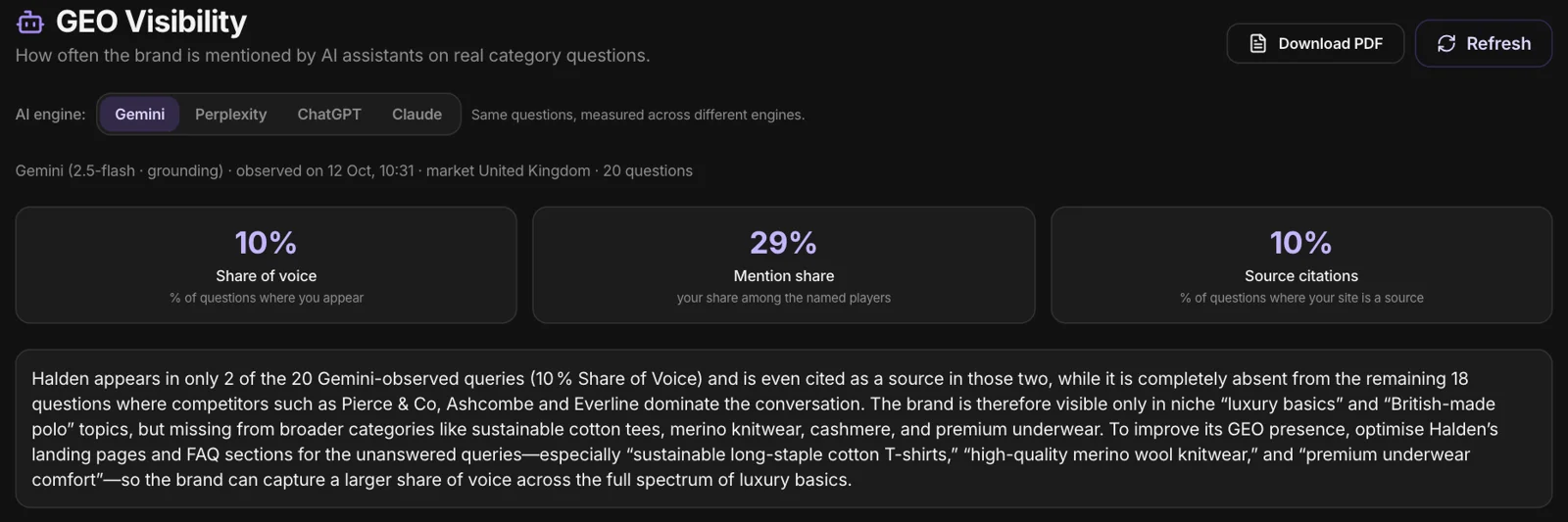
Start from the questions your customers ask assistants, and look at who gets cited instead of you, and from which sources. Every absence is a piece of content to write or a source to cover.
How to measure it
- The questions. A stable list of questions customers actually ask, in their language and for each market.
- The engines. The same questions put to several assistants, because they answer differently.
- The metrics. Whether you’re cited, in what position, in what tone, which competitors appear, whether your site is used as a source; and your share of all mentions (share of voice).
- Time. Answers change: the measurement only makes sense when repeated, so you can see the trend.
The most common mistakes
- Writing for machines. Copy stuffed with keywords also reads worse for people, and the research says it doesn’t work well.
- Watching only one assistant. Each one has different sources and behaviors.
- Forgetting third-party sources. Your website is only one of the voices the assistant listens to.
- Measuring only once. A snapshot doesn’t tell you whether you’re improving.