
Your site,
your competitors.
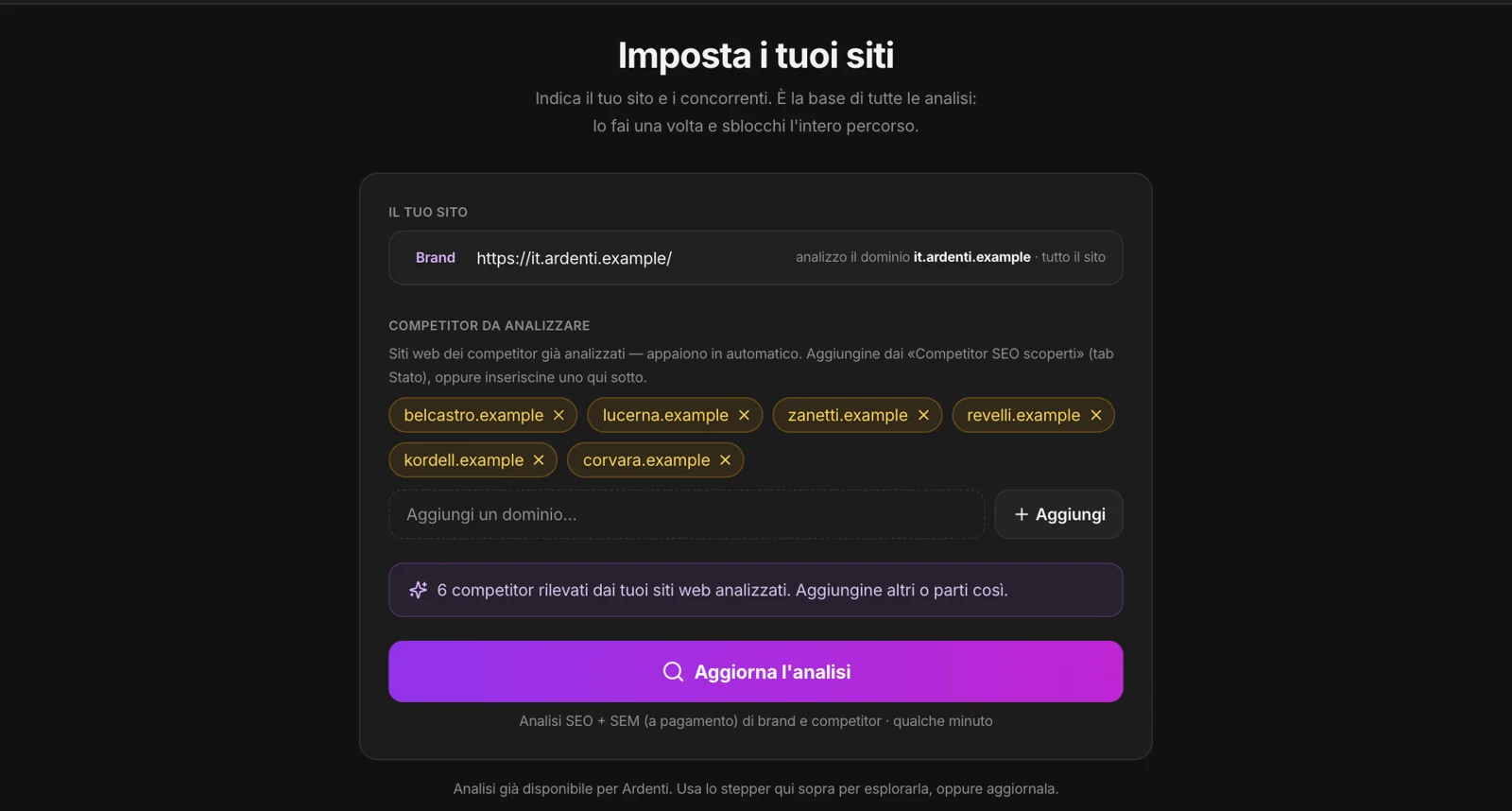
The domain comes from the analysis of the brand’s website; the competitors from the sites already analyzed and from the project’s context, and you can add more by hand. The search market and language come from the project.
Then a single analysis, a few minutes long: rankings, keywords, search competitors and paid presence, for the brand and for each competitor.
SEO health,
at a glance.
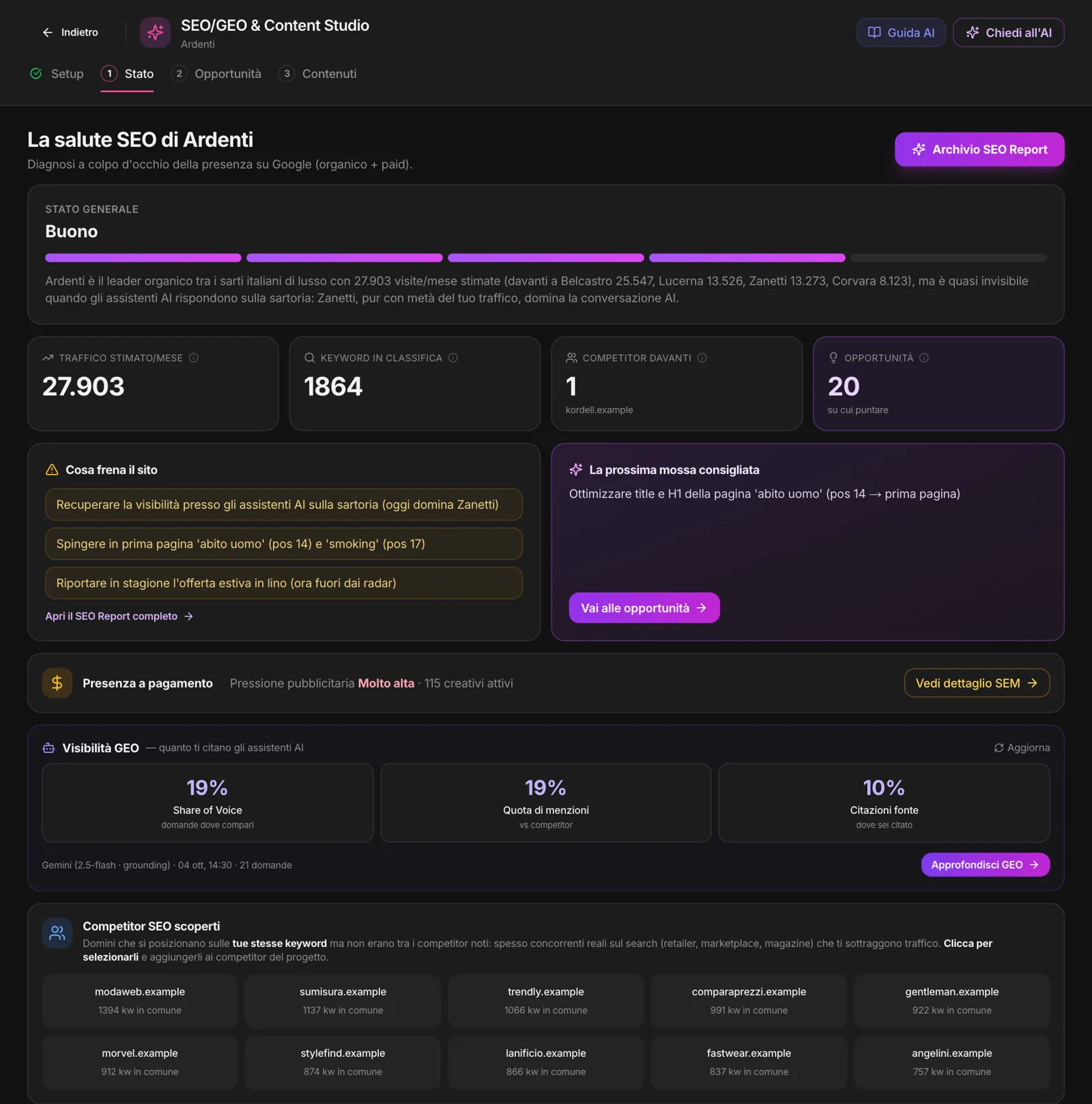
A verdict and four numbers: estimated organic traffic, ranking keywords, competitors ahead of you, opportunities. Below, what’s holding the site back and the recommended next move.
Then paid presence — how much advertising pressure there is, counting the active creatives on Google Ads —, visibility in AI assistants and the SEO competitors discovered: domains that rank for your keywords but weren’t among the known competitors. Marketplaces, retailers, magazines. One click adds them to the analysis.
A strategist’s
read.
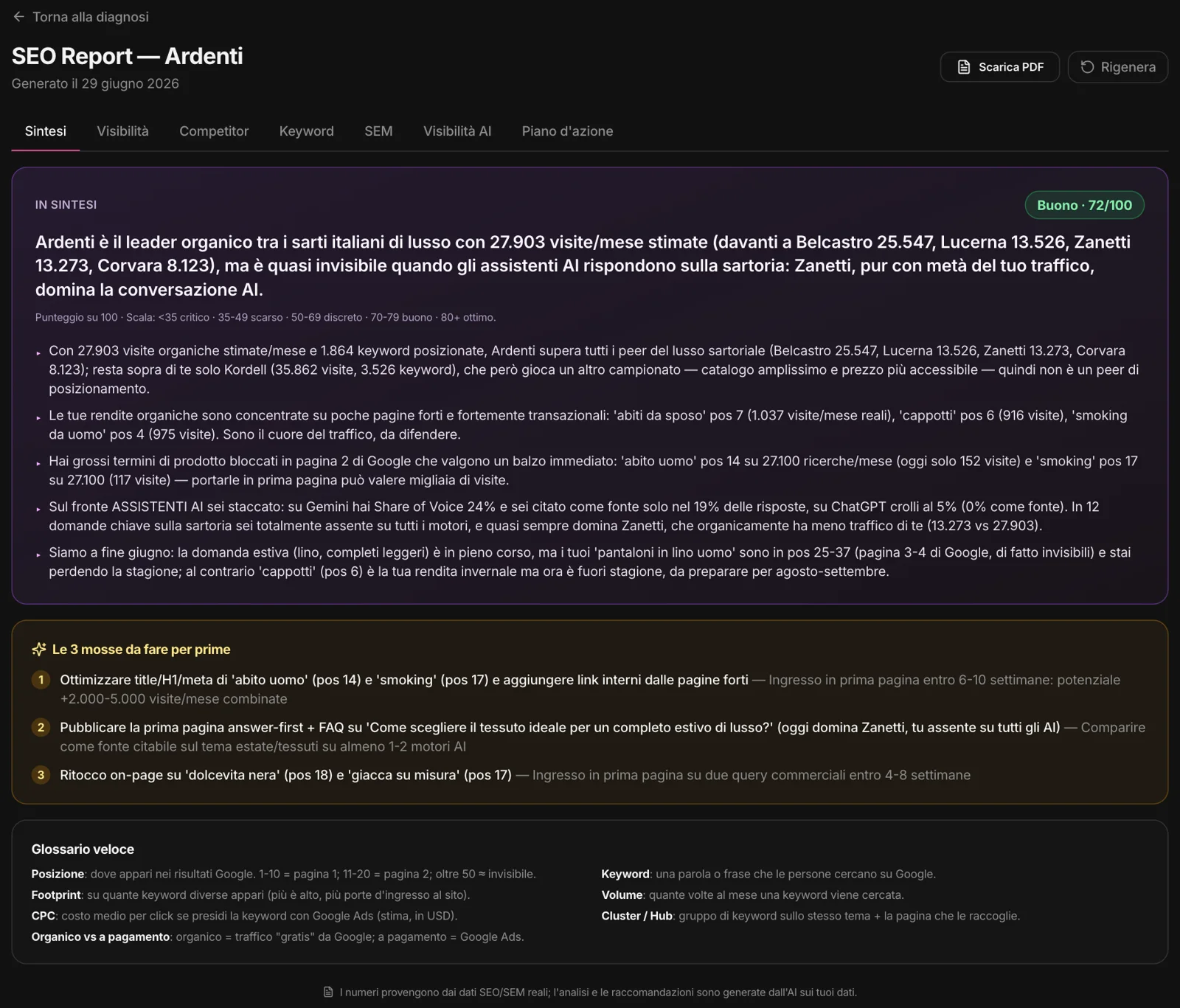
The SEO Report brings everything together — rankings, competitors, ads, visibility in AI assistants, brand context — and reads it the way a strategist would: a summary, the three moves to make first, competitors, keywords, ads, AI visibility, the action plan.
The numbers come from real data; the analysis and recommendations from AI, on your data. It downloads as a PDF, and earlier reports stay in the archive.
How often AI assistants
cite you.
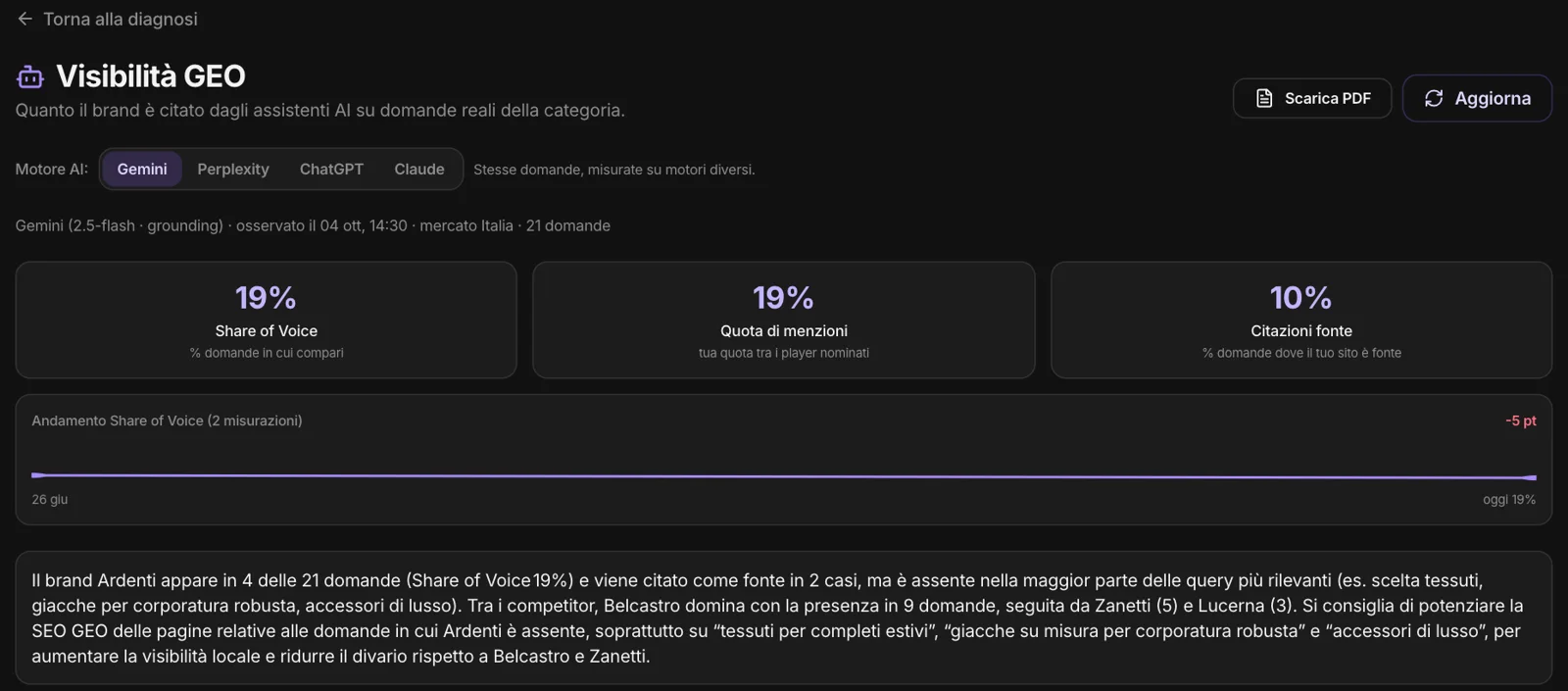
MAPS prepares a set of real questions from the category — the ones a person asks an assistant before choosing — and puts them to Gemini, Perplexity, ChatGPT and Claude, in the project’s language and market.
Cited as a source 10%
Cited as a source 14%
Cited as a source 5%
Cited as a source 0%
The same brand, on the same questions, has different visibility on each assistant: that’s why all of them are measured. Assistants’ answers change over time, and the measurement needs repeating.
Three numbers
and a read.
Share of Voice: in how many questions the brand appears. Mention share: how much the brand weighs among all the brands named in the answers. Citations as a source: in how many answers the assistant uses the brand’s website as a source — the strongest signal.
Below, the trend from one measurement to the next and a written read: where the brand is present, where it’s missing, who dominates and what to do.
Where you’re present,
where they talk about others.
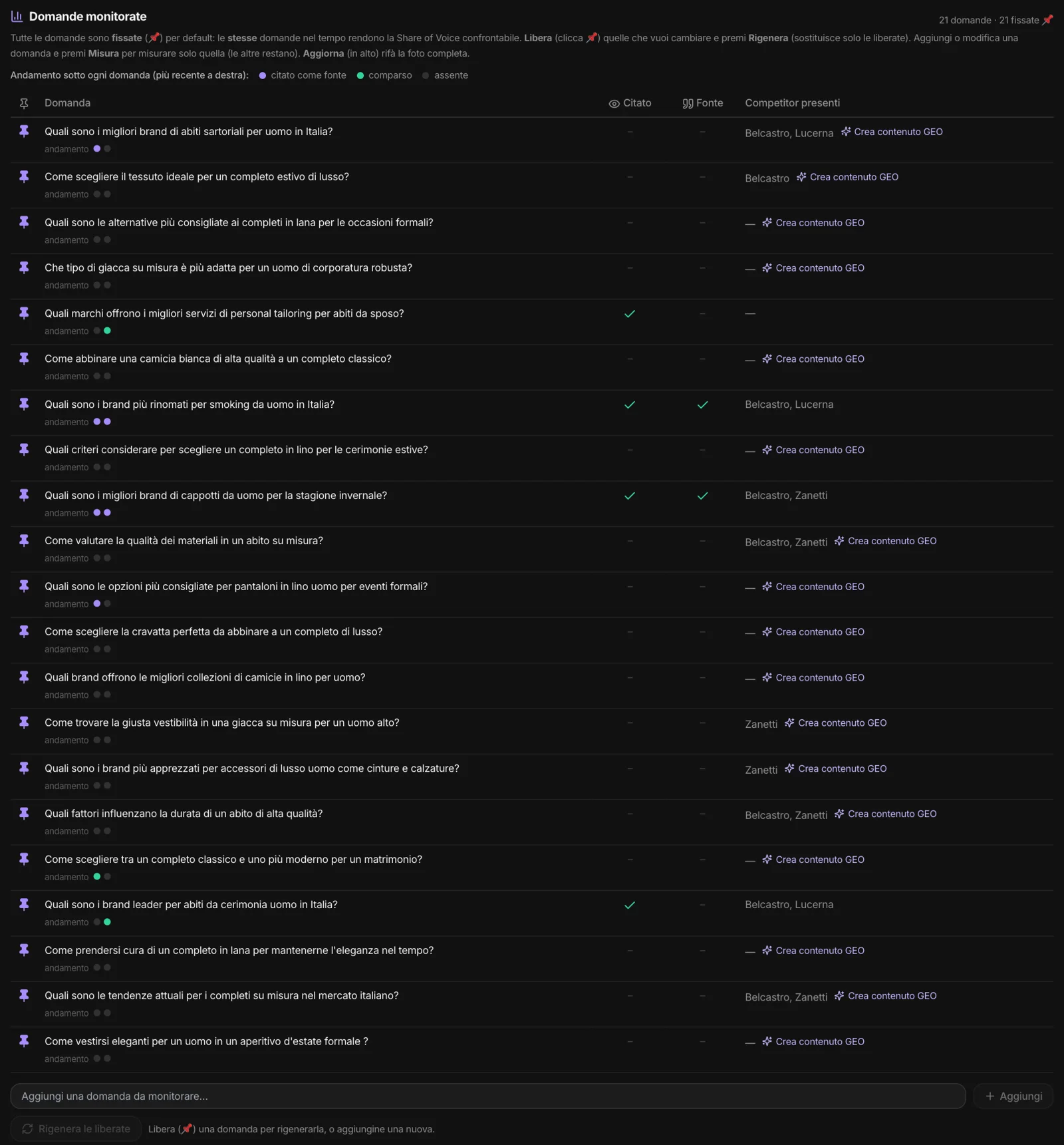
For each question: whether the brand is mentioned, whether the site is a source, which competitors show up in its place, and the trend across previous measurements.
The questions stay fixed from one measurement to the next, so the comparison over time holds up; you can unlock some to change them, and add your own. Where the brand is missing, “Create GEO content” takes that question straight into an editorial plan. The measurement downloads as a PDF.
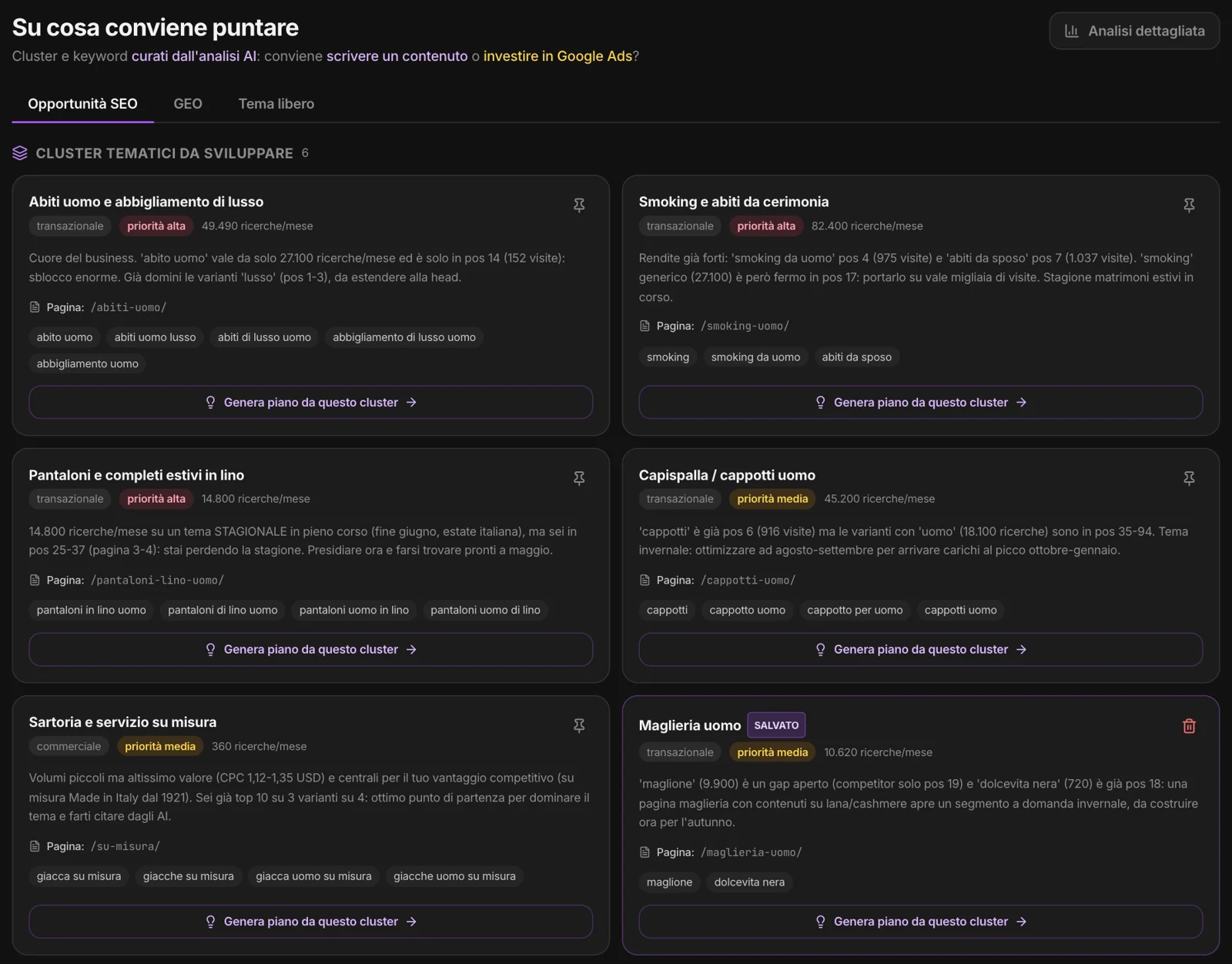
What’s worth
going after.
Keywords are grouped into topic clusters: priority, monthly searches, intent, the page on the site that should capture them and why, with the numbers. An editorial plan starts from each cluster.
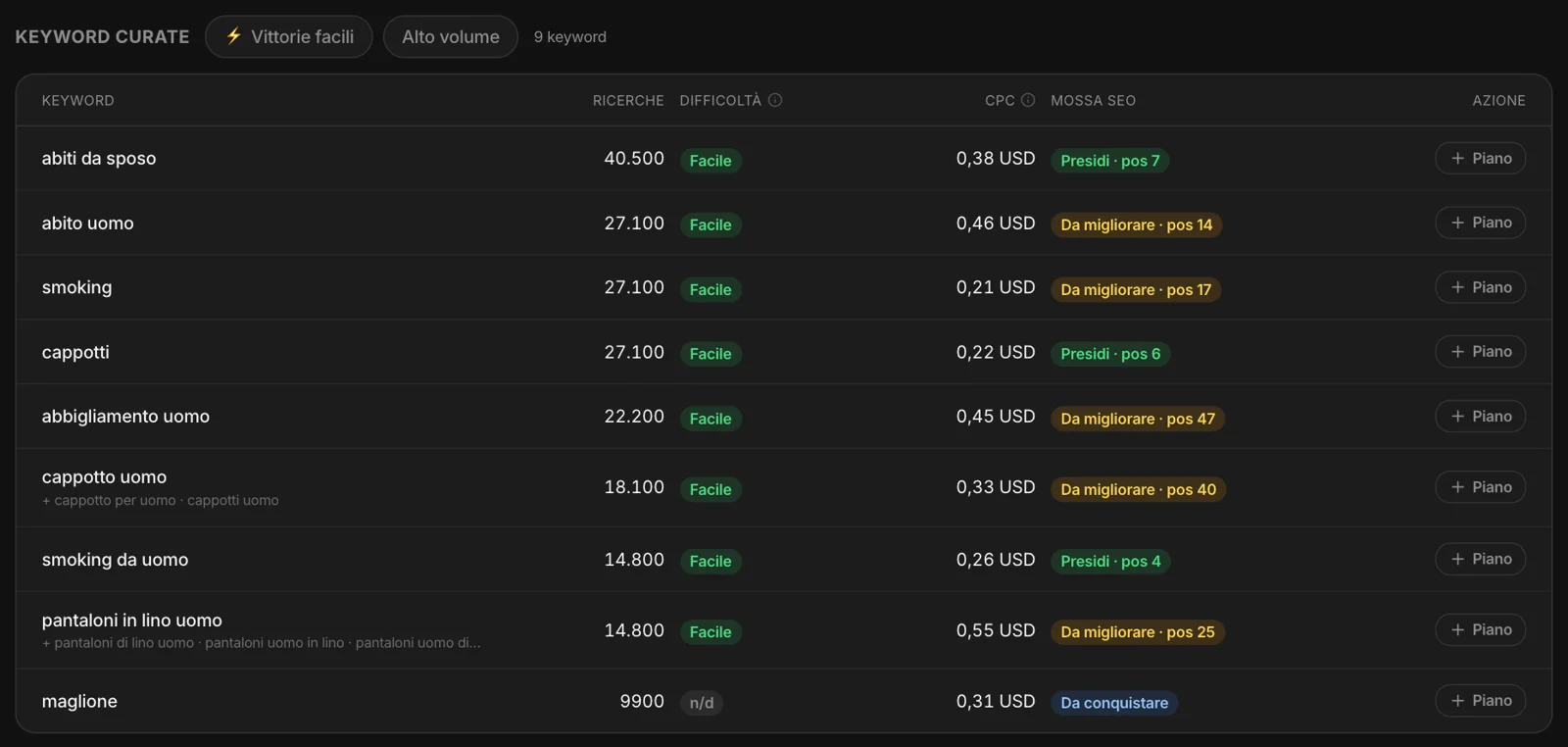
Real data,
the right move.
For each keyword: searches, difficulty, cost per click, and the SEO move — to win, to improve, to defend — based on the site’s actual ranking. “Quick wins” isolates the ones within reach.
And when it’s worth paying: the keywords where you’re already on page one or two but the click is expensive. Tactical Google Ads, candidate, or already covered.
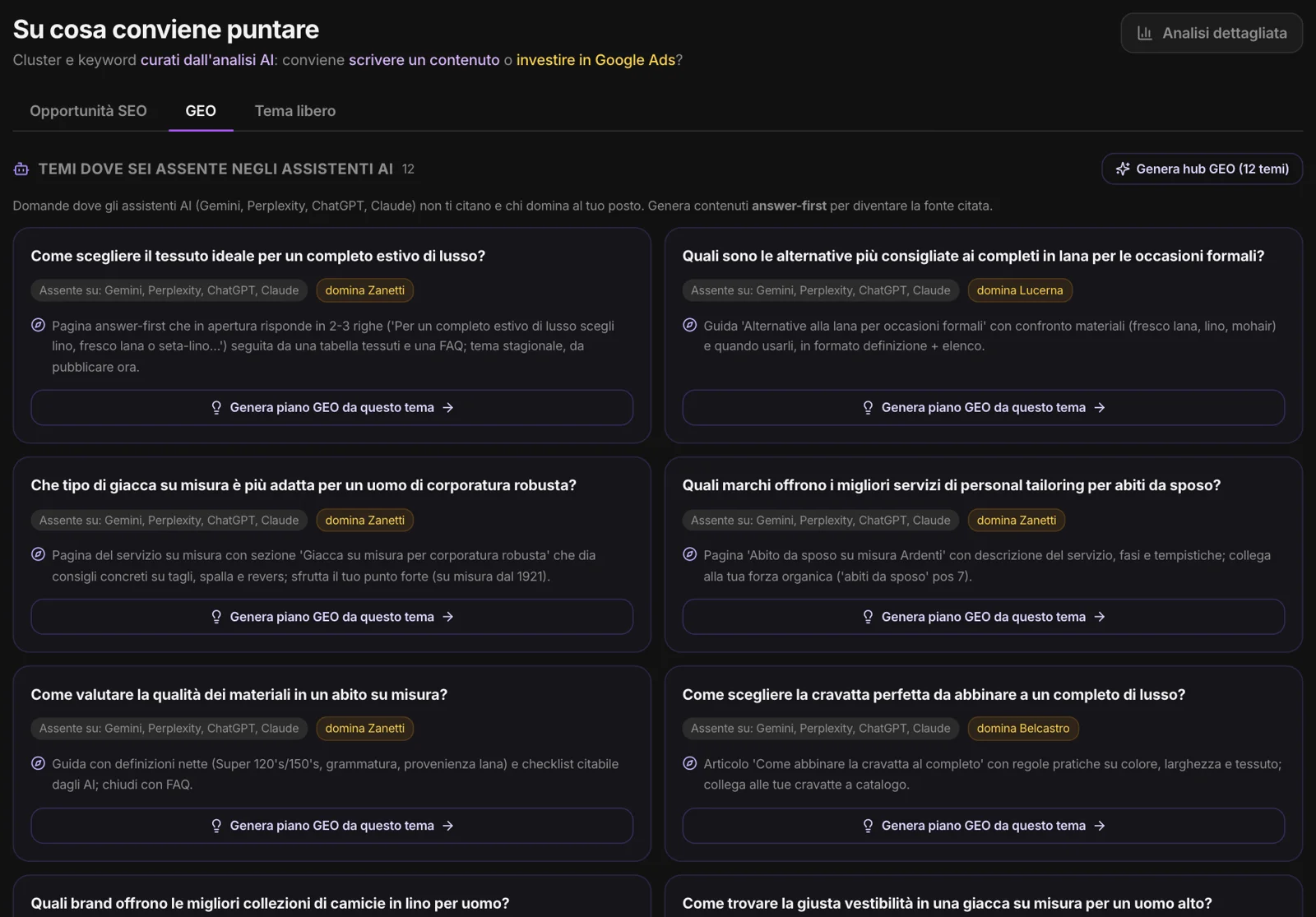
Where assistants
talk about others.
The topics where the brand is absent from every assistant’s answers, and who dominates in its place. For each: the content to write to become the cited source, and “Generate GEO plan”.
With Open theme you start from a topic of your own: MAPS ties it to real keywords and turns it into a plan, in a GEO version too.
From the plan
to the article.
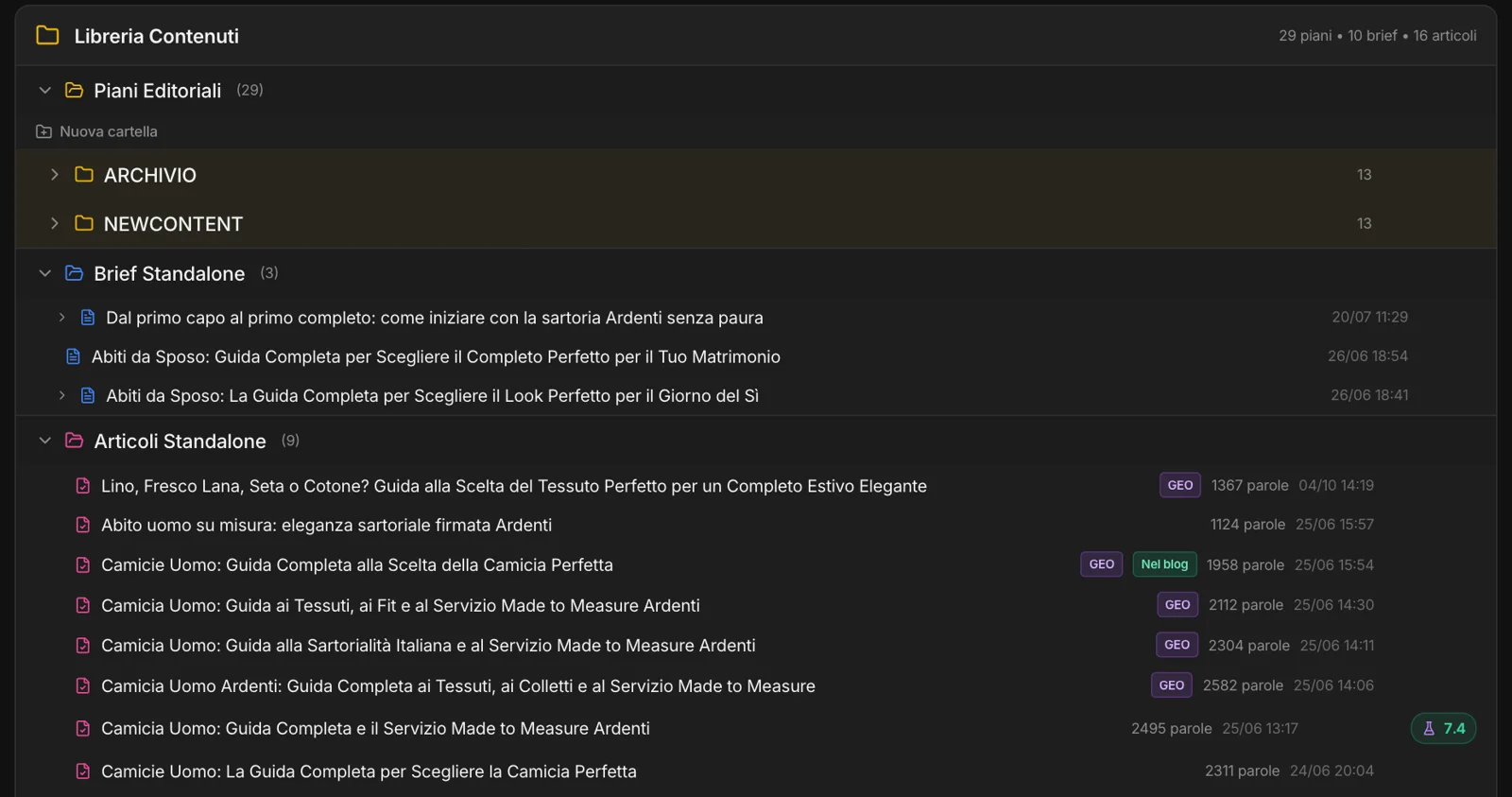
The editorial plan lists the articles: title, primary and secondary keywords, intent, type, length, outline. From each entry a brief — meta tags, H2/H3 structure, key points, call to action, the angle that sets you apart — and from the brief the article.
Articles also come from a campaign: a piece of content planned in Campaign opens here and the brief prepares itself. Everything ends up in a library of folders; with the GEO toggle, every article in the plan is written for assistants from the start.
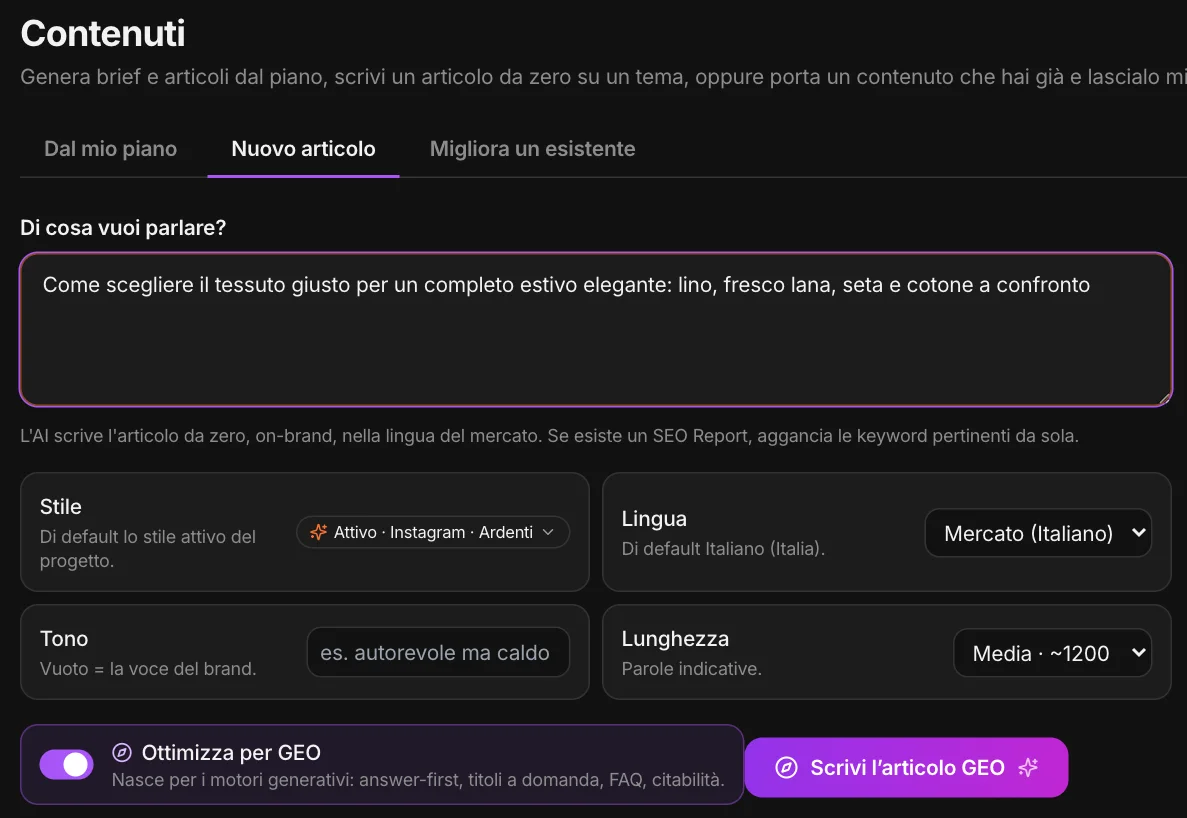
One topic,
one article.
Write what you want to talk about. Choose the reference style, the language — the market’s by default —, the tone and the length. If there is an SEO Report, the article ties into the relevant keywords.
With “Optimize for GEO” it is written for generative engines: a direct answer up front, question headings, an FAQ section, quotable statements. And one firm rule: no invented data, sources or quotes.
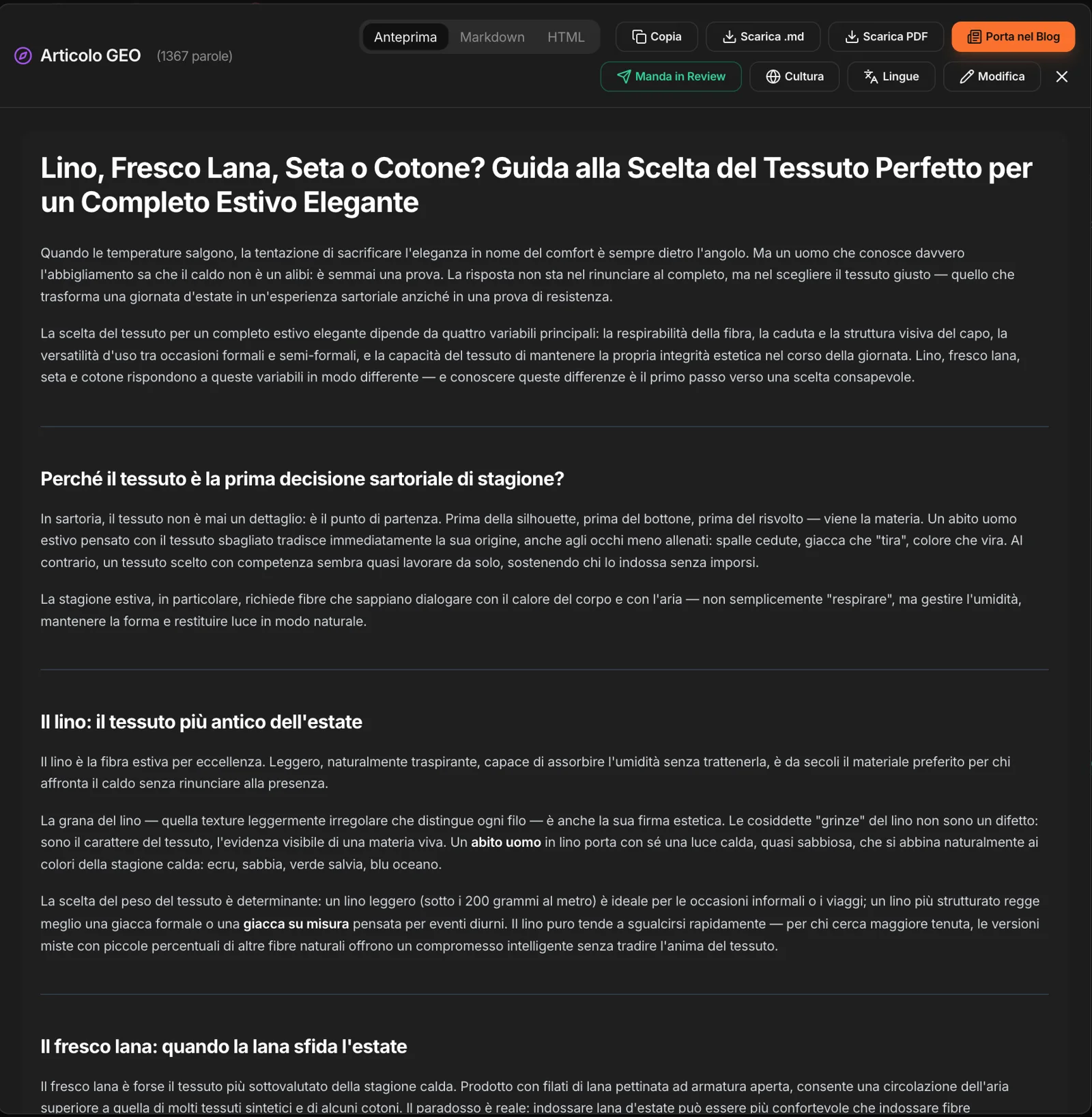
Ready to read,
ready to use.
The article reads the way your audience will read it, or you can take it as Markdown or HTML. You edit it by hand or with MAPS — the whole text or just one passage: expand, shorten, make it clearer —, and the AI writes the meta description.
Then: PDF, “Send to Blog” in the Web Studio, Review with the client, the Culture Judge, Languages — the version for another country, rewritten for that market — and, if the project has its personas, a test with synthetic users.
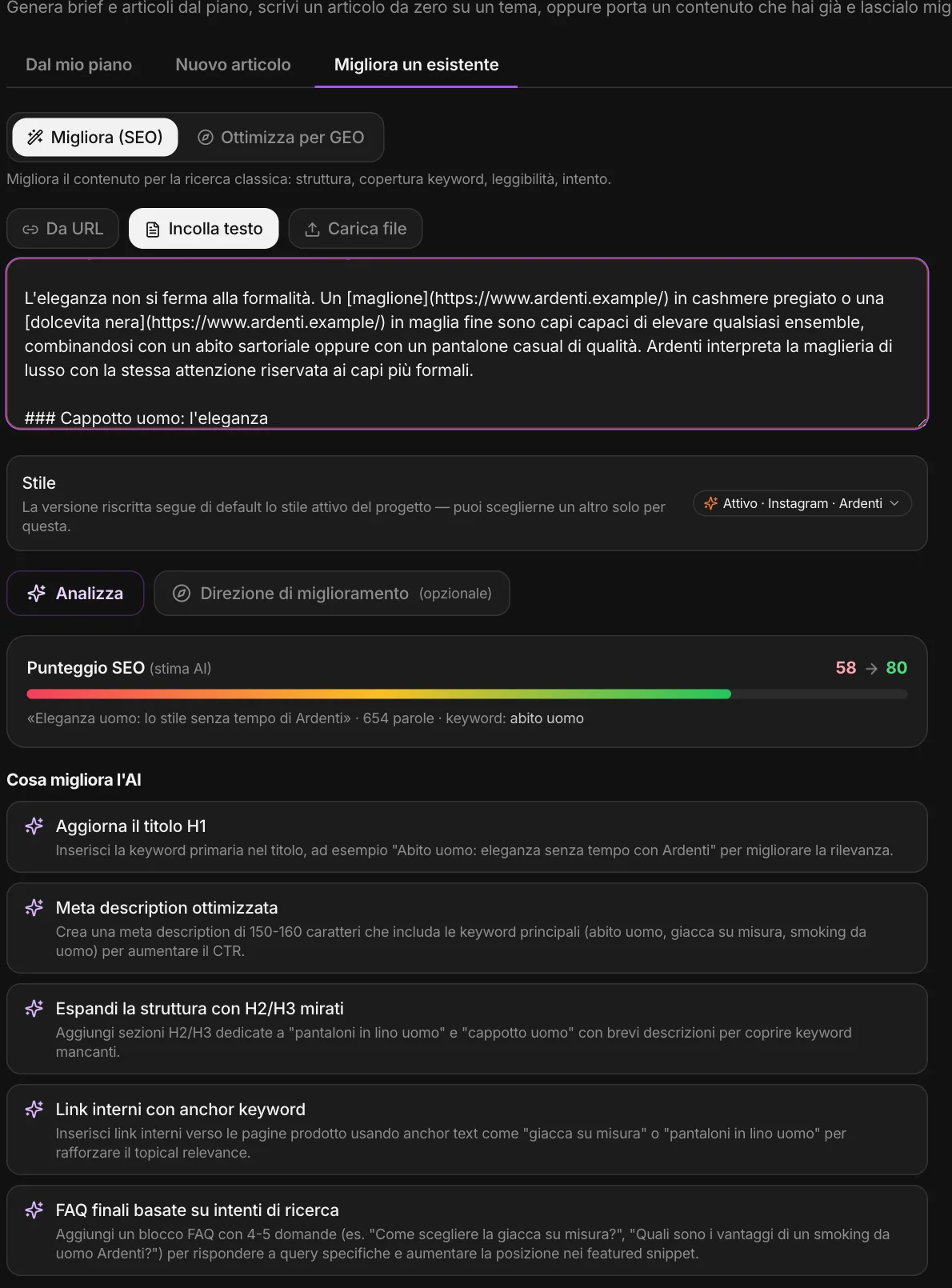
Already have
a piece of content?
Bring it in from a URL, paste it or upload a file. MAPS assesses it — an estimated SEO score, the score it could reach, the target keyword — and proposes improvements, one by one. Then it rewrites it in the market’s language and saves it to the library.
You can give it a direction: feedback from the synthetic user test, or your own. In GEO mode it assesses six dimensions — answer up front, FAQ, quotable statements, entities, self-contained passages, authority — and rewrites it for assistants.
Not a text generator.
Work that lasts.
What the studio produces stays in the project, and comes in handy elsewhere.
Ask the AI
The studio’s chat knows the rankings, keywords, ads, GEO visibility and reports, and also the plans, briefs and articles already written.
Paid presence
The SEM detail: who runs ads, how many active creatives, on which topics and in which languages, read by AI.
In the Web Studio
“Send to Blog” turns the article into a blog page on the site built in the Web Studio.
The market’s language
Plans, briefs and articles are written in the language of the project’s market; research uses the right country and language.
If you sell to businesses
With the B2B profile, plans, briefs, articles, analyses, GEO questions and the SEO Report speak to people choosing a supplier for their company.