MAPS Intelligence
Resources/Strategic Tools
Strategic Tools · 10 min read

Customer Journey Map: how to build it channel by channel

Stages, touchpoints, emotions and critical moments of the buying journey: why a journey per channel is worth more than a generic one, and how to use it to decide where to act.

Updated October 6, 2026 · MAPS editorial team
In brief

A Customer Journey Map represents a customer’s path from the first need to purchase and beyond, stage by stage: what they do, which touchpoints they encounter, how they feel, where they get stuck. It helps you see the experience through the customer’s eyes and decide where to act. To be useful, it has to be built for a specific profile and channel: someone who buys in a store doesn’t follow the same path as someone who buys online.

What it contains

  • The stages — for example: need, search, evaluation, purchase, use, repurchase or word of mouth.
  • The actions — what the customer does at each stage.
  • The touchpoints — where they encounter the brand: website, social media, store, reviews, customer service.
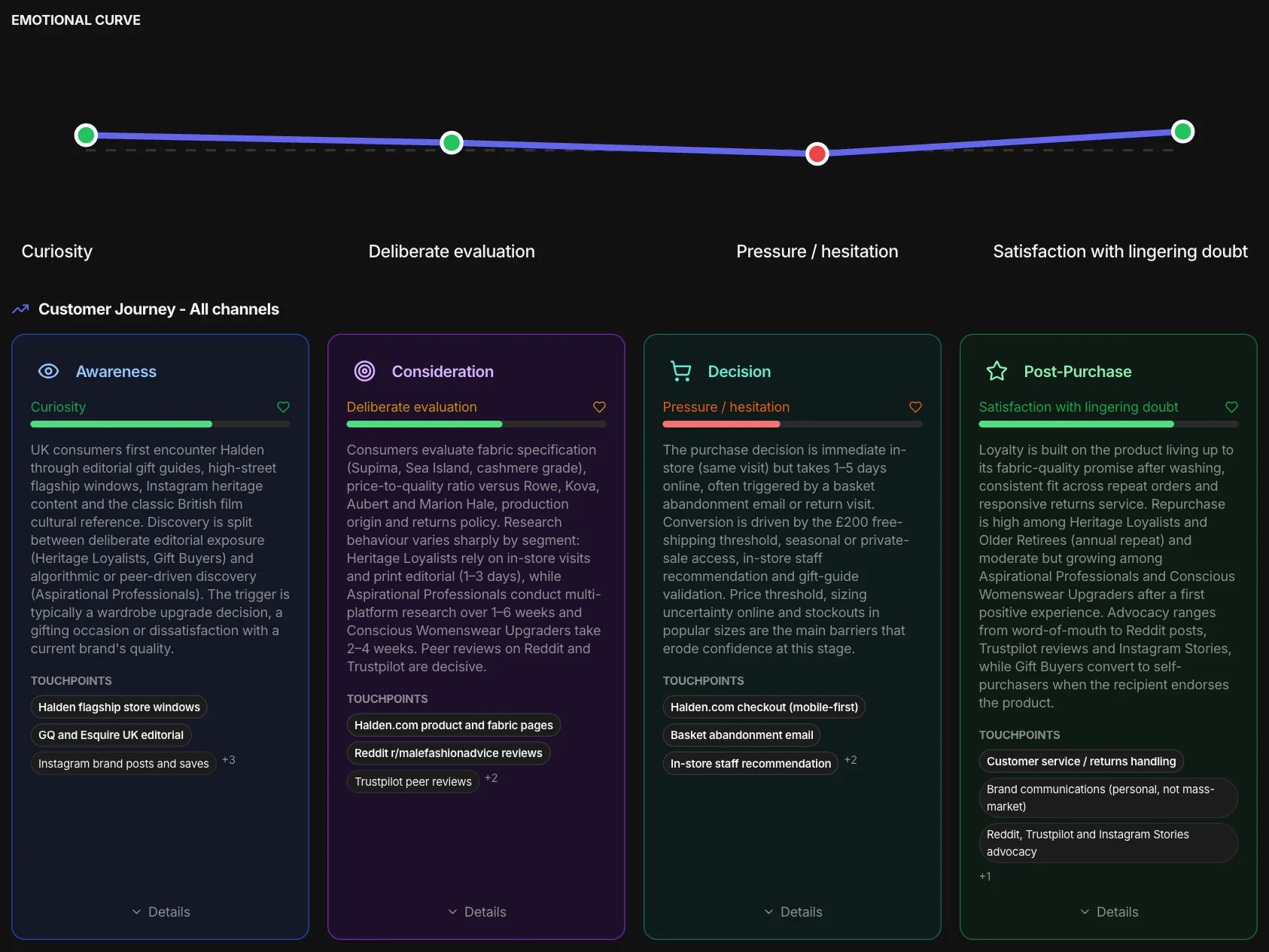
  • The emotional curve — how their state of mind changes along the way.
  • The critical moments — where they hesitate, get stuck or drop out.
  • The opportunities — what could be done at those points.

How to build it

1. Choose profile and channel

A journey applies to one profile and one channel. Someone buying in a department store worries about fit without a proper fitting; someone buying online worries about returns; someone buying in a boutique is looking for the relationship. An “average” journey hides exactly these differences.

2. Reconstruct the real journey

Start from evidence: browsing and sales data, reviews, conversations with sales staff, interviews. Describe the journey as it is, not as it should be.

3. Draw the emotional curve

For each stage, how the customer feels. The low points of the curve are the natural candidates for action; the high points are the ones to protect and to talk about.

4. Don’t forget who’s in the middle

If you sell through a retailer, before the end customer there’s the buyer who decides to stock you, with their own journey: scouting, sample collection, terms, order, reorder. Ignoring them means ignoring your first customer.

5. Try “what if” scenarios

Once the journey is drawn, imagine a move — an at-home try-on service, a video consultation — and ask how each stage would change. It’s the fastest way to compare different interventions.

The most common mistakes

  • One journey for everyone. Different channels and profiles have different journeys.
  • The ideal journey instead of the real one. The map is there to reveal problems, not to confirm the process.
  • Only the brand’s own touchpoints. Reviews, friends, marketplaces and creators are part of the journey.
  • No priorities. A map with thirty critical moments, all weighted the same, doesn’t tell you where to start.
How MAPS does it

In MAPS the Consumer Journey Map is built channel by channel, starting from the channels analyzed in Consumer Focus — or as a synthesis of all of them. For each channel: the emotional curve, the touchpoints of each stage, the critical moments. Where you sell through a retail chain, MAPS also builds the buyer’s journey, from the channel analysis in Distribution Focus. And “what-if” scenarios show the before and after of a move. In B2B the journey becomes the business customer’s procurement journey.

A journey in MAPS: the multi-brand store customer, with the emotional curve and the four stages

Frequently asked questions

How many stages should a customer journey map have?

As many as truly describe your customer’s journey: often between five and seven, from need to repurchase. More than the number, what matters is that each stage corresponds to a real change in what the customer does or thinks.

What’s the difference between a customer journey and a funnel?

The funnel looks at the path from the company’s point of view, as a sequence of conversions. The journey looks at it from the customer’s point of view: what they do, how they feel, where they encounter the brand and where they get stuck.

Do you need a journey for each channel?

Yes, when the channels are genuinely different: in store, online and in multi-brand retailers, the fears, touchpoints and critical moments change. A single journey tends to hide exactly these differences.

What about B2B?

The journey becomes a procurement journey: from the need that arises within the company to supplier evaluation, the quote, the trial, support and reordering, with several people involved in the decision.

Origin and references

The journey map comes from service design. Among its roots: the service blueprint proposed by G. Lynn Shostack (“Designing Services That Deliver,” Harvard Business Review, 1984).

Written by the MAPS editorial team with the help of AI, checked and reviewed by the team.

Related articles
Strategic Tools·8 min di lettura

Empathy Map: what it is and how to use it to understand the customer

What your customer says, thinks, does and feels, what they see and hear, what holds them back and what they want: how to fill it in without making things up, and how to turn it into decisions.

Read →
Strategic Tools·9 min di lettura

Value Proposition Canvas: how to find fit with the customer

The customer profile — jobs, pains, expected gains — next to what you offer: how to build it on evidence and tell whether your proposition really answers.

Read →
Methodology·9 min di lettura

Social Listening: how to listen to the market and turn it into insight

Don’t count mentions: understand what the market is saying, in which language, on which platforms. How to set up your searches, read themes and sentiment, and put what you find to use.

Read →