MAPS Intelligence
Resources/Strategic Tools
Strategic Tools · 9 min read

Value Proposition Canvas: how to find fit with the customer

The customer profile — jobs, pains, expected gains — next to what you offer: how to build it on evidence and tell whether your proposition really answers.

Updated October 6, 2026 · MAPS editorial team
In brief

The Value Proposition Canvas compares two things: the customer profile — the jobs they want to get done, the pains they run into, the gains they’re looking for — and the value map — the products and services you offer, how they relieve those pains and how they create those gains. There’s fit when what you offer answers what really matters to the customer.

The two halves

The customer profile

  • Jobs — what the customer is trying to get done: functional jobs (dressing for an interview), social ones (making a good impression), emotional ones (feeling confident).
  • Pains — what holds them back, annoys or worries them before, during and after the job.
  • Gains — what they’d like to achieve, from the must-have outcomes to the ones that would surprise them.

The value map

  • Products and services — what you offer.
  • Pain relievers — how what you offer eliminates or eases the customer’s pains.
  • Gain creators — how it creates the gains the customer is looking for.

How to build it

1. One segment at a time

Each profile applies to one segment. If your customers have different jobs, you need different profiles: a single, averaged one describes nobody.

2. The customer before the product

Fill in the profile first, with evidence: interviews, reviews, support requests, research. Only then move to the value map. Starting from the product leads you to write down the pains the product solves, not the ones the customer has.

3. Rank by importance

Not all pains weigh the same. Put the most severe and most frequent at the top, and the must-have gains ahead of the nice-to-haves.

4. Look for fit, and for gaps

Link every pain reliever to a pain and every gain creator to a gain. Two valuable lists remain: the important pains you don’t solve (opportunities) and the features that answer nothing (costs to review).

5. Check it against the market

The canvas is a hypothesis. Real fit is verified with customers: first through conversations and tests, then through sales.

The most common mistakes

  • A made-up profile. A profile written at a desk confirms the proposition instead of testing it.
  • Only functional jobs. Many choices are decided on social and emotional jobs.
  • Vague pains. “It’s too expensive” says little; “I don’t know if the garment will fit me without trying it on” tells you what to do.
  • Everything linked to everything. If every feature solves every pain, you haven’t made any choices.
  • Stopping at the canvas. Without checking with customers, fit stays on paper.
How MAPS does it

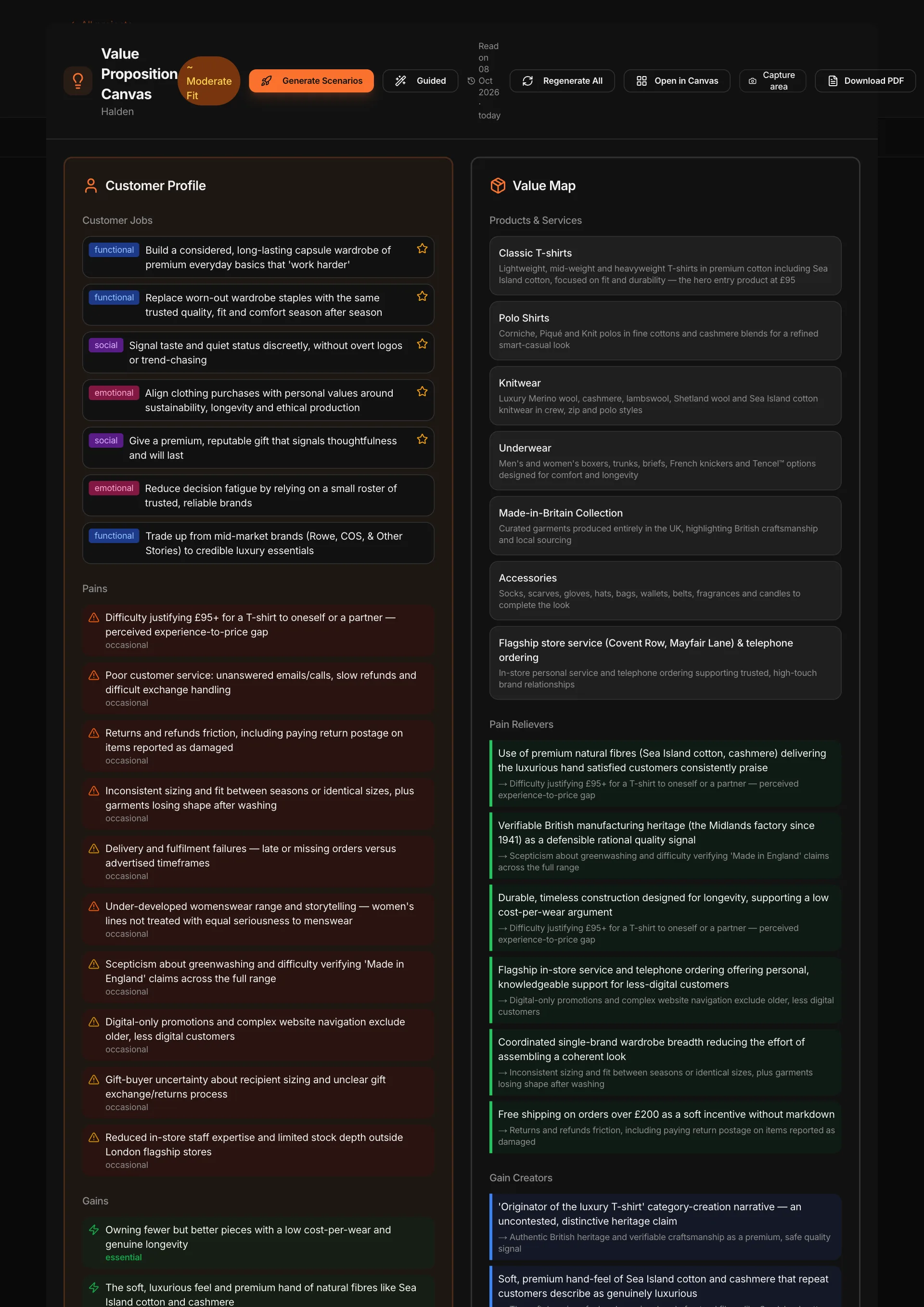
In MAPS the Value Proposition Canvas puts the customer on one side — their jobs, what holds them back, what they’re looking for — and what you offer on the other, with a verdict on fit and the gaps to close. Then you can set a direction — for example “made-to-measure, reachable online” — and MAPS builds three scenarios, from the most cautious to the most ambitious, saying which one it recommends and why. Every proposition can be tested with the project’s synthetic users.

The Value Proposition Canvas in MAPS: the customer, the offer, the verdict on fit and the gaps

Frequently asked questions

What’s the difference between the Value Proposition Canvas and the Business Model Canvas?

The Value Proposition Canvas zooms in on two blocks of the Business Model Canvas — the customer segment and the value proposition — and compares them in detail. The Business Model Canvas describes the entire model.

What are “jobs to be done”?

They’re the jobs the customer is trying to get done when choosing a product: functional, social or emotional. The idea is that people don’t buy a product for its own sake, but something that helps them get that job done.

How many canvases do you need?

One for each segment with different jobs. Two segments that want different things from the same product deserve two profiles.

How do you know if there’s fit?

When what you offer solves the pains and creates the gains that matter most to the customer. The canvas helps you formulate the hypothesis; confirmation comes from tests with customers and from sales.

Origin and references

Alexander Osterwalder, Yves Pigneur, Gregory Bernarda and Alan Smith, Value Proposition Design (2014).

Written by the MAPS editorial team with the help of AI, checked and reviewed by the team.

Related articles
Strategic Tools·9 min di lettura

Business Model Canvas: what it is and how to use it

The nine blocks that describe how a company creates, delivers and captures value: how to fill them in, in what order, and how to use the canvas to imagine different models.

Read →
Strategic Tools·8 min di lettura

Empathy Map: what it is and how to use it to understand the customer

What your customer says, thinks, does and feels, what they see and hear, what holds them back and what they want: how to fill it in without making things up, and how to turn it into decisions.

Read →
AI & Marketing·9 min di lettura

Synthetic users: what they are and how to use them to test an idea

Simulated people built on a market’s data: what they can tell you, what they can’t, how to interview them without fooling yourself, and when you still need the real customer.

Read →