MAPS Intelligence
Resources/Strategic Tools
Strategic Tools · 9 min read

Business Model Canvas: what it is and how to use it

The nine blocks that describe how a company creates, delivers and captures value: how to fill them in, in what order, and how to use the canvas to imagine different models.

Updated October 6, 2026 · MAPS editorial team
In brief

The Business Model Canvas is a one-page framework that describes how a company creates, delivers and captures value, in nine blocks: customer segments, value proposition, channels, customer relationships, revenue streams, key resources, key activities, key partners and cost structure. It lets you see the business model all at once, and imagine different ones.

The nine blocks

The canvas reads in two halves. On the right is value — for whom, what, how it gets there and how it pays —; on the left is efficiency — what it takes to produce it and what it costs.

  • Customer segments — who you create value for. Several segments with different needs should be kept apart.
  • Value proposition — why those customers should choose you: the problem you solve, the need you meet.
  • Channels — how the proposition reaches the customer: communication, sales, delivery, support.
  • Customer relationships — what kind of relationship you build: personal, automated, community-based, subscription.
  • Revenue streams — how and how much customers pay: sale, subscription, license, commission.
  • Key resources — what you need to make the model work: people, brands, technology, capital.
  • Key activities — what you have to do well: manufacture, design, distribute, run a platform.
  • Key partners — who you need on the outside: suppliers, alliances, distributors.
  • Cost structure — what all of this costs, and which costs weigh the most.

How to fill it in

1. Start from customers and the proposition

Begin with the right half: segments and value proposition are the heart of the model. If there’s confusion here, the rest of the canvas will describe a company that doesn’t know who it works for. To go deeper on the proposition, the Value Proposition Canvas is the companion tool.

2. Follow value all the way to revenue

Channels, relationships and revenue answer one question: how the proposition reaches the customer and turns into cash. Check for consistency: a luxury product with a purely automated relationship, or a subscription with no reason to stay, are signs of friction.

3. Then the part that makes it possible

Resources, activities and partners must serve the right half. Every item should answer “which value block does it support?”. Whatever supports nothing is a cost to discuss.

4. Separate how it is from how you’d like it to be

A canvas describes either the current model or a possible one: mixing them is confusing. Take the snapshot first, then one or more alternative versions, and compare them block by block.

An example. An apparel brand that sells through multi-brand stores might imagine an alternative model with made-to-measure booked online and the fitting in the boutique. The channels change (online + boutique), as do the relationships (personal appointment), revenue (higher price per garment), key resources (tailors, a measurement system) and costs. The canvas shows at a glance everything the choice touches.

The most common mistakes

  • A segment that’s too broad. “Women 25-45” is not a segment: two customers with different needs require different propositions.
  • The proposition as a list of features. What matters is the problem you solve, not the product specs.
  • Disconnected blocks. Every resource and activity must serve a piece of value.
  • Stopping at the snapshot. The canvas is at its best when you use it to compare alternative models.
  • Forgetting the numbers. Revenue and costs without orders of magnitude make it impossible to tell whether the model holds up.
How MAPS does it

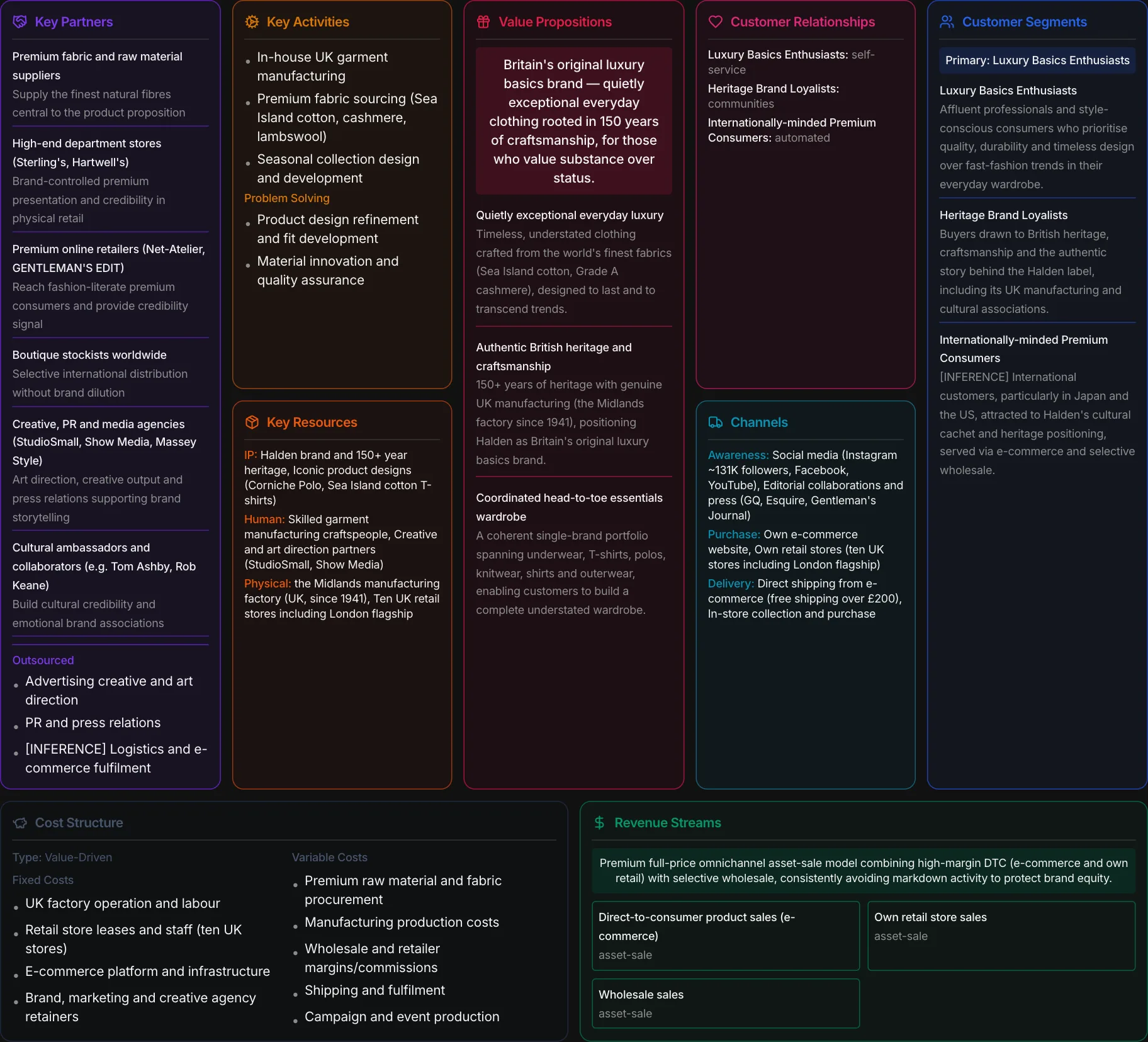
In MAPS the Business Model Canvas is generated from Analyze, starting from what the project knows: the nine blocks, each with MAPS’s confidence level. Then the evolution scenarios: choose a different path and MAPS redraws the model block by block, with the impact on each one. The same group of tools includes identity, value proposition, positioning and the map; everything can be taken to the canvas to work on with the team, or exported to PDF.

The Business Model Canvas in MAPS: the nine blocks with their confidence level

Frequently asked questions

What’s the difference between a Business Model Canvas and a business plan?

The canvas describes the logic of the model on one page, and is made to be discussed and changed. The business plan is an extended document, with numbers, timelines and an operating plan. The canvas usually comes first.

Which block do you start with?

Customer segments and the value proposition: they’re the heart of the model. All the other blocks exist to bring that proposition to those customers sustainably.

Does it work for an established brand too?

Yes: it’s especially useful for imagining evolutions — a new channel, a new way of making money, a new audience — and seeing everything the choice touches.

How does it relate to the Value Proposition Canvas?

The Value Proposition Canvas goes deeper on two blocks of the Business Model Canvas: the customer segment and the value proposition. They were designed by the same authors to be used together.

Origin and references

Alexander Osterwalder and Yves Pigneur, Business Model Generation (2010).

Written by the MAPS editorial team with the help of AI, checked and reviewed by the team.

Related articles
Strategic Tools·9 min di lettura

Value Proposition Canvas: how to find fit with the customer

The customer profile — jobs, pains, expected gains — next to what you offer: how to build it on evidence and tell whether your proposition really answers.

Read →
Strategic Tools·9 min di lettura

SWOT analysis and the TOWS matrix: how to do it right

Strengths, weaknesses, opportunities and threats: how to gather them with evidence, tell internal from external, and turn the SWOT into action with the TOWS matrix.

Read →
Methodology·10 min di lettura

Brand positioning: a four-phase process

Understand, choose, test, activate: how to arrive at a defensible positioning, capture it in one sentence and turn it into concrete choices.

Read →