
MAPS Intelligence
Resources/Creative Methods
Creative Methods · 9 min read

Scenario planning for campaigns: communicating for more than one future

Drivers of change, plausible scenarios, weak signals: how to build campaigns for different futures, and one that holds up in all of them.

Updated October 6, 2026 · MAPS editorial team
In brief

Scenario planning is a method for deciding under uncertainty: instead of predicting the future, it builds several plausible futures from the drivers of change, and prepares a strategy for each. Applied to campaigns, it leads you to design communication for different scenarios, plus a robust one that holds up in all of them, with the signals that tell you which future is arriving and when to change course.

Preparing, not predicting

A scenario is not a forecast: it is a coherent story about what the world could look like, built by combining forces that are changing. The value isn’t in guessing which scenario will come true, but in not being caught off guard by any of them.

When to use it

  • When the market is uncertain and a campaign, or a communication platform, has to last more than one season.
  • When you want a strategy that is ready to change, with the signals that tell you when.
  • Over one- to three-year horizons, with forces of change that can be named.

How to do it

1. Choose the horizon and the drivers

How far ahead? And which forces will change the market: demographics, income, technology, regulation, habits. Separate the near-certain ones (an aging population) from the uncertain and important ones: those are what generate different scenarios.

2. Build three or four scenarios

One classic approach is to cross two uncertainties in a 2×2 matrix; another is to combine the drivers into three distinct stories. Each scenario has a name, a description of the world and the combination of drivers that produces it.

3. Read the implications

What each scenario means for the brand and for communication: what people will look for, what they will fear, what will be credible. This is where scenarios become useful.

4. Design the campaigns

For each scenario, a cautious approach and a bold one; then a robust campaign that works whichever future arrives. Seeing them together lets you choose whether to bet or to hedge.

5. Name the signals and the tipping points

For each scenario, the weak signals that announce it and the thresholds beyond which to switch campaigns: a drop in premium sales, a rise in searches for budget alternatives. Without signals, scenarios remain an exercise.

An example. “Vellani”, pet food with veterinary diets, two years out. Drivers: aging people and pets, pensioners’ income, health coverage. Three scenarios: a sustainable balance, an affordability crisis, increasingly connected health. For each, a cautious concept and a bold one, plus a robust one — science, transparency and a fair price — that holds in all of them. And a warning signal to monitor: falling sales of the premium line.

The most common mistakes

  • One optimistic, one pessimistic, one in between. Those aren’t scenarios: they are the same story with three degrees of confidence.
  • Picking your favorite scenario. The method is there to prepare for all of them, not to confirm what you hope for.
  • Too many drivers. The scenarios become unreadable; better a few uncertain, decisive forces.
  • No signals. Without indicators and thresholds, nobody will know when to change course.
How MAPS does it

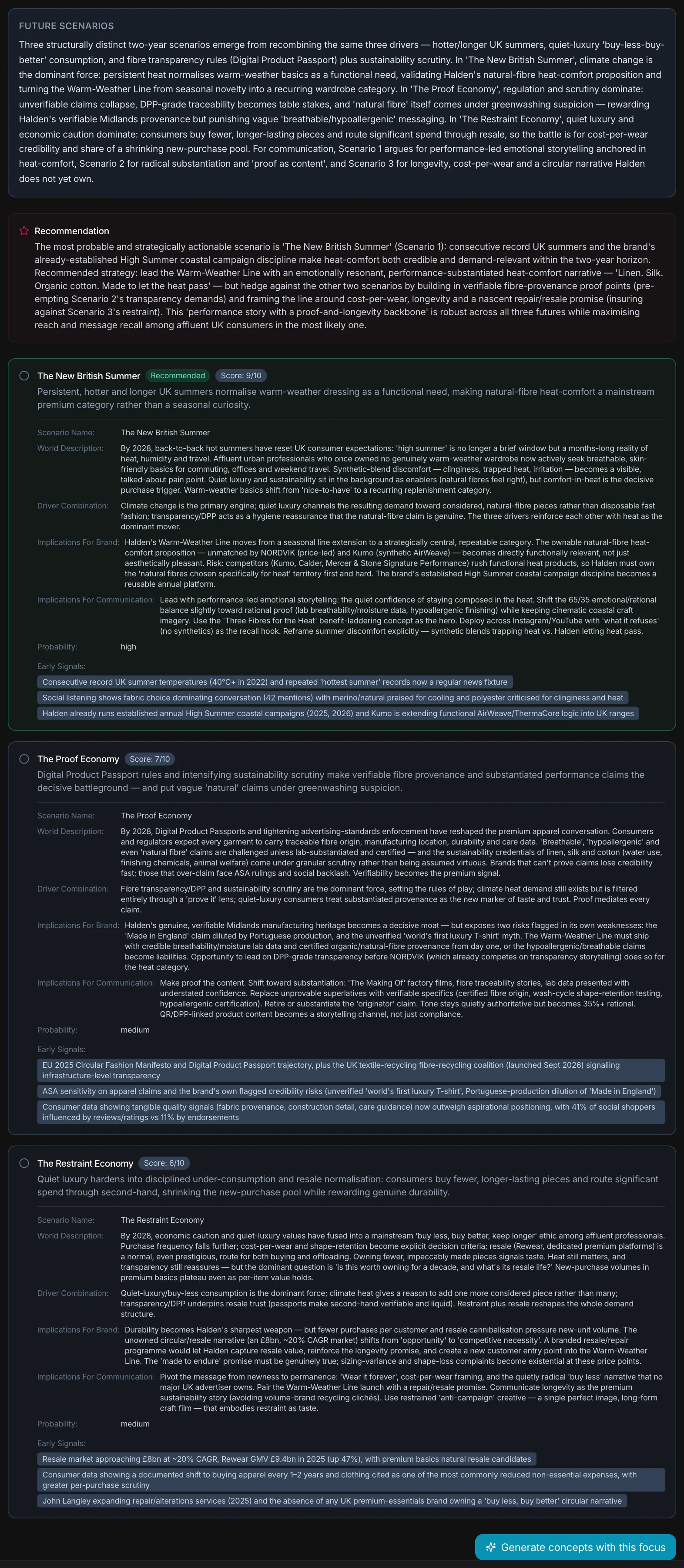
In the MAPS Campaign Lab, Scenario Planning is one of the eight methodologies. On top of the brief, it asks for the drivers of change and the horizon — one, two or three years. The analysis builds three plausible scenarios: for each, what the world looks like, which combination of drivers produces it, what it implies for the brand and for communication, how likely it is and the weak signals that announce it. There are seven concepts: a Safe and a Bold one for each scenario, plus a Robust one that holds up in all of them; if you choose a scenario other than the recommended one, the concepts give it more weight without losing the others. In the Methodology tab, the development states which scenario it is designed for, the signals that confirm the direction, the point at which to abandon it and how to adapt it.

Future scenarios: Sustainable Balance, Affordability Crisis, Connected Health, with implications and signals

Frequently asked questions

What is the difference between a scenario and a forecast?

A forecast says what will happen; a scenario describes what could happen. Scenario planning builds several precisely because no one knows which will arrive.

How many scenarios do you need?

Usually three or four: enough to cover truly different futures, few enough to work with.

What is a robust strategy?

A strategy that works reasonably well in every scenario, even if it isn’t the best possible in any of them. It is the choice of those who prefer to hedge rather than bet.

What horizon should campaign scenarios cover?

For communication, usually one to three years: far enough out to see real change, close enough to translate it into campaigns.

Origin and references

Pierre Wack, “Scenarios: Uncharted Waters Ahead”, Harvard Business Review (1985), on scenario planning work at Shell; Peter Schwartz, The Art of the Long View (1991).

Written by the MAPS editorial team with the help of AI, checked and reviewed by the team.

Related articles
Strategic Tools·9 min di lettura

SWOT analysis and the TOWS matrix: how to do it right

Strengths, weaknesses, opportunities and threats: how to gather them with evidence, tell internal from external, and turn the SWOT into action with the TOWS matrix.

Read →
Methodology·10 min di lettura

Strategic validation: putting an idea to the test before you invest

Find the riskiest assumptions, choose the right test, decide up front what counts as evidence: a method for failing small instead of failing big.

Read →
Creative Methods·9 min di lettura

Cultural tension: campaigns that take a stand

What a cultural tension is, how to find and weigh it — relevance, risk, the brand’s right to talk about it — and how to decide how strongly to take sides.

Read →