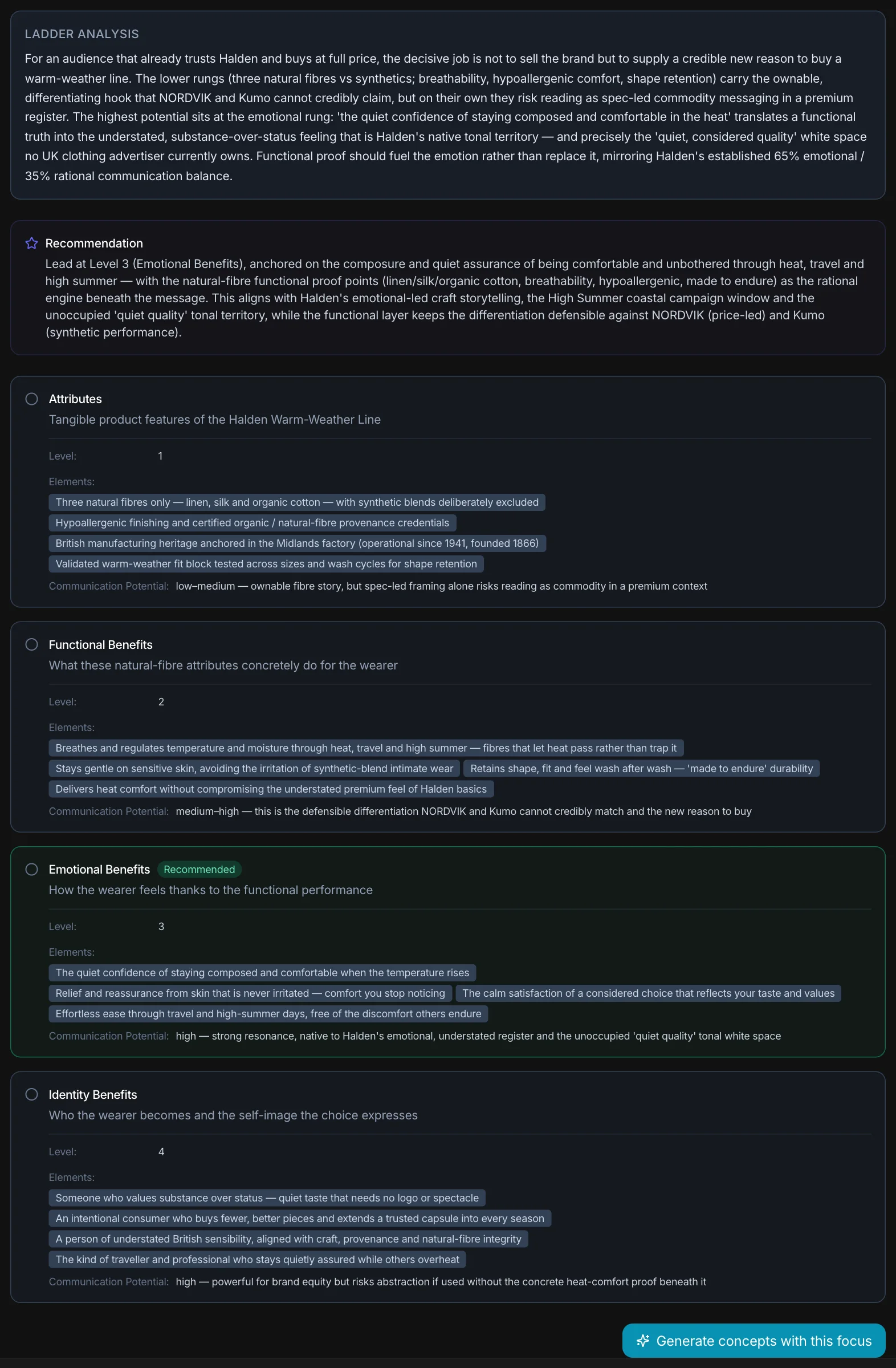
The means-end chain
The underlying idea is that people don’t choose a product for its features, but for what those features mean to them. Every attribute is a means that leads to consequences, and the consequences lead to personal values. The original research distinguishes three levels — attributes, consequences, values —; in communication practice a four-rung ladder is often used.
- Attribute — the tangible feature: the construction, the ingredient, the material.
- Functional benefit — what it does for the user: lasts longer, fits better, saves time.
- Emotional benefit — how it makes you feel: confident, proud, at ease.
- Identity benefit — who you become, what you say about yourself: the established professional, the caring parent.
When to use it
When communication is stuck on product features and every competitor says the same things; when you need to understand why the customer really chooses; when you want to see which rung competitors speak from and where there is room.
How to do it
1. Start from the attributes that matter
Not every feature: the ones customers notice and use to choose. Interviews, reviews and product comparisons tell you which they are.
2. Climb by asking “why does that matter?”
It’s the typical laddering interview question: why does this attribute matter to you? And why does that benefit matter? Each answer is one rung higher. The same logic as the 5 Whys, used to understand a motivation instead of a cause.
3. Draw the ladder, and place the competitors
For each rung, write the brand’s concrete elements and mark where competitors communicate. Often the whole category sits on attributes, or entirely on a generic emotion: the free rung is right there.
4. Choose the rung, and keep the anchor
The higher you climb, the greater the differentiation — and the risk that the message becomes abstract. A good identity message always has a functional anchor: a concrete attribute or benefit that makes it believable.
The most common mistakes
- Skipping rungs. An identity message without a concrete benefit beneath it sounds like a slogan.
- Writing the ladder at your desk. The real rungs come from customers’ words, not the brand’s.
- Always climbing to the top. Identity isn’t always the right rung: in some categories a clear functional benefit is worth more.
- Ignoring competitors. The right rung is the open one, not the highest one.