The job, not the product
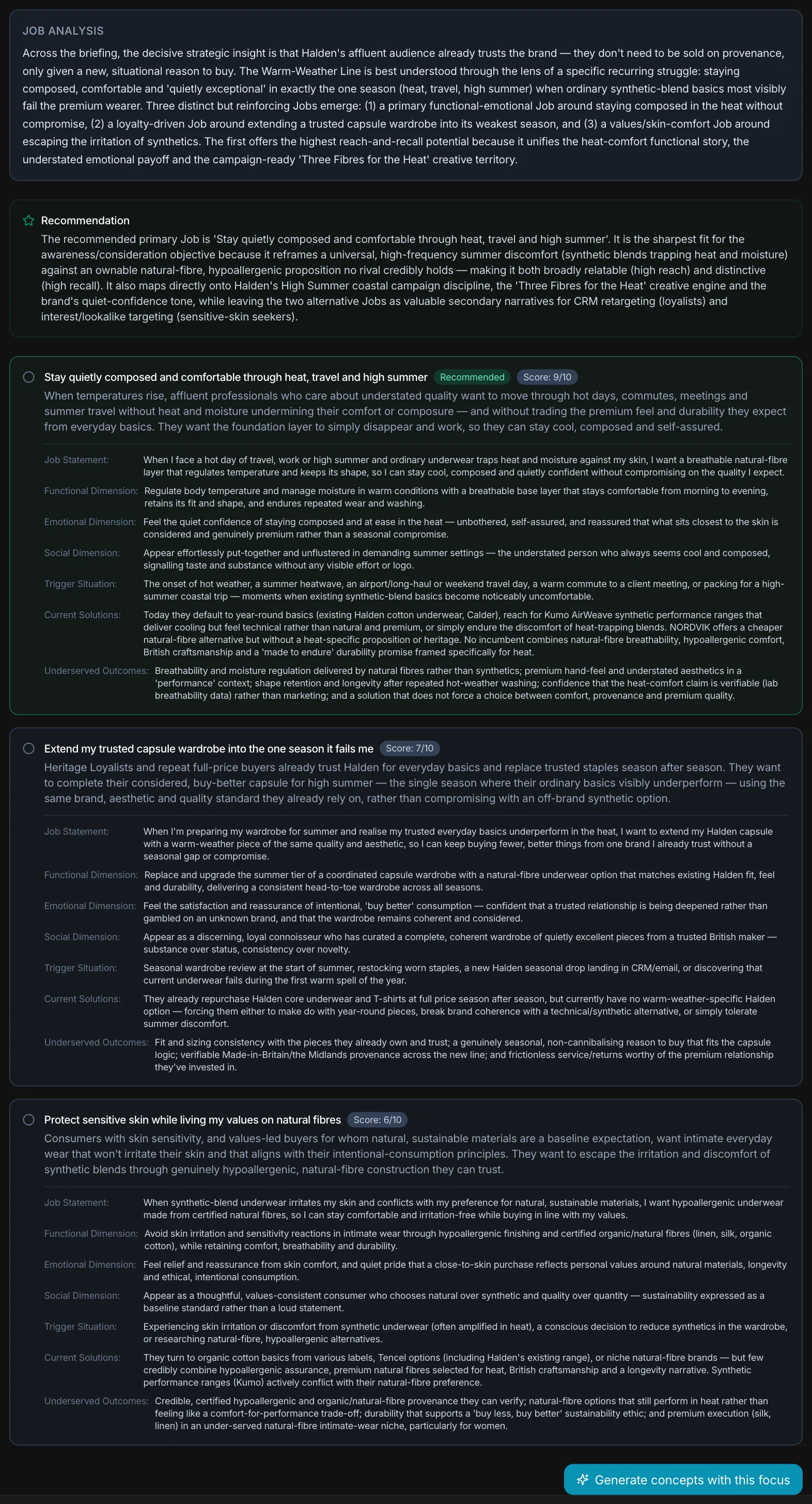
Nobody buys a suit: they buy a successful first day in a new role. The job always has three dimensions: functional (being appropriately dressed), emotional (feeling confident), social (being seen as up to the task). And it always has a context: it happens at a precise moment, for a precise reason.
JTBD is also used to design the offer — it is one of the pillars of the Value Proposition Canvas, in the customer jobs column. Here we use it for something else: finding campaign ideas.
When to use it
- When you want to communicate the value buyers perceive, not a list of features.
- When there are specific moments that trigger the purchase, and you want to be there.
- In B2B, where the job is the decision-maker’s: securing supply, fulfilling orders, protecting margin.
How to do it
1. Write the job statement
One sentence: “when [situation], I want to [motivation], so I can [expected outcome]”. “When I get a promotion, I want to show up in my new role looking the part, so I can be taken seriously from day one.”
2. Look at how the job gets done today
Which solutions the customer uses now — even outside your category — and what is left uncovered. Unmet needs are the campaign’s territory.
3. Choose the way in
The same job can be told in three ways. Through the trigger: the campaign arrives when the job switches on — the promotion, the wedding, the new season. Through the transformation: the before and after. Through the emotional and social dimension: how the person doing the job wants to feel and be seen.
4. Write the campaign’s job story
Situation, motivation, expected outcome — and the sequence of touchpoints that stages them. A JTBD campaign is often planned around the moment of the trigger: where is the customer when the job switches on?
The most common mistakes
- Mistaking the product for the job. “Buying a jacket” is not a job; “making a good impression at the first meeting with a client” is.
- Jobs that are too broad. “Feeling good” fits any product and suggests no campaign.
- Forgetting the trigger. Without the moment that switches on the need, the campaign doesn’t know when and where to speak.
- Functional only. Many jobs are decided on the social and emotional dimension.