
MAPS Intelligence
Resources/Creative Methods
Creative Methods · 8 min read

Cross-industry thinking: borrowing ideas from other sectors

When the whole category talks the same way, the answer lies outside it: how to frame the problem, find distant industries that have solved it and transfer their logic.

Updated October 6, 2026 · MAPS editorial team
In brief

Cross-industry thinking looks for the solution to a communication (or product) problem in distant industries that have already solved it, and transfers their logic — not their form. It works when the whole category communicates the same way: if the answer isn’t inside the category, it pays to look outside.

Why it works

Every category develops its habits: the same colors, the same words, the same promises. If you only look at competitors, you end up looking like them. Another industry that has faced the same problem — making a complex product understandable, building trust, making something boring interesting — has often already found a solution that would seem new in your category.

The semiotic map tells you which codes the category has saturated; cross-industry thinking is one of the ways to find codes to borrow.

How to do it

1. Write down the problem, not the product

The starting point is a communication problem framed in the abstract: “every competitor uses the same technical language and customers can’t tell the difference”. If you start from the product (“sell more kibble”), you will only find industries similar to yours.

2. Look for distant industries that have solved it

Who has had to make something complex understandable? Who has built trust through transparency? The more distant the industry, the more original the idea — but the more work it will take to transfer it.

3. Extract the logic

Not the campaign, but the mechanism that makes it work: a dashboard that makes performance visible, a document that tells the origin of every ingredient. Logic transfers; aesthetics usually don’t.

4. Transfer it: faithful or reinterpreted

Two routes. Faithful: you bring the logic over as it is. Reinterpreted: you adapt it creatively. Putting them side by side shows how much you need to copy and how much to invent.

5. Assess originality and feasibility

Every transfer needs weighing: how new it is in your category, how feasible it is, how well the audience will understand it without knowing the industry it came from.

An example. “Vellani”, pet food with a line of veterinary diets: every competitor speaks the same technical language. From luxury automotive: a nutritional performance dashboard. From science-based cosmetics: an ingredient passport. From sustainable fashion: an environmental footprint per serving. Three industries, three logics, each in a faithful and a reinterpreted version.

The most common mistakes

  • Copying the surface. Borrowing another industry’s aesthetics without its logic produces references, not solutions.
  • Industries that are too close. Taking ideas from the competitor in the adjacent industry isn’t cross-industry thinking.
  • Starting from the product. The problem framed in the abstract is what opens up the search.
  • Forgetting the audience. A brilliant transfer the customer doesn’t understand doesn’t work.
How MAPS does it

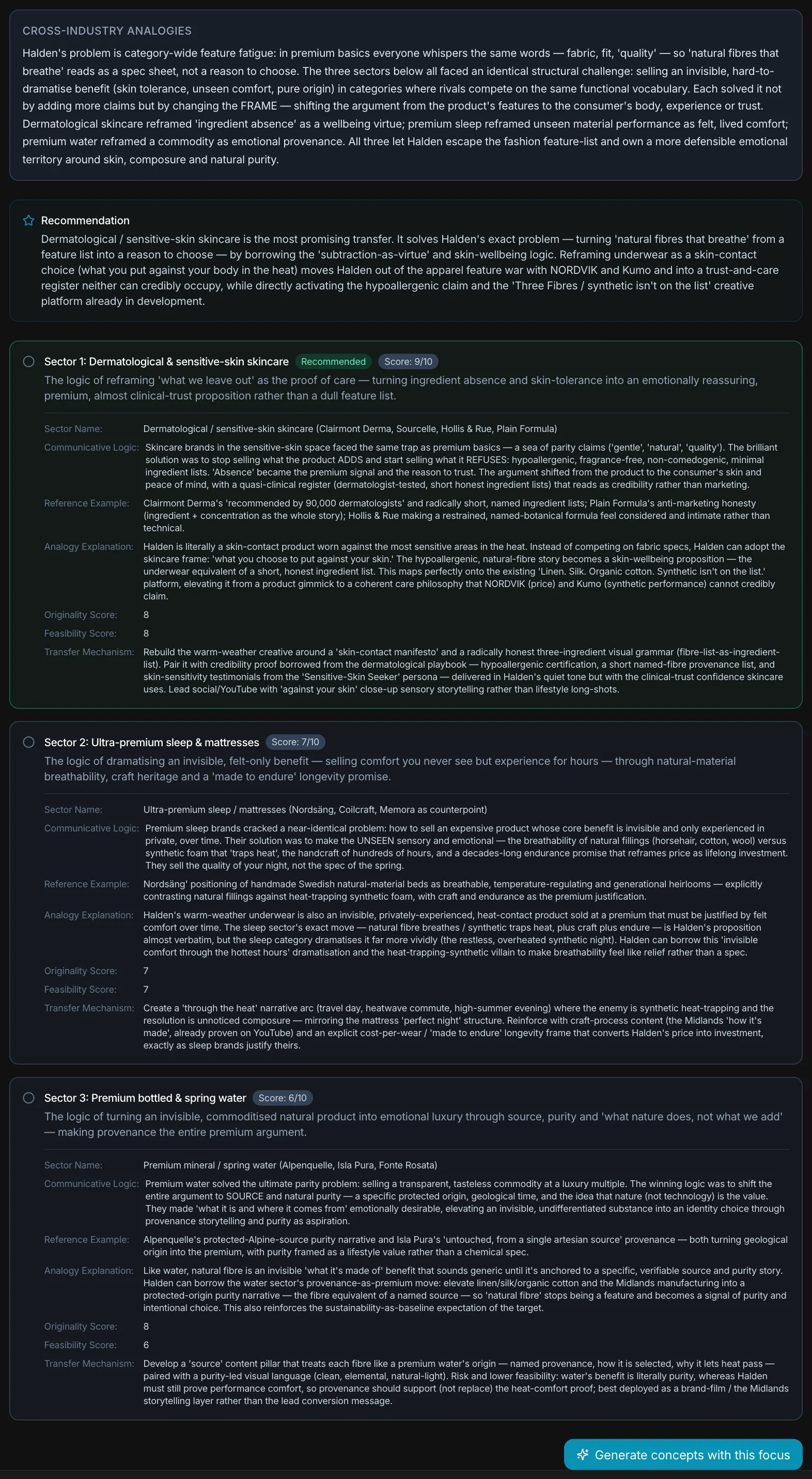
In MAPS, cross-industry thinking appears in two places. In the Idea Lab, Cross-Industry Transfer is one of the fifteen creative methods, in the “Connection” family along with forced analogy and biomimicry. In the Campaign Lab it is one of the eight methodologies: the brief asks for the specific communication problem, and the search for industries starts from there. The analysis finds three distant industries with their communication logic, why it can be transferred, how original it is and how feasible. For each industry, two concepts, one Faithful and one Reinterpreted; if you choose an industry other than the recommended one, the concepts give it more weight but still cover the others. In the Methodology tab, the development states the source industry, the original logic and what was changed.

Cross-industry analogies: three industries with communication logic, transferability, originality and feasibility

Frequently asked questions

What does cross-industry thinking mean?

Looking for solutions to a problem in industries other than your own that have already tackled it, and adapting their logic to your category.

How do you choose the industries to borrow ideas from?

By starting from the problem, not the product: you look for industries that have had to solve the same problem — explaining, building trust, engaging — and did it well.

Isn’t it just copying?

No, as long as you transfer the logic and not the form. A solution taken from another industry has to be adapted to your own audience, and often reinterpreted.

When is it worth using?

When every competitor communicates the same way, or when the category has a problem of trust, understanding or boredom that other industries have already tackled.

Written by the MAPS editorial team with the help of AI, checked and reviewed by the team.

Related articles
Creative Methods·8 min di lettura

SCAMPER: seven questions to transform an idea

Substitute, combine, adapt, modify, put to other uses, eliminate, reverse: how to use SCAMPER to spark new ideas from a product, service or campaign that already exists.

Read →
Strategic Tools·9 min di lettura

The semiotic square in marketing: what it is and how to use it

Greimas’s tool, brought into marketing by Floch: how to build it from an underlying tension, read the four positions and find the open spaces in a category.

Read →
Methodology·9 min di lettura

Competitive Intelligence: a method for gathering data that matters

From questions to decisions: how to plan, gather, verify and interpret information on competitors and the market — ethically, with sources and dates.

Read →