
MAPS Intelligence
Resources/Creative Methods
Creative Methods · 8 min read

SCAMPER: seven questions to transform an idea

Substitute, combine, adapt, modify, put to other uses, eliminate, reverse: how to use SCAMPER to spark new ideas from a product, service or campaign that already exists.

Updated October 6, 2026 · MAPS editorial team
In brief

SCAMPER is a creative technique that generates new ideas by starting from something that already exists — a product, a service, a campaign — and asking it seven questions, one per letter: Substitute, Combine, Adapt, Modify, Put to other uses, Eliminate, Reverse. It works because it turns “think of something new” into seven concrete exercises.

The seven lenses

  • S — Substitute. What could you swap for something else? A material, an ingredient, a channel, a spokesperson.
  • C — Combine. What could you bring together? Two products, two services, a product and an experience.
  • A — Adapt. What already exists elsewhere that you could borrow? An idea from another industry, from another era.
  • M — Modify. What could you magnify, shrink, accentuate, or change in shape or tone?
  • P — Put to other uses. In what other context, for what other audience, for what other purpose could it work?
  • E — Eliminate. What could you remove without losing value? A step, a feature, a cost.
  • R — Reverse. What happens if you flip the order, the roles, the point of view?

When to use it

SCAMPER works best when there is already something to work on: a product to refresh, a service to extend, a format that has worn thin. It works less well on a problem that is still vague: first figure out what you are looking for, with methods such as the 5 Whys or the Six Thinking Hats.

How to do it

1. Describe the object in one sentence

What you are transforming, for whom, with what goal. “A classic men’s jacket for people who work in the city” is a good starting point; “our product” is not.

2. One letter at a time

Go through the seven questions in order, without judging. The goal of this phase is quantity: even ideas that seem absurd are useful, because they often lead to the good ones.

3. Make every idea concrete

For each answer, write an example: what actually changes, how the customer would see it. “Combine with digital” is an intention; “the online configurator with a fitting in store” is an idea.

4. Choose and validate

Only at the end do you judge: value for the customer, feasibility, fit with the brand. The two or three best ideas should be developed and tested with the people who have to buy them.

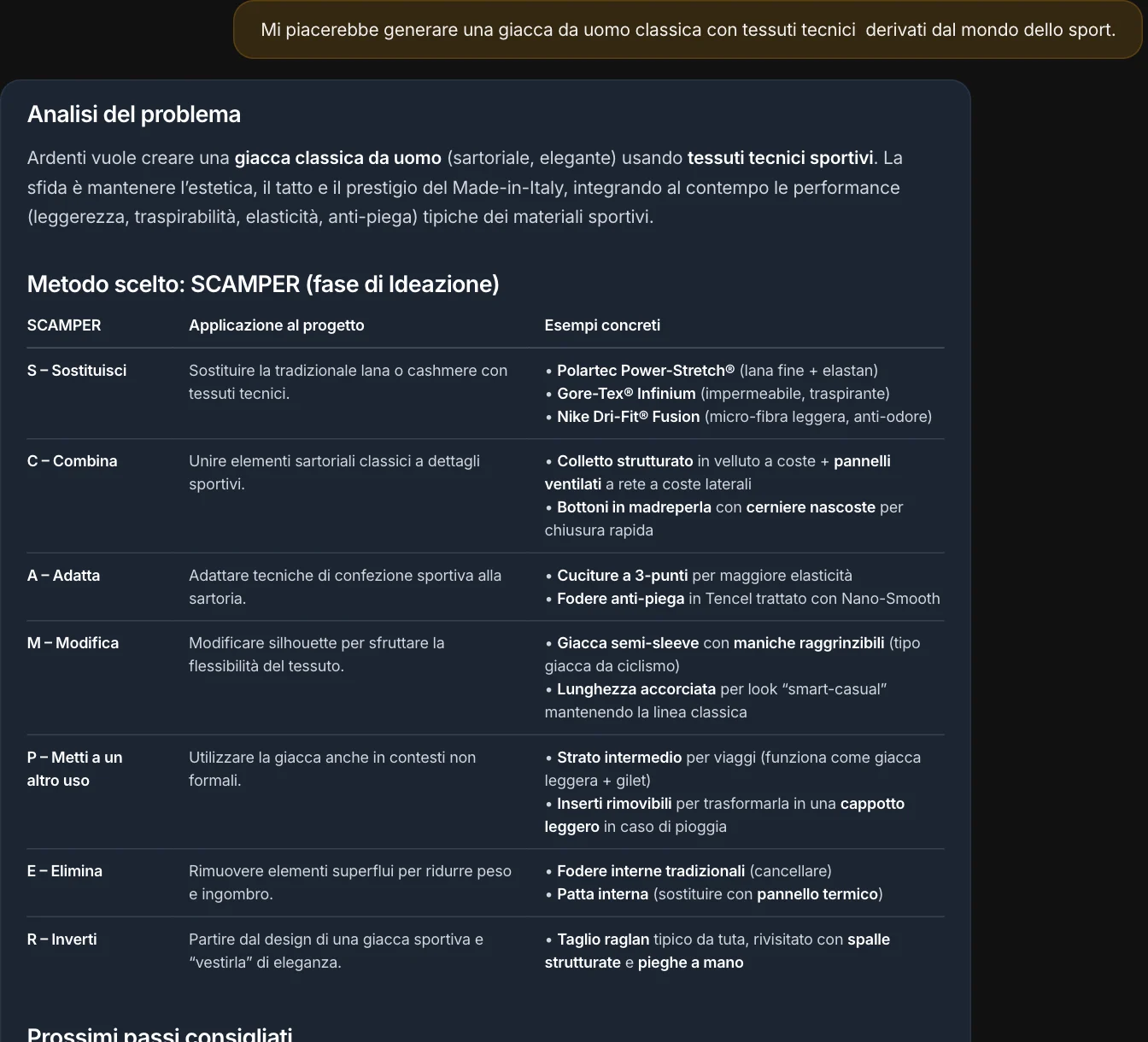
An example. A menswear tailoring brand, “Ardenti”, wants a classic jacket made with technical sports fabrics. Substitute: traditional wool with a technical fabric that looks like wool. Combine: the tailored cut with the stretch of running gear. Eliminate: the heavy lining. Put to other uses: the office jacket that also works for travel. Seven questions, about ten ideas, two to develop.

The most common mistakes

  • Judging too early. If every idea is shot down as it is born, the seven lenses produce only cautious variations.
  • Stopping at the easy letters. Substituting and modifying come naturally; reversing and eliminating are the ones that surprise.
  • Abstract ideas. Without a concrete example, nothing can be evaluated.
  • Forgetting the customer. A new idea is not necessarily a useful one: testing it with the audience is still essential.
How MAPS does it

In the MAPS Idea Lab, SCAMPER is one of the fifteen creative methods, in the “Divergence” family. You describe a problem (Problem Explorer) or bring an idea you have already sketched (Creativity Enhancer): the AI picks the method that suits the problem. When it picks SCAMPER, it applies it letter by letter, with concrete examples and next steps, using what the project knows as a springboard and without inventing market data. Under every answer you get four directions — Go deeper, Change angle, Toward a solution, Explore —; “Visualize” generates images of the idea, and “Develop” turns it into a card you can test with synthetic users. Developed ideas go into the Archive and can be found again in the chat.

The problem analysis and the SCAMPER method applied, with concrete examples

Frequently asked questions

What does SCAMPER stand for?

It is an English acronym: Substitute, Combine, Adapt, Modify, Put to other uses, Eliminate, Reverse.

Can you use it alone, or do you need a group?

It works both ways. A group produces more variety; on your own, what matters most is the discipline of going through all seven questions.

Does SCAMPER work for campaigns too, not just products?

Yes: you can apply it to a format, a channel, a message. For example, swapping the spokesperson, combining two channels, reversing who tells the story.

How long does a session take?

It depends on the object, but an hour or two is usually enough to go through the seven lenses and choose the ideas to develop.

Origin and references

Bob Eberle, SCAMPER: Games for Imagination Development, building on the question list of Alex F. Osborn, the inventor of brainstorming.

Written by the MAPS editorial team with the help of AI, checked and reviewed by the team.

Related articles
Creative Methods·8 min di lettura

Six Thinking Hats: one problem, six points of view

Facts, feelings, risks, benefits, new ideas and process control: how to use the Six Thinking Hats to discuss a problem without the loudest voice winning.

Read →
Creative Methods·8 min di lettura

Cross-industry thinking: borrowing ideas from other sectors

When the whole category talks the same way, the answer lies outside it: how to frame the problem, find distant industries that have solved it and transfer their logic.

Read →
AI & Marketing·9 min di lettura

Synthetic users: what they are and how to use them to test an idea

Simulated people built on a market’s data: what they can tell you, what they can’t, how to interview them without fooling yourself, and when you still need the real customer.

Read →