These aren’t Jung’s archetypes
Jungian archetypes — the Hero, the Sage, the Explorer and the rest — describe a brand’s personality, and are covered in the article on brand identity. Communication archetypes answer a different question: in this campaign, how does the brand speak, and to whom? The same brand can have a stable personality and use different communication archetypes for a launch, a repositioning, a corporate campaign.
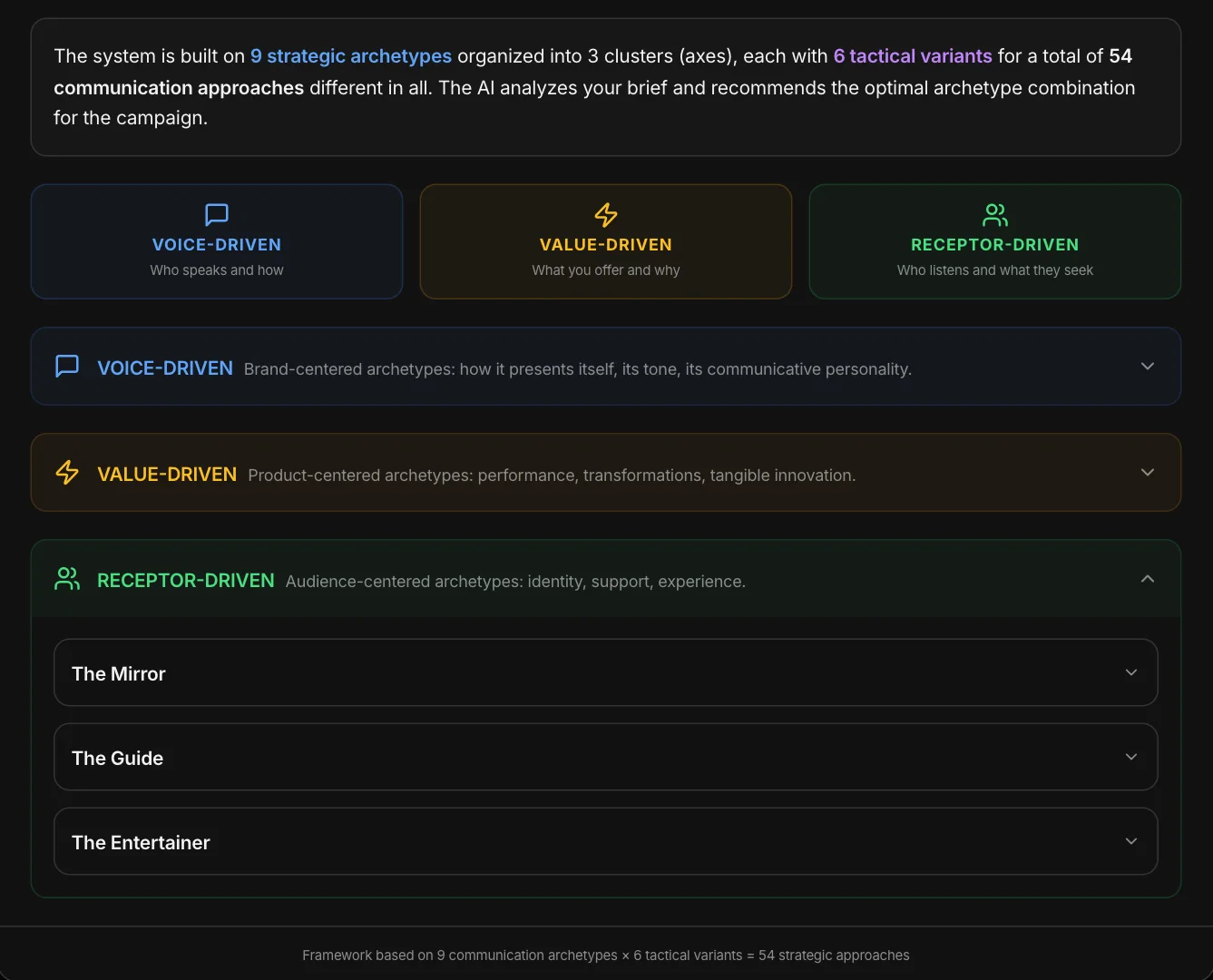
Three families, nine archetypes
Voice-driven — who speaks
- The Authority — the recognized expert: trust built on expertise, credentials, data.
- The Storyteller — stories that create connection: not a product, a meaning.
- The Provocateur — challenges the industry’s conventions and seeks out those who share the vision.
Value-driven — what is offered
- The Engineer — performance and numbers: superiority isn’t an opinion, it’s a fact.
- The Transformer — the before and after: who you were and who you can become.
- The Innovator — the novelty that changes the category’s rules.
Receptor-driven — who listens
- The Mirror — reflects the audience’s identity: not “buy me”, but “you’re one of us”.
- The Guide — the mentor who walks alongside, not the protagonist.
- The Entertainer — engages through memorable experiences.
Each archetype has six tactical variants, that is, concrete ways to put it into practice. The Engineer, for example, can speak through technical specification, scientific validation or comparative performance; the Storyteller through the origin story or behind the scenes.
How to build a mix
1. Start from the target and the competitors
What motivates the audience and what holds it back; which archetypes competitors already use, and where there is open space. If the whole category speaks as the Authority, a Storyteller stands out.
2. Assign the roles
A primary archetype that sets the tone; a secondary one that complements it; possibly a tertiary. The weights add up to one hundred: a 55/30/15 mix makes it clear who leads.
3. Choose the variants
For each archetype, the tactical variants that serve the objective. This is where the mix becomes operational: not “let’s speak as the Engineer”, but “let’s speak through comparative performance”.
4. Write down the why
Every weight needs a reason tied to the target or the competitors. A mix without a rationale is an aesthetic preference.
The most common mistakes
- Confusing them with brand personality. The communication archetype is chosen for the campaign; the personality stays.
- A single archetype. You almost always need a mix: speaking only as the Authority risks coldness, only as the Entertainer, lightness.
- Equal weights. A 33/33/33 mix doesn’t say who leads.
- Staying abstract. Without tactical variants, the archetype never becomes a message.