
MAPS Intelligence
Resources/Strategic Tools
Strategic Tools · 9 min read

Go-to-market: how to bring a product to market

The first segment to win, the ideal customer, the channels, demand generation and a phased launch with go/no-go criteria: the strategy for not launching blind.

Updated October 6, 2026 · MAPS editorial team
In brief

A go-to-market strategy (GTM) is the plan for bringing a product to market: the first segment to win, the ideal customer, how to enter the market, how to generate demand and how to sell. The best ones proceed in phases — preparation, pilot, scale — each with go/no-go criteria: the numbers to hit before moving on to the next.

When you need one

  • A new product in a market where you’re already present.
  • A new market for a product you already have: a country, a channel, a customer type.
  • A relaunch of a product that didn’t work or needs repositioning.

These are three different situations: in the first the risk is the product, in the second the market, in the third the memory the market has of you.

How to build it

1. The first segment

Not “everyone who might need it,” but the group to win first: the one with the strongest need, the easiest to reach, that can serve as a reference for the others.

2. The ideal customer

Within the segment, the profile worth going after first: who they are, what drives them, who decides, what holds them back. In B2B it’s a company with its own characteristics, and a buying committee.

3. Entry, demand, sales

How you enter the market (channels, partners, distribution), how you generate demand (content, advertising, word of mouth, events), how you sell (online, sales force, resellers). Every choice depends on price and customer: a product that costs a few euros can’t support a field sales team.

4. The phases, with go/no-go criteria

Preparation, pilot launch, scale. For each phase: objectives, activities, and the thresholds to hit to move forward. The pilot exists to learn cheaply: if the thresholds aren’t met, you fix things before spending the big budget.

5. Metrics and pivot signals

The success metrics and the signals that tell you to change course: a segment that doesn’t respond, an acquisition cost that’s too high, a channel that doesn’t convert.

An example. “Orto Alto,” a fictional startup making vertical gardens for restaurants, picks as its first segment plant-based restaurants in the two largest cities in its region. Pilot: ten restaurants in three months. Go criterion: at least seven renew after the trial period. If renewals fall short of the threshold, before scaling it reworks the maintenance service, the reason most often cited by those who don’t renew.

The most common mistakes

  • Launching to everyone. The budget gets spread thin and no segment is truly won.
  • No pilot phase. You find out what doesn’t work after the budget is already spent.
  • Go/no-go criteria decided afterward. Every result becomes a green light.
  • A channel at odds with the price. The cost of selling eats the margin.
How MAPS does it

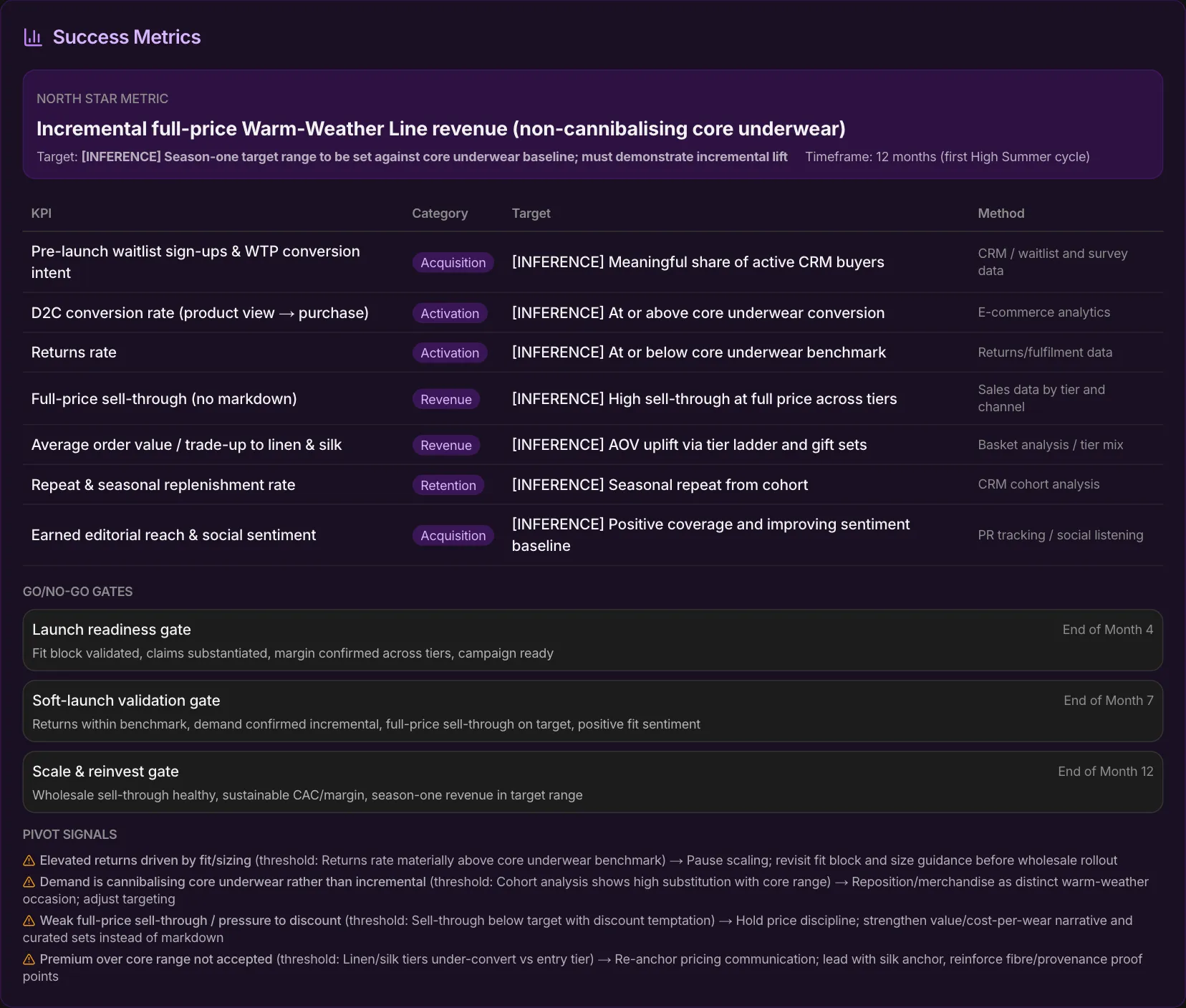
In MAPS, the GTM Strategy Canvas is the fourth step of “From Idea to Campaign,” and it opens pre-filled with what the concept, the feature matrix and the price produced. You state what kind of launch it is — a new product, a new market, a relaunch —, how it sells, over how many months, with what budget. MAPS builds the first segment to win, the ideal customer, market entry, demand generation, sales. And the phases — preparation, pilot launch, scale — each with objectives, activities and go/no-go criteria; then success metrics, thresholds and pivot signals. In B2B the customer is a company; for a startup the launch starts from the first customers. Like every tool on the path, it can be tested with synthetic users.

Success metrics, go/no-go thresholds, pivot signals

Frequently asked questions

What does a go-to-market strategy include?

The segment to win first, the ideal customer, entry channels, demand generation, the sales model, the launch phases and the metrics for deciding whether to move forward.

What are go/no-go criteria?

Measurable thresholds, set in advance, that a launch phase must hit before you move to the next one. If they aren’t met, you fix things instead of scaling.

What’s the difference between a go-to-market and a marketing plan?

A go-to-market covers launching a product or entering a market, and includes sales and distribution; a marketing plan usually covers a period and all of the company’s marketing activities.

Written by the MAPS editorial team with the help of AI, checked and reviewed by the team.

Related articles
Strategic Tools·10 min di lettura

Pricing strategy: how to decide what to charge

Costs, perceived value, competitors and objective: the methods for setting price, the architecture of offer tiers, the break-even point and what to do if a competitor responds.

Read →
Strategic Tools·9 min di lettura

Planning a marketing campaign: the plan, step by step

Objective, audience, message, channels, budget, KPIs, creative brief and timeline: how to write a campaign plan that the creative team and the media team can actually use.

Read →
Methodology·10 min di lettura

Strategic validation: putting an idea to the test before you invest

Find the riskiest assumptions, choose the right test, decide up front what counts as evidence: a method for failing small instead of failing big.

Read →