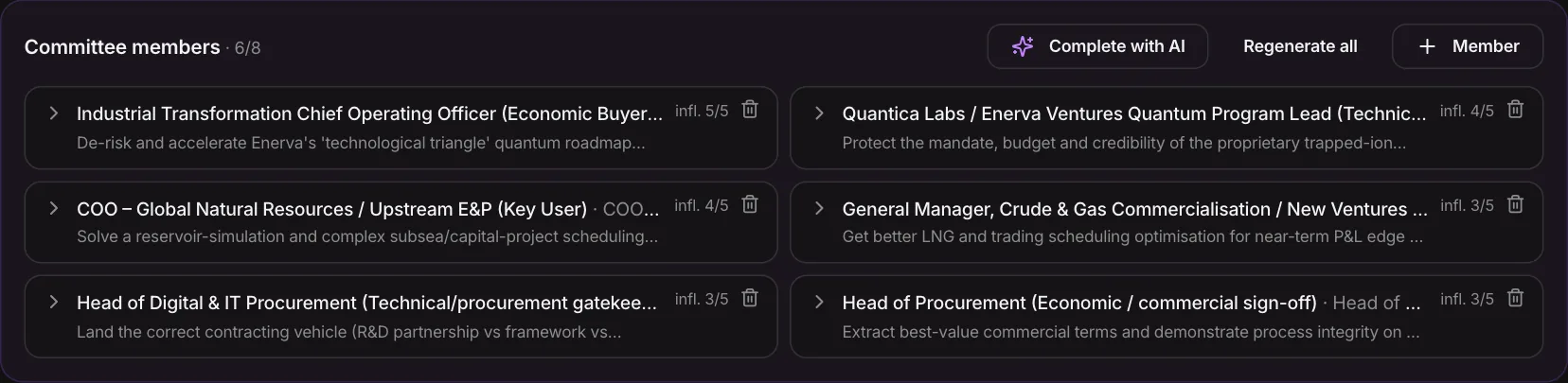
Who’s usually in it
- Who decides on budget — the CEO, the general manager or the CFO.
- Who evaluates — the technical side, quality, security, IT.
- Who uses — the people who will work with the product every day.
- Procurement — terms, pricing, alternatives, supplier risk.
- Who can block — even without deciding: a legal department, a manager who fears change.
How to prepare
1. Map the people and their weight
For each one: role, influence on the decision, what they want to achieve for the company and for themselves, what they fear. See the account map.
2. Look for the conflicts
Procurement wants price, quality wants zero risk, users want simplicity. The proposal has to hold together goals that contradict each other.
3. Uncover what they don’t say
Every member has information they won’t share unless you ask the right way: an incumbent supplier they have a relationship with, a budget constraint, a red line. The right questions — for example with SPIN — are how you bring it to the surface.
4. Cover every role
A deal with a single contact is fragile. You need a path for every role, and ideally an internal ally.
5. Rehearse the meeting
Rehearse the meeting — who speaks, what they ask, where consensus stalls — before you walk into the room, and review afterward what worked and what didn’t.
The most common mistakes
- Selling only to the champion. Their enthusiasm doesn’t convince the others.
- Ignoring who can block. They’re often not in the meeting, but they decide the outcome.
- A proposal for one role only. The CFO doesn’t read technical specs.