
MAPS Intelligence
Resources/B2B Sales
B2B Sales · 8 min read

Strategic Selling and the account map: who influences the decision

Economic buyer, technical buyer, user buyer, coach: how to map influence inside an account, what each person wants for the company and for themselves, and where you’re exposed.

Updated October 6, 2026 · MAPS editorial team
In brief

Strategic Selling is a method for complex sales that starts from one question: who influences the decision, and what does each person want? It distinguishes the roles — economic buyer, technical buyer, user buyer, coach — and for each one, the result they seek for the company and their personal win. The account map puts it all on one page and shows where you’re exposed.

The buying influences

  • Economic buyer — gives final approval and controls the budget. Looks at return and risk.
  • Technical buyer — checks that the solution meets the requirements. Can say no, rarely can say yes alone.
  • User buyer — will work with the solution. Judges the impact on their own work.
  • Coach — guides you inside the organization: who matters, what carries weight, how to move.

Results and personal wins

Every person seeks a result for the company — fewer defects, lower costs — and a personal win: being seen as the one who solved the problem, avoiding a risk, making their job easier. A proposal that delivers both has a much better chance.

How to build the account map

  • List the people involved and their buying-influence role.
  • For each one: result for the company, personal win, attitude toward you.
  • Assess how well each role is covered: who you know, who knows you, who you’ve never met.
  • Flag the red flags: no coach, an economic buyer you’ve never met, a hostile role.
  • Write the coverage plan: whom to meet, with what message, through whom.

The most common mistakes

  • Confusing your contact with the decision-maker.
  • Not having a coach. Without one, you’re moving in the dark.
  • Talking only about business results. People also decide for themselves.
How MAPS does it

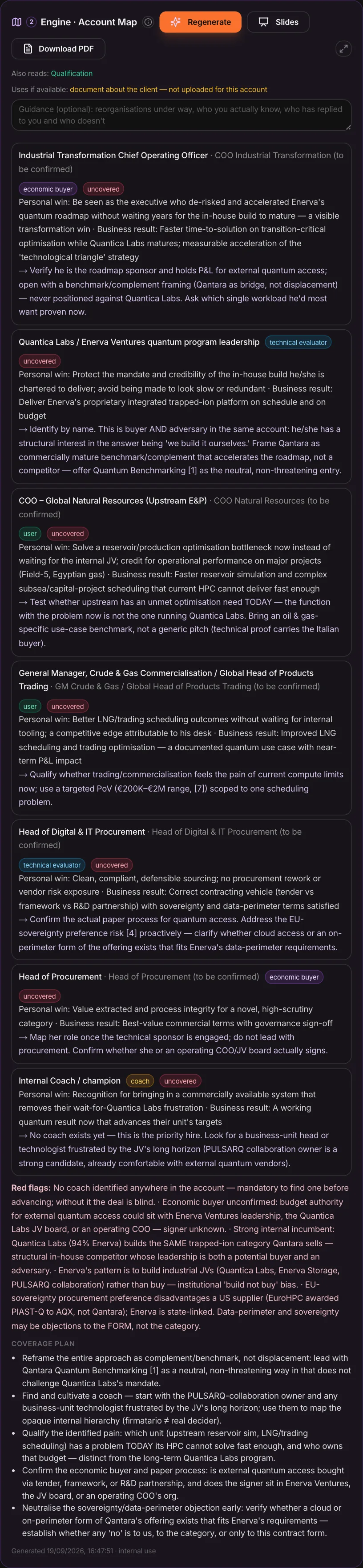
In MAPS’s ABM & Sales Studio the Account Map engine, based on Strategic Selling, maps who decides and who influences: for each role the type of influence, the personal win and the business result, how well it’s covered and how to cover it, plus the red flags — for example “no internal coach identified” — and the coverage plan. Decision-makers come from research on public profiles, with the source: they are hypotheses to verify before any contact.

The Account Map in MAPS: influence by role, personal win and business result, coverage, red flags

Frequently asked questions

What’s the difference between an account map and an org chart?

An org chart shows positions. An account map shows influence on the decision, what each person wants and how well you know them: it can give weight to people who sit low on the org chart.

Who is the coach?

A person — often inside the account — who has a stake in your success and helps you understand how the decision works. Not necessarily the decision-maker.

What are personal wins?

The benefits a person gets for themselves from the decision: recognition, less risk, less work, career growth.

Origin and references

Robert B. Miller and Stephen E. Heiman, Strategic Selling (1985).

Written by the MAPS editorial team with the help of AI, checked and reviewed by the team.

Related articles
B2B Sales·8 min di lettura

The B2B buying committee: who really decides, and how to prepare

In complex sales, a group decides, not a person. How to map roles, goals and resistance, and how to rehearse the meeting before you walk into the room.

Read →
B2B Sales·8 min di lettura

MEDDIC and MEDDPICC: how to qualify a B2B deal

Metrics, economic buyer, criteria, process, pain, champion — and in the extended version, paper process and competition: how to use the method without inflating the pipeline.

Read →
B2B Sales·9 min di lettura

Account-based marketing (ABM): what it is and how to do it

Treating a client company as a market of one: how to choose accounts, decide the level of personalization (1:1, 1:few, 1:many) and align marketing and sales.

Read →