
MAPS Intelligence
Resources/B2B Sales
B2B Sales · 8 min read

MEDDIC and MEDDPICC: how to qualify a B2B deal

Metrics, economic buyer, criteria, process, pain, champion — and in the extended version, paper process and competition: how to use the method without inflating the pipeline.

Updated October 6, 2026 · MAPS editorial team
In brief

MEDDIC is a method for qualifying a B2B deal: it checks six elements — Metrics, Economic buyer, Decision criteria, Decision process, Identify pain, Champion. MEDDPICC adds Paper process and Competition. It helps you see what you know, what’s missing and whether the deal is worth investing in.

The elements

  • Metrics — the measurable outcome the customer wants to achieve.
  • Economic buyer — who has the final say on budget.
  • Decision criteria — what the offers will be compared on.
  • Decision process — who decides, in what order, on what timeline.
  • Pain — the problem that makes the purchase necessary, and what it costs.
  • Champion — the internal person who wants your solution and has the influence to back it.
  • Paper process (MEDDPICC) — contracts, legal, procurement, signatures: what it takes to get to the order.
  • Competition (MEDDPICC) — who you’re up against, including “do nothing.”

How to use it

For each element ask yourself: what do I know for certain, what am I assuming, what do I not know. The gaps aren’t a failure: they’re the questions to ask, and whom to ask. A deal with many gaps isn’t lost, but it isn’t qualified yet: investing a lot of time in it is a risk.

An example. A component manufacturer wants to get in as a second supplier to a distributor. It knows the pain (defects in the private-label products), assumes the metrics (returns and complaints), and doesn’t know who the economic buyer is or what the approval process looks like. The honest verdict: keep qualifying before preparing an offer.

The most common mistakes

  • Filling it in to pad the pipeline. An optimistic MEDDIC is worse than no MEDDIC.
  • Mistaking an enthusiastic contact for a champion. A champion has influence, not just goodwill.
  • Ignoring the paper process. Many “closed” deals stall in procurement or legal.
  • Forgetting the status quo among the competitors.
How MAPS does it

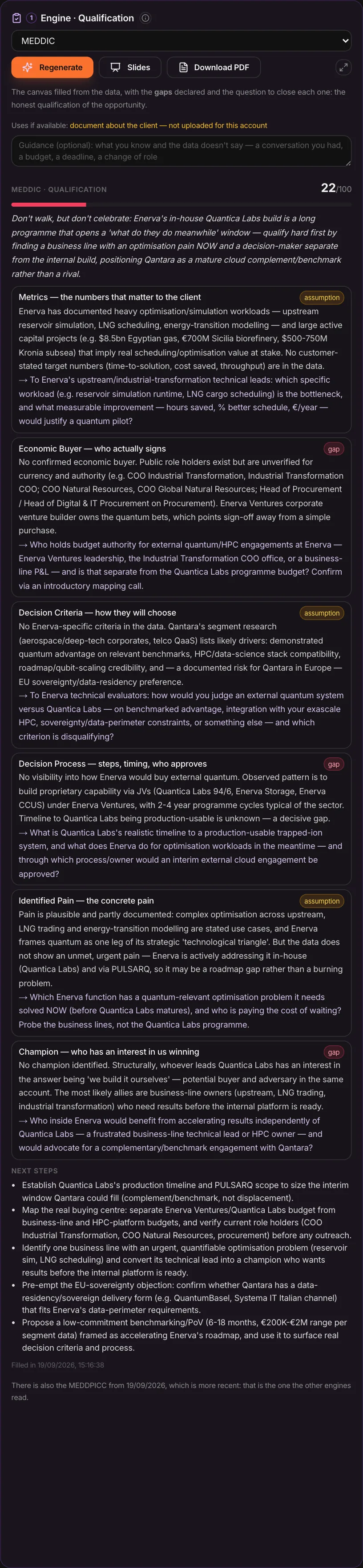
In MAPS’s ABM & Sales Studio the Qualification engine fills in the MEDDIC or MEDDPICC canvas from project data, account research and your materials: for each field, what is known, with the confidence level — known, assumption or gap — and for each gap the question to ask and whom to ask. Then a score and an honest verdict: the engine doesn’t inflate the deal, it tells you what’s missing before you invest. The gap questions can be taken into the simulated buying committee.

MEDDPICC qualification in MAPS: score, verdict, fields with confidence level and questions on the gaps

Frequently asked questions

What’s the difference between MEDDIC and MEDDPICC?

MEDDPICC adds two elements: the paper process (contracts, approvals, signatures) and competition. It’s useful in longer, more structured sales.

Does MEDDIC replace BANT?

BANT (budget, authority, need, timing) is a quicker check for the early stages. MEDDIC goes deeper and is designed for complex sales with multiple decision-makers.

When do you use it?

Throughout the deal: at the start to decide whether to invest, then to update what you know and what’s missing before every major step.

Who is the champion?

A person inside the customer organization who wants your solution, has influence and access to the decision-makers, and helps you navigate the organization.

Origin and references

MEDDIC originated in the mid-1990s in the sales team at PTC (Parametric Technology Corporation), with Jack Napoli and Dick Dunkel; MEDDPICC is its later extension.

Written by the MAPS editorial team with the help of AI, checked and reviewed by the team.

Related articles
B2B Sales·8 min di lettura

Strategic Selling and the account map: who influences the decision

Economic buyer, technical buyer, user buyer, coach: how to map influence inside an account, what each person wants for the company and for themselves, and where you’re exposed.

Read →
B2B Sales·7 min di lettura

Mutual Action Plan: the shared plan all the way to signature

The milestones to a decision, with an owner on both sides: how to build an action plan with the customer, and why it shortens deals.

Read →
B2B Sales·8 min di lettura

SPIN Selling: the questions that move a complex sale forward

Situation, Problem, Implication, Need-payoff: the method born from observing thousands of sales calls, and how to prepare the questions for each role.

Read →