A real account,
or a pool to explore.
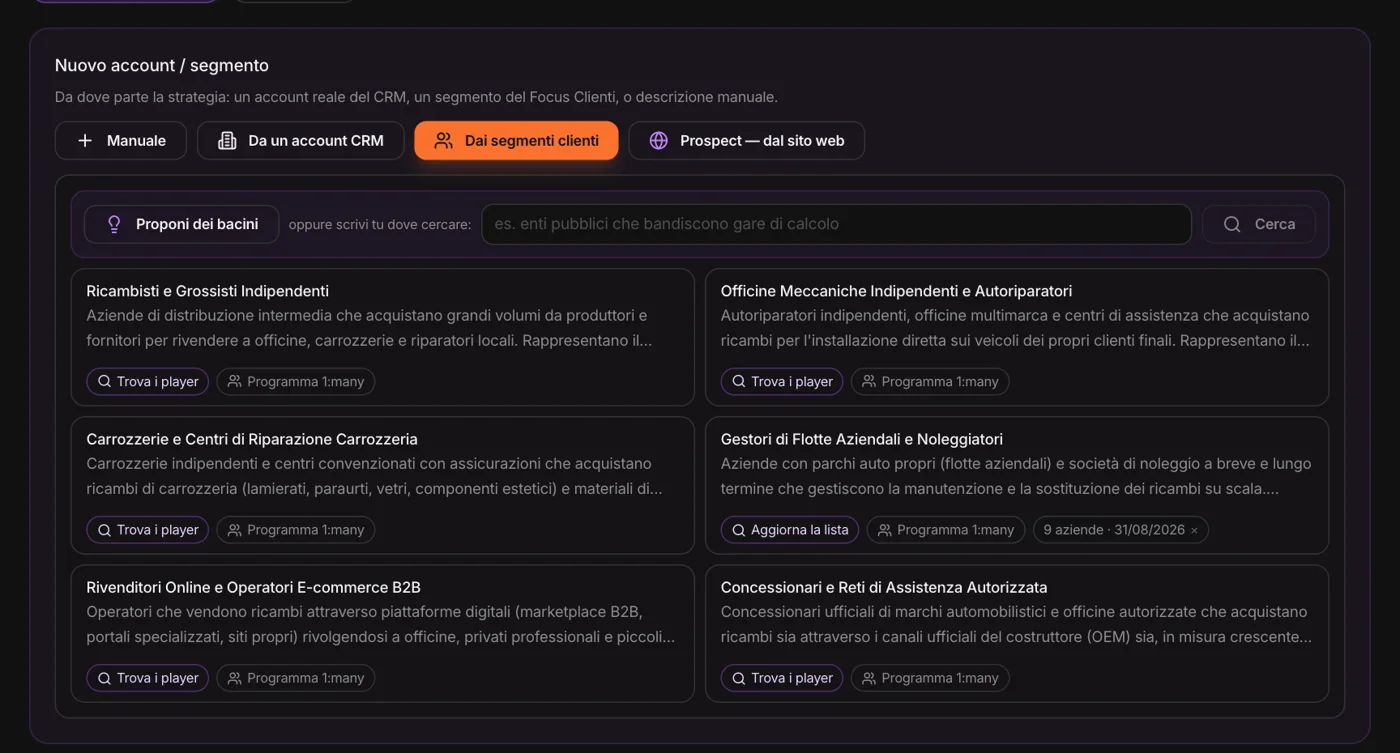
A CRM account brings its status, historical value, open pipeline, win rate, reasons for lost deals and the decision-makers involved. A Customer Focus segment becomes a 1:many program. A prospect’s website is enough to start from scratch. Or you start from the Buying Committee (“Develop in the Studio”) or from the Portfolio.
Don’t know where to look? Propose pools: MAPS suggests customer pools from the project context. On each one, Find the players searches for real companies — first in the project data, then on the web — and saves the list: one click on a company brings it into the studio and starts the research.
Who they are,
and who decides.
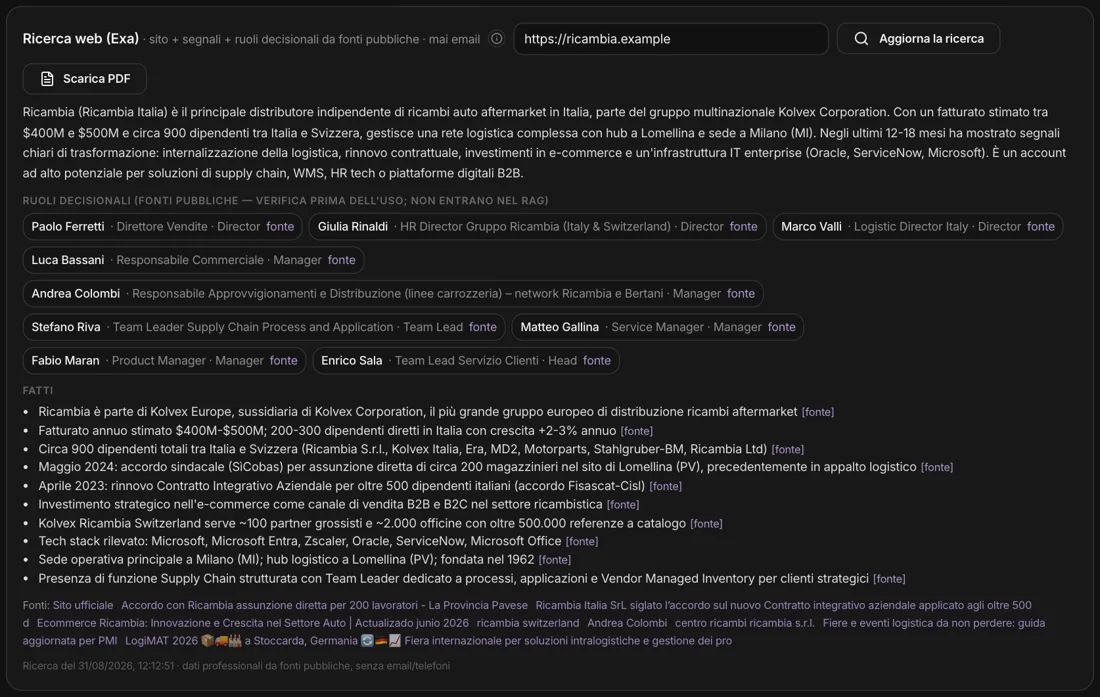
MAPS reads several pages of the company’s website; from the web it takes news and signals, and the decision-makers from public profiles, with their role and the source. Every fact has its source. Never emails, never phone numbers: the names are hypotheses to verify before any contact.
The research fills only the account’s empty fields: what you wrote stays. It refreshes in one click and exports to PDF.
What you sell,
to whom, and with which materials.
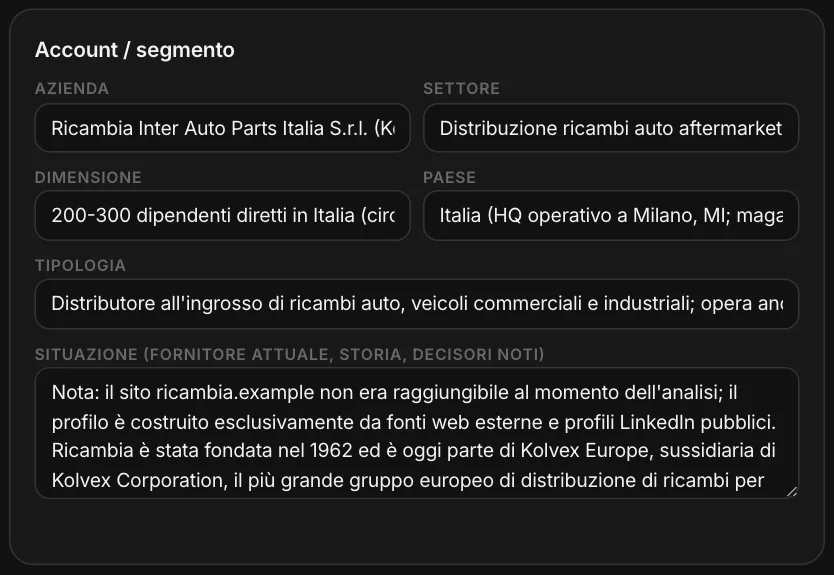
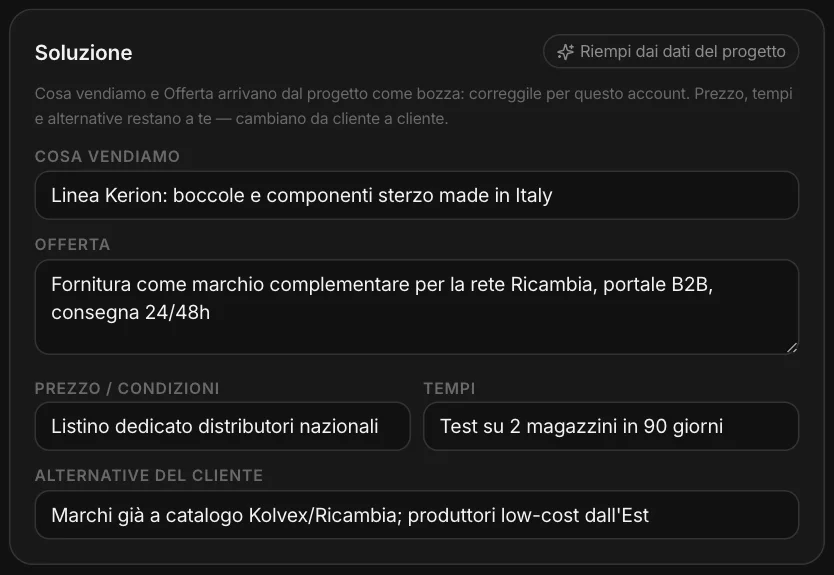
Two tabs: the account — sector, size, country, situation — and the solution: what you sell, the offer, price and terms, timing, the customer’s alternatives. “Fill from project data” completes it from the value proposition.
In Materials you upload what you have: presentations, price lists, competitor sheets, the customer’s buying process, account documents. Each type is read by the engines that need it: the numbers by the Business Case, the competitors by the Battlecard, the process by the Mutual Action Plan.

Each method is an engine.
And the engines talk to each other.
Each engine works on the account with the project data, the research, the country’s cultural profile and the materials. And it reads the conclusions of the others: the Challenge starts from the qualification and the Account Map, the Business Case from the Challenge, the Mutual Action Plan from the qualification, the map and the business case. Each card says what it reads, has an ⓘ explaining the method, regenerates with your guidance, and becomes slides or a PDF.
ABM/ABX plan
Tier, messages for each decision-maker, content and sequence.
Qualification
MEDDIC or MEDDPICC: what we know, what’s missing.
Account Map
Who decides, who influences, who’s missing.
Challenge
The insight that changes the conversation.
Business Case
The value in numbers, with the assumptions stated.
Battlecard
Who you’re up against, and how to respond.
SPIN question set
The questions for each role, in the right order.
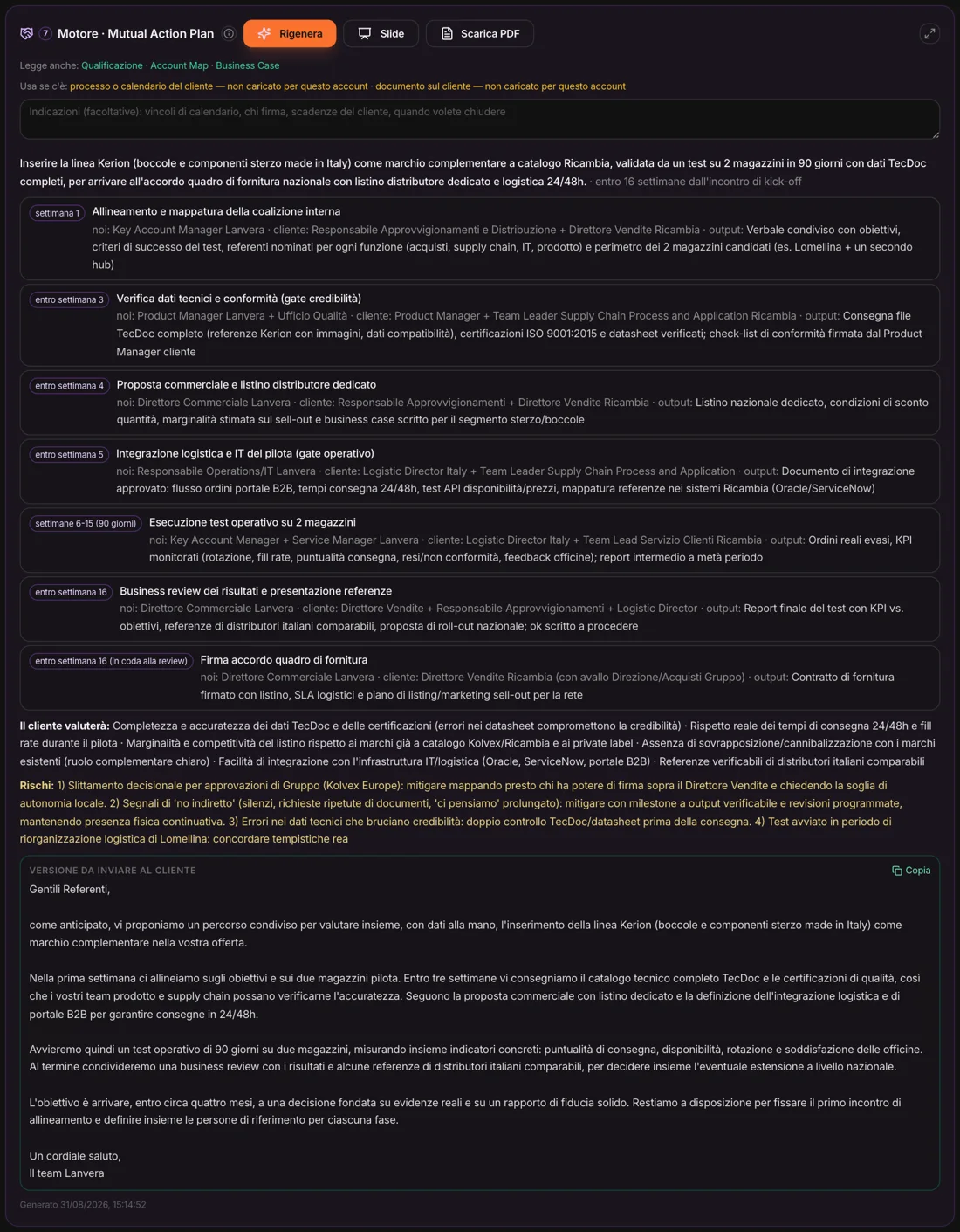
Mutual Action Plan
The shared plan all the way to signature.
The plan for the account,
from message to content.
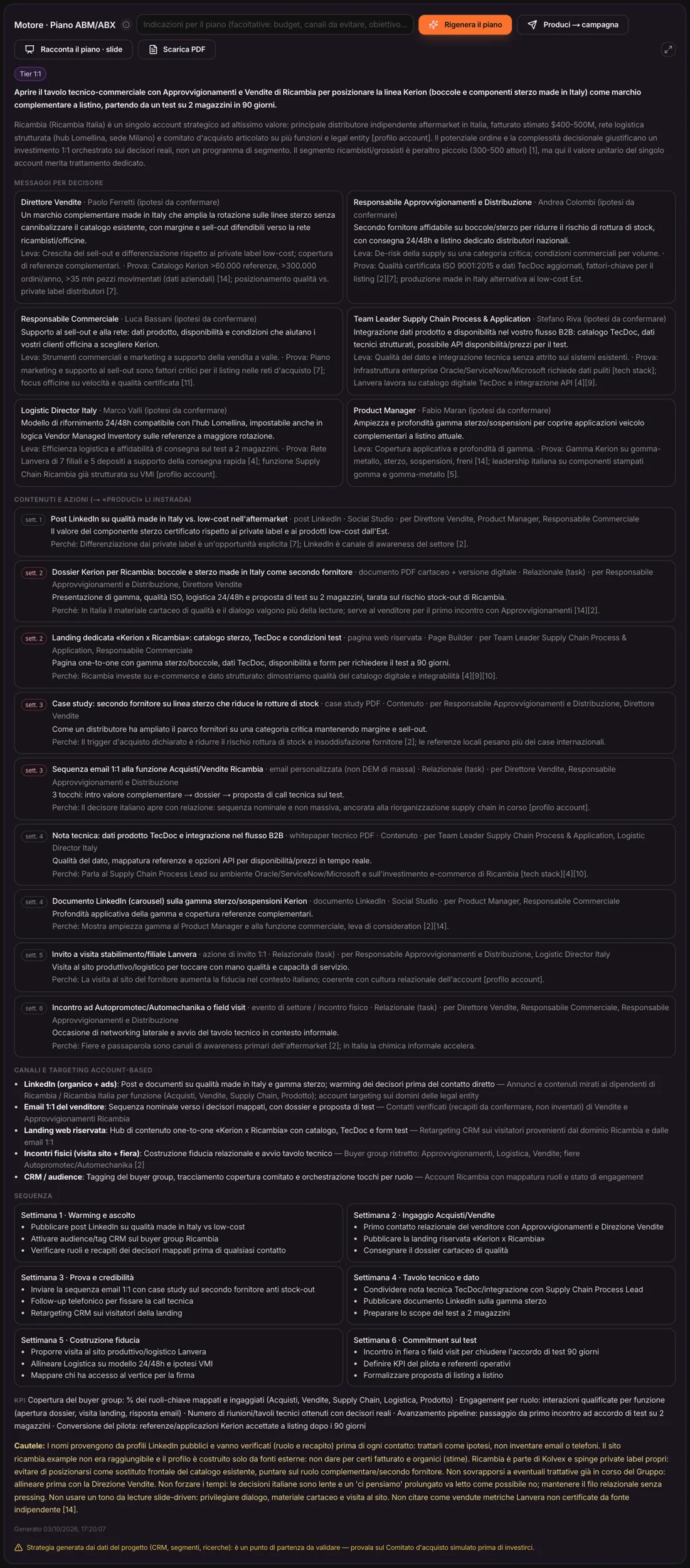
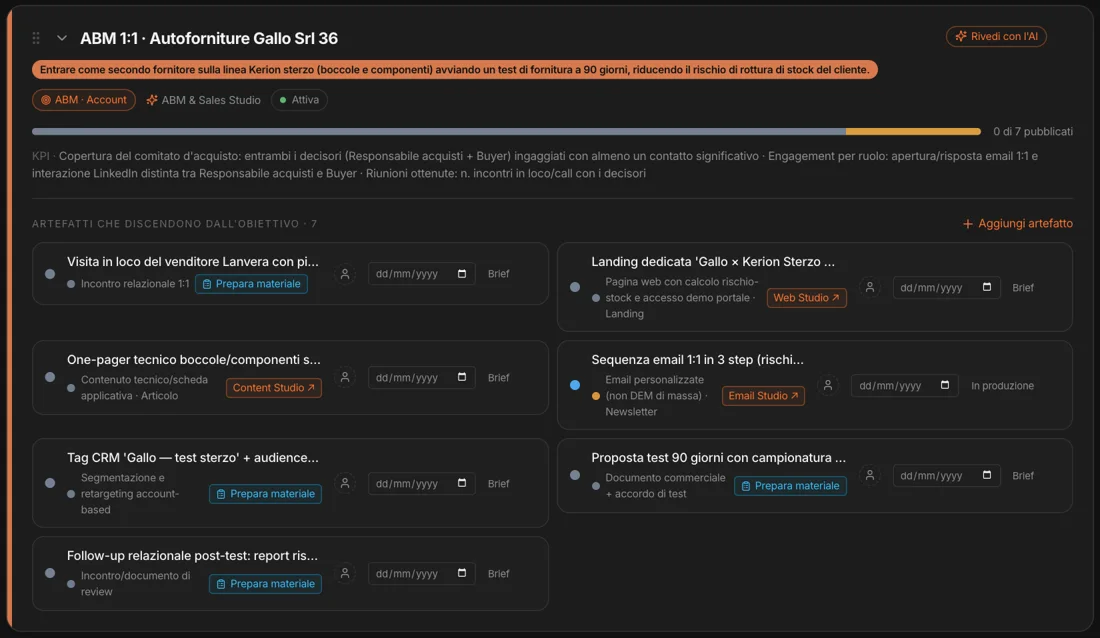
The engine chooses the tier — 1:1, 1:few, 1:many — and explains why. Then it writes a message for each decision-maker, with the lever and the proof; the content to produce, each piece with format, channel, week and reason; the channels with account-level targeting, the week-by-week sequence, the KPIs and the caveats.
Here: tier 1:1, a supply trial at two warehouses in 90 days, six decision-makers with their message, nine pieces of content — from a LinkedIn post to a plant visit.
Qualification
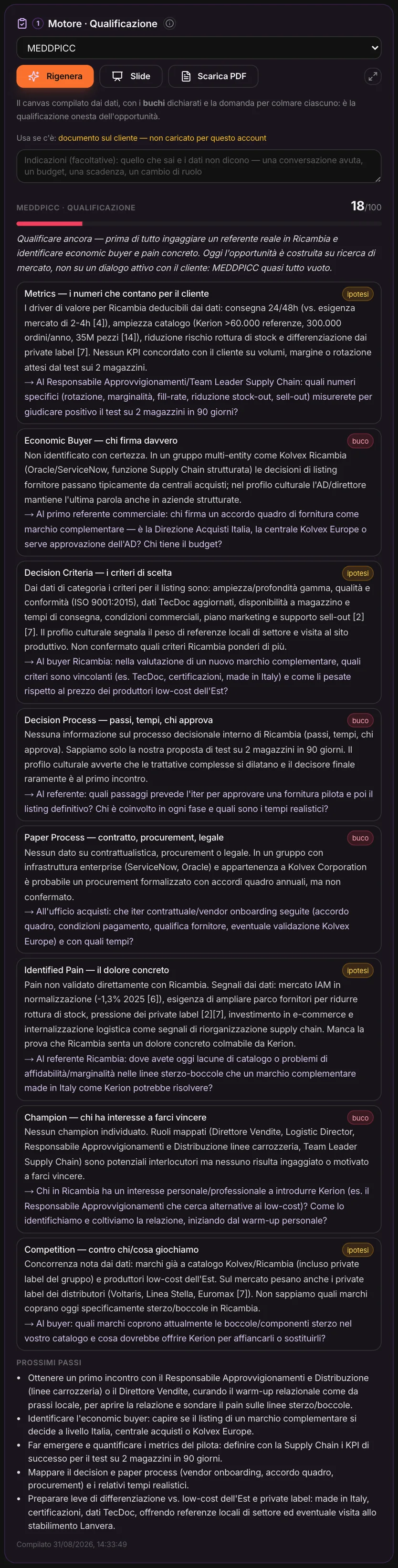
The qualification canvas filled in from the data: for each field, what we know, with the confidence — known, hypothesis or gap — and for each gap the question to ask and whom to ask. A score and an honest verdict.
Here MEDDPICC, 18 out of 100: “keep qualifying”. The engine doesn’t inflate the deal: it says what’s missing before you invest.
Account Map
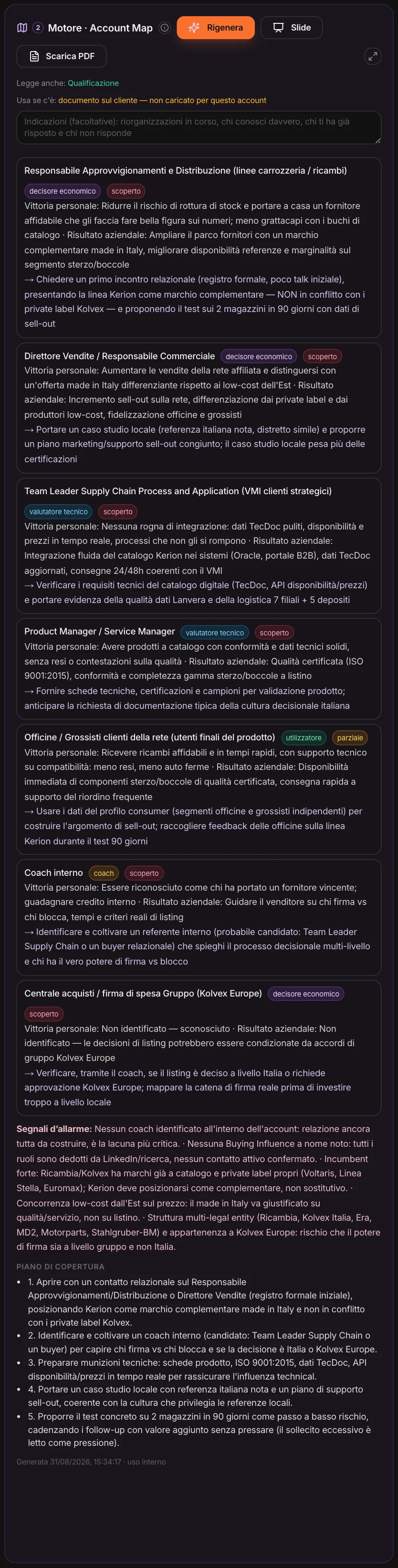
Who decides and who influences: for each role, the type of influence — economic buyer, technical evaluator, user, coach —, the personal win and the business result they’re after, how well covered they are, and how to cover them.
Plus the red flags — here: no internal coach identified — and the coverage plan.
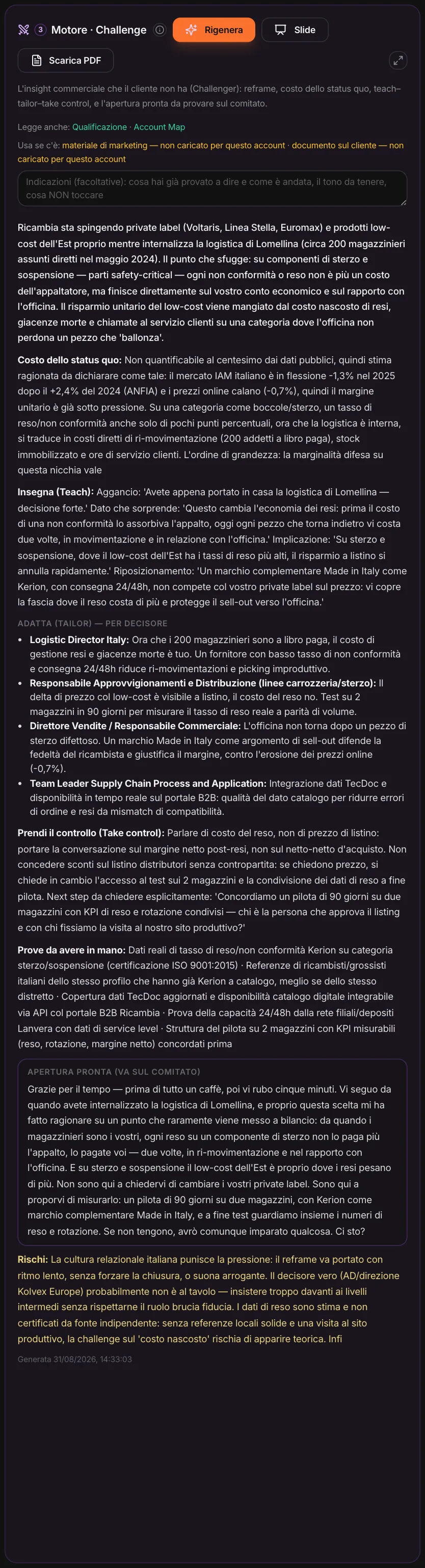
Challenge
The insight the customer doesn’t have: the cost of the status quo, what to teach them, how to tailor it to each decision-maker, how to take control of the conversation. And a ready-made opening to use in the meeting.
Here: while the distributor pushes its private labels, on steering and suspension every defect costs more than the margin gained.
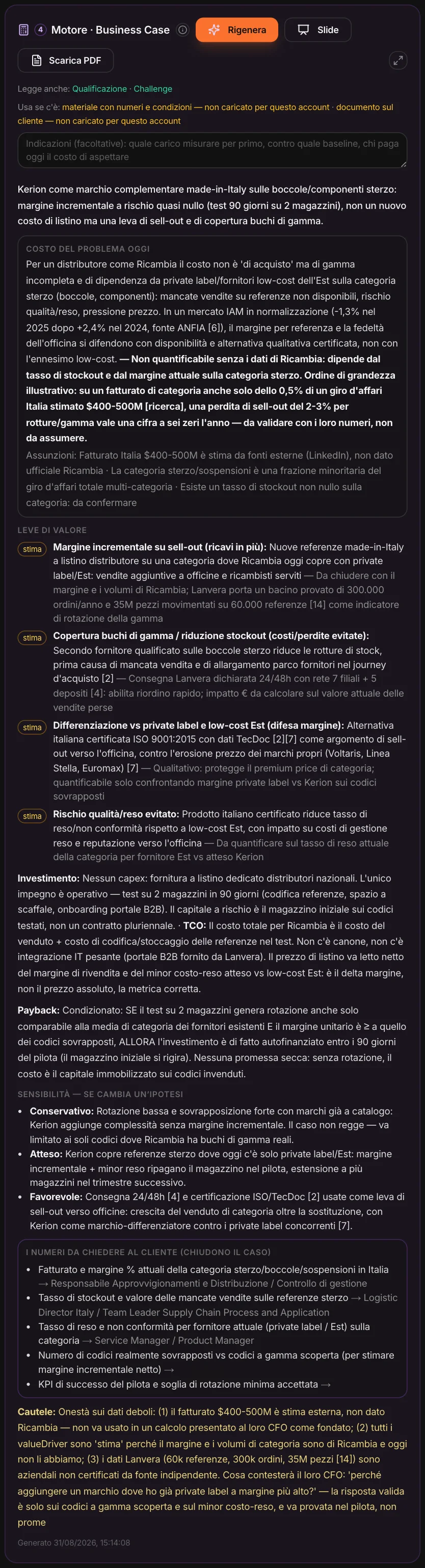
Business Case
The value in numbers: the cost of the problem with its stated assumptions, the value levers — each marked as data or estimate —, investment, total cost, payback, what happens if an assumption changes.
And the list of numbers to ask the customer for, with the role to ask. No made-up ROI.
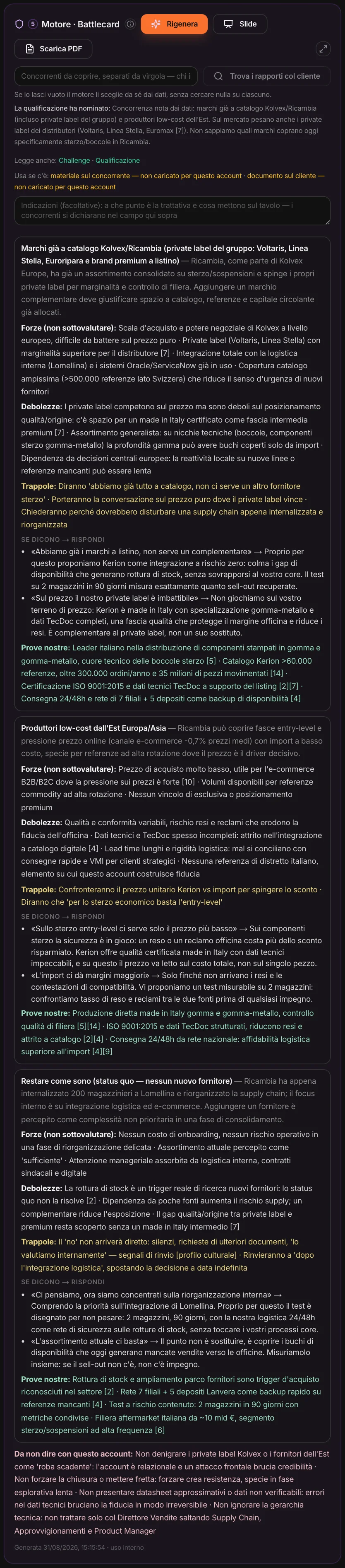
Battlecard
Who you’re up against: one to three competitors — including “staying as we are” —, with position, strengths, weaknesses, traps, ready answers (“if they say… respond”) and proof points.
With “Find their links to this client” MAPS searches the web for ties between the competitors and the account; and it closes with what never to say.
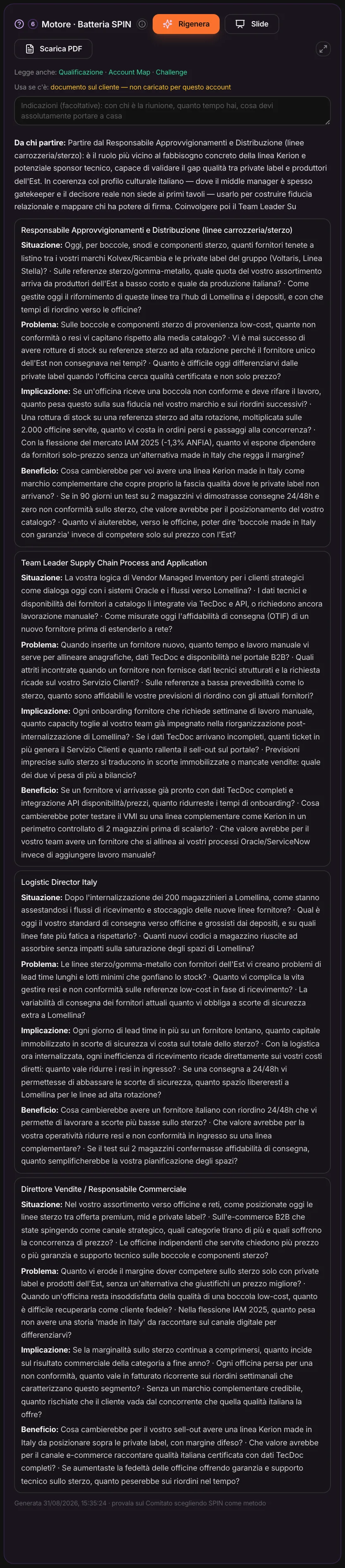
SPIN question set
The questions for each role, in the four phases: Situation, Problem, Implication, Need-payoff, two or three per phase, and the order to ask them in.
They start from what the other engines have understood: the qualification, the map, the Challenge.
The shared plan,
all the way to signature.
The milestones up to the decision, with an owner on both sides and a verifiable outcome for each; the decision criteria, the risks. Relative timing — never made-up dates.
And a clean customer version, ready to copy and send.
Before you invest,
you test it.
Four bridges to the Buying Committee: you bring the Challenge opening into the meeting, the SPIN questions, the MEDDIC gap questions, or open the committee on its own. If the committee is empty, the members arrive already filled in from the Studio’s data: the people from the research, the influence map, the qualification.
The loop closes: the Business Case, the Mutual Action Plan, the Battlecard, the Account Map and the SPIN read the committee’s latest meeting — consensus, what was needed, open objections for each member — and use it. Develop, simulate, measure, refine, produce.

From the plan,
a campaign.
Produce → campaign turns the ABM plan into a campaign: each piece of content becomes an artifact and goes to the right Studio — emails to the Email Studio, posts to the Social Studio, articles to the Content Studio, landing pages to the Web Studio. Relationship actions — a visit, a phone call, a tag in the CRM — become tasks, with the supporting material to prepare.
Each engine also becomes a deck: “Slides” takes it into Presentations — the business case for the CFO, the competitive briefing, the plan shared with the customer.
Where to grow,
within the customer base.
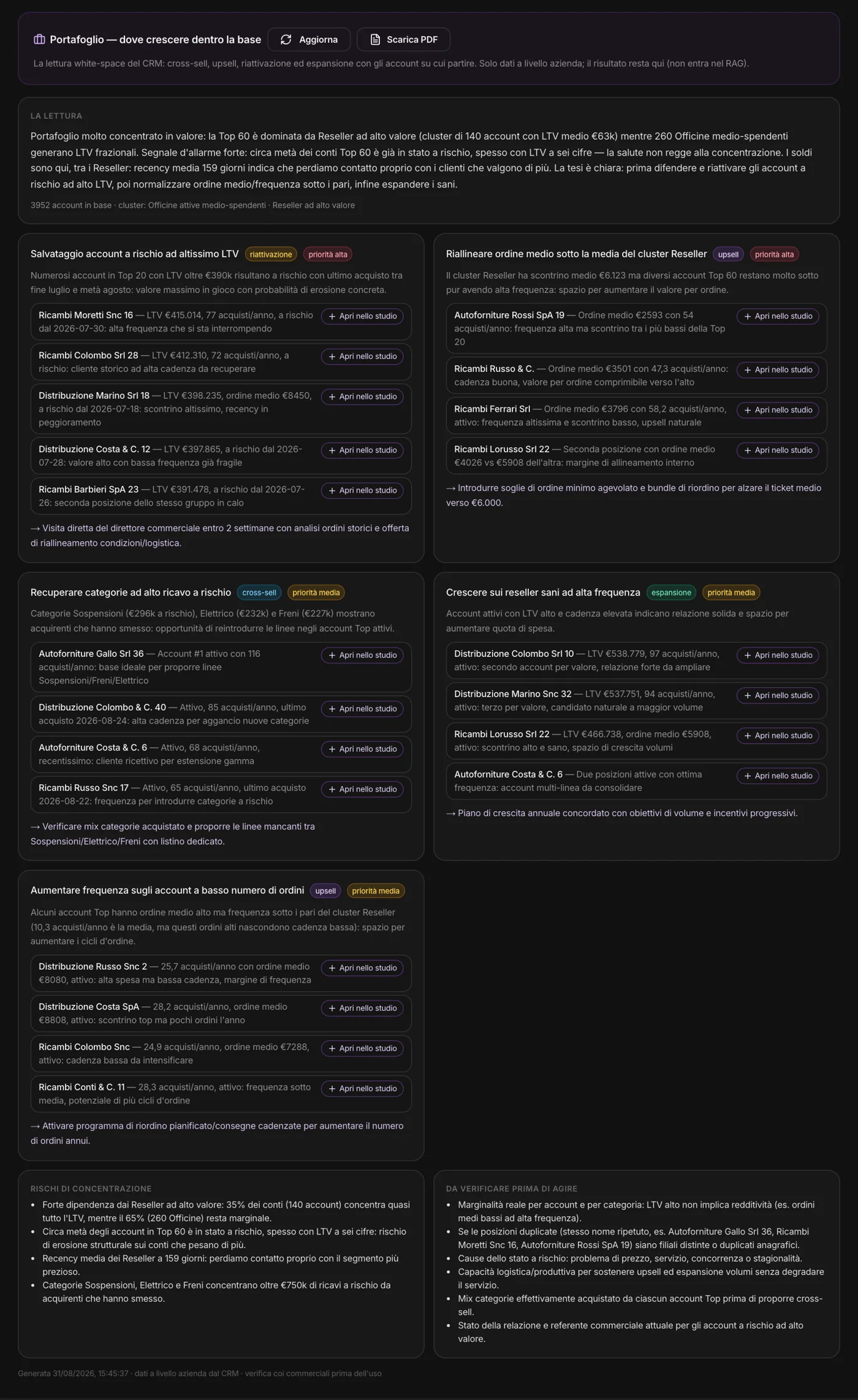
A separate tab reads the whole CRM portfolio, not a single account: the reading, the growth moves — cross-sell, upsell, reactivation, expansion — each with the named accounts, the signal in the data and the action; concentration risks; what to verify before acting.
Company-level data only. From each account, “Open in the studio” takes the work on the engines there.