
MAPS Intelligence
Resources/B2B Sales
B2B Sales · 9 min read

Account-based marketing (ABM): what it is and how to do it

Treating a client company as a market of one: how to choose accounts, decide the level of personalization (1:1, 1:few, 1:many) and align marketing and sales.

Updated October 6, 2026 · MAPS editorial team
In brief

Account-based marketing (ABM) is a B2B strategy in which marketing and sales treat a client company — the account — as a market of one: they choose it, study it, and build messages, content and actions tailored to the people who make decisions inside it. It is practiced at three levels of personalization: 1:1 (one account), 1:few (a few similar accounts), 1:many (many accounts in the same segment).

Why it works

In B2B, a few companies are worth a lot, and each one decides as a group. A generic message reaches everyone and convinces few; a message designed for that company and that role speaks to the problems they actually have. ABM shifts the effort from contact volume to account quality.

How to do it, in six steps

1. Choose the accounts

Start from your ideal customer profile and from the data: existing customers with growth potential, prospects showing the right signals (growth, new locations, leadership changes, announced projects). Few, and well chosen.

2. Decide the level

1:1 for the handful of strategic accounts, with a tailored program; 1:few for groups of accounts with similar needs; 1:many for broader segments, with light personalization. The level determines how much to invest per account.

3. Study the account

Its market, its strategy, its challenges, recent news, who decides and who influences. All from public sources and CRM data.

4. One message per decision-maker

The head of procurement, quality, the CFO: each with their own lever and their own proof. A single message for everyone convinces no one.

5. Content, channels and sequence

What to produce — a case study, a tailored analysis, a site visit — on which channels, in what order, week by week. Marketing and sales work from the same plan.

6. Measure by account

Not leads generated but accounts moving forward: decision-maker engagement, meetings, opportunities, value. And red flags when a key role is left uncovered.

ABM and ABX

ABX (account-based experience) extends the approach to the whole relationship: not just acquisition, but the account’s experience before and after signing, with sales, marketing and customer service working in concert.

The most common mistakes

  • Too many accounts. ABM with a thousand accounts is a mass campaign under another name.
  • Personalizing only the name. You need to talk about the account’s problems, not just mention it.
  • Marketing and sales working apart. Without a shared plan, each tells a different story.
  • Measuring contacts. What counts is accounts moving forward.
How MAPS does it

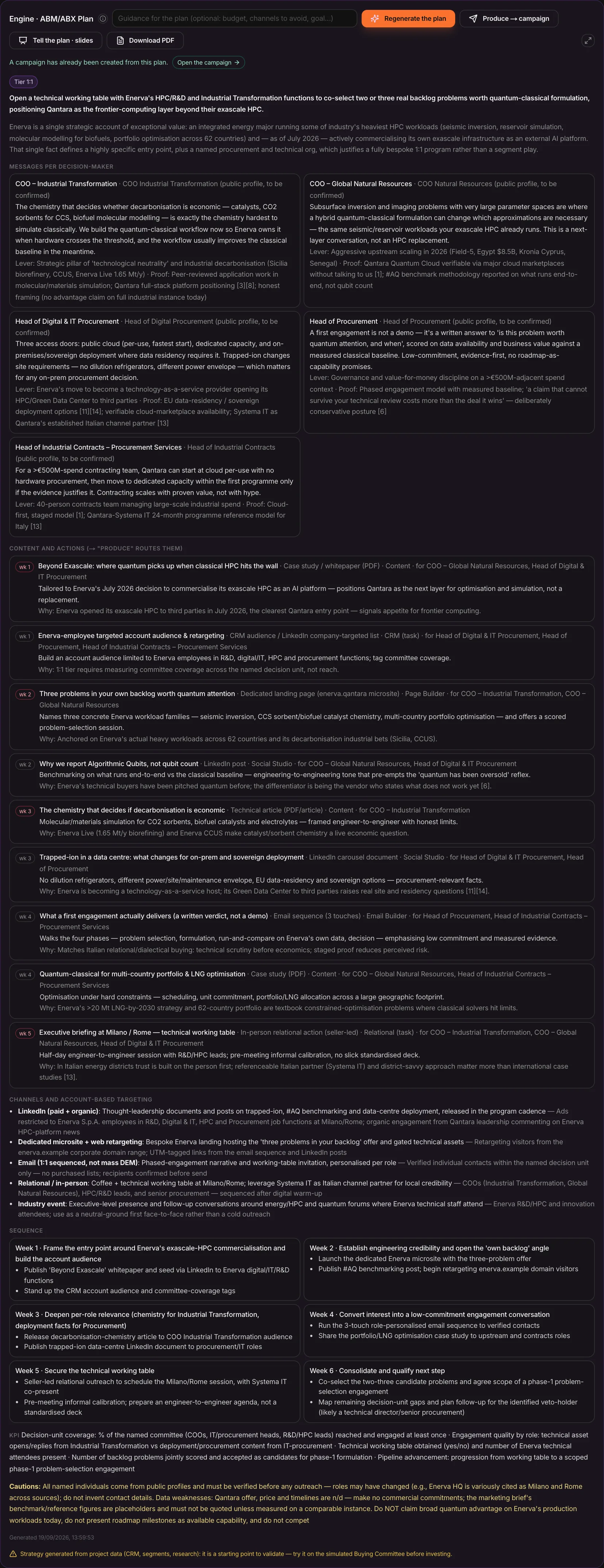
In MAPS’s ABM & Sales Studio (B2B projects only) you start from a CRM account, from a segment — which becomes a 1:many program — or from a prospect’s website. MAPS researches the account — website, news, decision-makers from public profiles with the source, never emails or phone numbers — and the ABM/ABX Plan engine chooses the tier and explains why, writes a message for each decision-maker with the lever and the proof, the content with format, channel and week, the sequence, the KPIs and the caveats. The plan then becomes a campaign in the Studios.

The ABM plan in MAPS: 1:1 tier, objective, messages per decision-maker with lever and proof, content with week and channel

Frequently asked questions

What’s the difference between ABM and lead generation?

Lead generation looks for many contacts and then qualifies them. ABM starts from a few chosen companies and builds tailored actions for the people who decide inside them.

How many accounts in a 1:1 ABM program?

Few: as many as the team can handle with a truly tailored plan. Often a handful, or a few dozen at most.

Is ABM only for large companies?

No: it pays off whenever a few customers are worth a lot and decide as a group, including for a small company selling to large customers.

Who should lead ABM, marketing or sales?

Both, with a shared plan: marketing brings research, messages and content; sales brings the relationship and knowledge of the account.

Origin and references

The term “account-based marketing” was popularized in the early 2000s by ITSMA (Information Technology Services Marketing Association), which also defined its three levels: 1:1, 1:few and 1:many.

Written by the MAPS editorial team with the help of AI, checked and reviewed by the team.

Related articles
B2B Sales·8 min di lettura

The B2B buying committee: who really decides, and how to prepare

In complex sales, a group decides, not a person. How to map roles, goals and resistance, and how to rehearse the meeting before you walk into the room.

Read →
B2B Sales·8 min di lettura

Strategic Selling and the account map: who influences the decision

Economic buyer, technical buyer, user buyer, coach: how to map influence inside an account, what each person wants for the company and for themselves, and where you’re exposed.

Read →
Practical Guides·9 min di lettura

B2B: preparing a complex deal, from the account to the buying committee

Understand the business customer, map who decides, build the business case and rehearse the meeting before you walk into the room.

Read →