
MAPS Intelligence
Resources/Practical Guides
Practical Guides · 9 min read

B2B: preparing a complex deal, from the account to the buying committee

Understand the business customer, map who decides, build the business case and rehearse the meeting before you walk into the room.

Updated October 6, 2026 · MAPS editorial team
In brief

In B2B, a complex sale is won before the meeting: by understanding the customer company and its market, mapping who decides and what each person wants, building a business case in the customer’s terms and preparing for objections. The buying committee — several people, with different criteria — is who you’re really talking to.

What’s different from consumer

  • The buyer is an organization: several people decide, with different roles and priorities.
  • The journey is long: from need to vendor evaluation, proposal, trial, contract.
  • The sources are different: trade press, trade shows, industry portals, LinkedIn, professional forums.
  • Value is measured in the customer’s terms: costs avoided, risks reduced, revenue.

Preparing the deal, in five steps

1. Understand the account

Its market, its strategy, its recent moves, its problems. All from public sources: the website, the press, financial statements, job postings.

2. Map who decides

Who has the final say, who influences, who can block. For each of them: what they want to achieve for the company and what they want for themselves — a promotion, one less risk.

3. Build the business case

The value of the proposal in the customer’s terms, with numbers they can check. A proposal that only talks about the product never reaches the CFO.

4. Prepare for objections

For each decision-maker, what they might object to and how to respond. Methods like SPIN or MEDDIC help you not miss anything.

5. Rehearse the meeting

Before you walk into the room, simulate it: who speaks, what they ask, where consensus stalls. And afterwards, prepare the next round.

The most common mistakes

  • Talking to just one person. An internal champion isn’t enough if the committee isn’t convinced.
  • A business case written from the vendor’s point of view.
  • Finding out in the meeting who’s blocking. You could have known beforehand.
  • Only one path. When the deal gets complicated, you need alternatives ready.
How MAPS does it

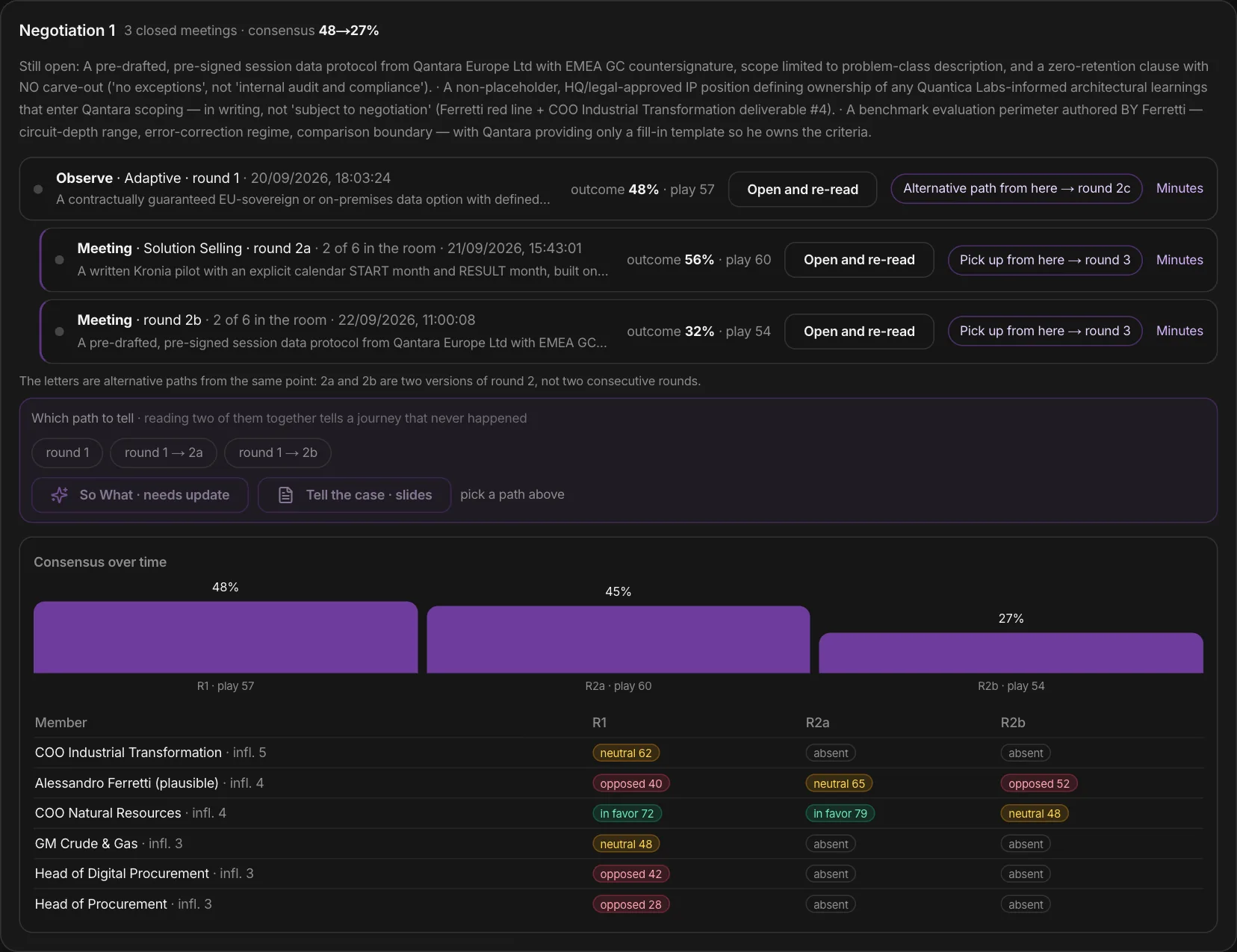
With the B2B profile, Monitor looks for decision-makers, buying processes, trade shows, industry portals and trade press, and the Analyze tools reason about the business customer. ABM & Sales Studio starts from an account in your CRM, a segment or a prospect’s website, and prepares the account plan, stakeholder map, business case, battlecard, SPIN and MEDDIC, and a mutual action plan. The Buying Committee simulates the customer’s decision-makers — in a meeting, on a written proposal, or watching a simulated salesperson — with weighted consensus, minutes, and multi-round negotiations with alternative paths. It’s a simulation: it prepares, it doesn’t predict.

A negotiation in the MAPS Buying Committee: three rounds with different methods, the alternative paths, and consensus over time for each member

Frequently asked questions

Does MAPS find decision-makers’ contact details?

No: account research uses only public information about companies and roles, never emails or phone numbers.

Does the simulated buying committee predict how the meeting will go?

No: it’s there to help you prepare — objections, positions, what it takes to close. The real meeting is still the real meeting.

Can we start from our CRM?

Yes: accounts can be pulled from your CRM, including HubSpot, with contact data pseudonymized.

What are SPIN and MEDDIC?

Two consultative selling methods: SPIN guides the questions (situation, problem, implication, need-payoff); MEDDIC checks the elements of a qualified deal (metrics, economic buyer, decision criteria, decision process, identified pain, champion).

Written by the MAPS editorial team with the help of AI, checked and reviewed by the team.

Related articles
Strategic Tools·10 min di lettura

Customer Journey Map: how to build it channel by channel

Stages, touchpoints, emotions and critical moments of the buying journey: why a journey per channel is worth more than a generic one, and how to use it to decide where to act.

Read →
Strategic Tools·8 min di lettura

Empathy Map: what it is and how to use it to understand the customer

What your customer says, thinks, does and feels, what they see and hear, what holds them back and what they want: how to fill it in without making things up, and how to turn it into decisions.

Read →
AI & Marketing·8 min di lettura

Multi-agent systems: when a single AI model isn’t enough

Several agents with different roles — experts, moderator, judge — debating a problem: when they improve reasoning, and how to design them.

Read →