The basic methods
- Cost-based (cost-plus) — cost plus a margin. Simple and safe on margin, but it ignores what the customer would pay.
- Competitor-based — you position yourself against market prices: below, in line, above. It makes sense if you know why you deserve that position.
- Value-based — you start from what the solution is worth to the customer. The hardest to estimate and usually the most profitable.
In practice you use all three: costs tell you the price you can’t go below, value the one you can’t go above, competitors where the customer places you when comparing.
Possible objectives
- Margin — maximize profit per unit.
- Penetration — a low price to win share fast.
- Premium positioning — price as a signal of quality.
- Competitiveness — stay in line so you don’t lose customers on price.
How to build it
1. Choose the objective
A penetration price and a premium price lead to opposite choices across the rest of the marketing mix. Deciding the objective first avoids a “middle” price that serves nobody.
2. Gather market prices
Competitors’ actual prices, for comparable products. When a price can’t be found, say so: an estimated price presented as real skews the whole line of reasoning.
3. Assess price sensitivity
How much customers react to an increase or a discount. Weigh how differentiated the product is: the advantages that emerged from the feature matrix are the ones that justify a higher price.
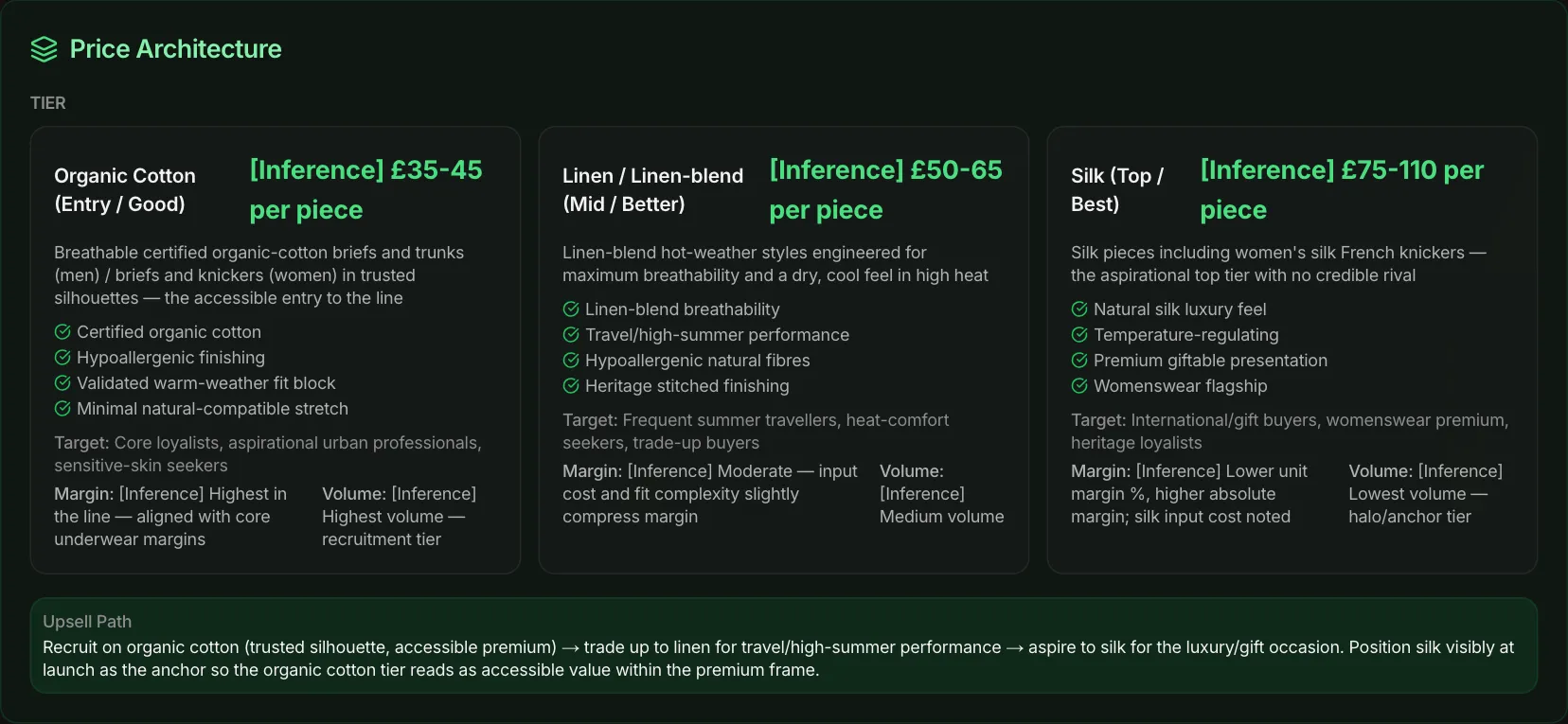
4. Design the architecture
More than one tier is often worthwhile — basic, mid, complete —, each with its own margin. The mid tier is often the best seller; the others frame it.
5. Calculate the break-even point
How many units you need to cover fixed costs: fixed costs ÷ (price − unit variable cost). If the number is out of reach, price or costs have to be revisited.
6. Prepare launch, promotions and responses
The launch price, the promotion policy, and what to do if a competitor cuts prices: follow, differentiate, ignore. Deciding in advance avoids improvised price wars.
The most common mistakes
- Costs only. You leave on the table the value the customer would have paid for.
- Copying the leader’s price. Without its costs and its brand, the same price means something else.
- Too many promotions. Customers learn to wait for the discount, and full price stops existing.
- No response plan. A competitor’s first move becomes an emergency.
- Break-even not calculated. A price can be “right” and the model still not hold up.