
MAPS Intelligence
Resources/Strategic Tools
Strategic Tools · 9 min read

Marketing mix: the 4Ps, the 7Ps and why they have to agree

Product, price, place and promotion — and, for services, people, process and physical evidence: what each lever decides and how to check that they don’t contradict each other.

Updated October 6, 2026 · MAPS editorial team
In brief

The marketing mix is the set of levers a company controls to reach its market objectives. In its classic form these are the 4Ps: product, price, place and promotion. For services, the 7Ps are used, adding people, process and physical evidence. The point isn’t to fill in every lever, but to make sure they agree with each other.

The 4Ps

  • Product — what you offer: features, quality, range, packaging, related services.
  • Price — what it costs, with which tiers, discounts, terms. See pricing strategy.
  • Place — where and how the customer finds it: channels, stores, online, coverage.
  • Promotion — how you make it known and chosen: advertising, digital, public relations, promotions, sales.

The 7Ps for services

  • People — who delivers the service: in services, staff are part of the product.
  • Process — how the service is delivered: timing, steps, ease.
  • Physical evidence — what the customer sees and touches: the premises, the materials, the website, the receipt.

The three extra Ps exist because a service can’t be seen before you buy it: the customer judges it by who delivers it, how it works and the cues that come with it.

How to use it

1. Start from positioning

The mix turns a choice already made into decisions: for whom, against whom, with what promise. Without clear positioning, each P gets decided on its own.

2. Decide each lever with its recommendations

For promotion, this also means the media mix and the calendar.

3. Check the pairs

For each pair of Ps: do they reinforce or contradict each other? A premium product sold in discount stores, a high price with communication that’s all about discounts, wide distribution for a product that needs expert advice: these are tensions to resolve before launch.

4. Close the gaps

Where a tension remains, choose which P to change. The easiest lever to move is usually promotion, but it isn’t always the wrong one.

An example. “Molino Serra,” a fictional organic flour brand, has premium product and pricing, but distribution concentrated in discount stores and communication built on deals. The price–place and product–promotion pairs contradict each other: it decides to shift distribution toward specialty stores and to communicate the origin of its grains.

The most common mistakes

  • Four separate plans. There’s only one mix: the levers have to be decided together.
  • Promotion = advertising. It includes everything that says something about the brand, sales included.
  • The 4Ps for a service. Without people and process, you neglect exactly what the customer judges.
  • No consistency check. Contradictions between levers show up later, in the sales figures.
How MAPS does it

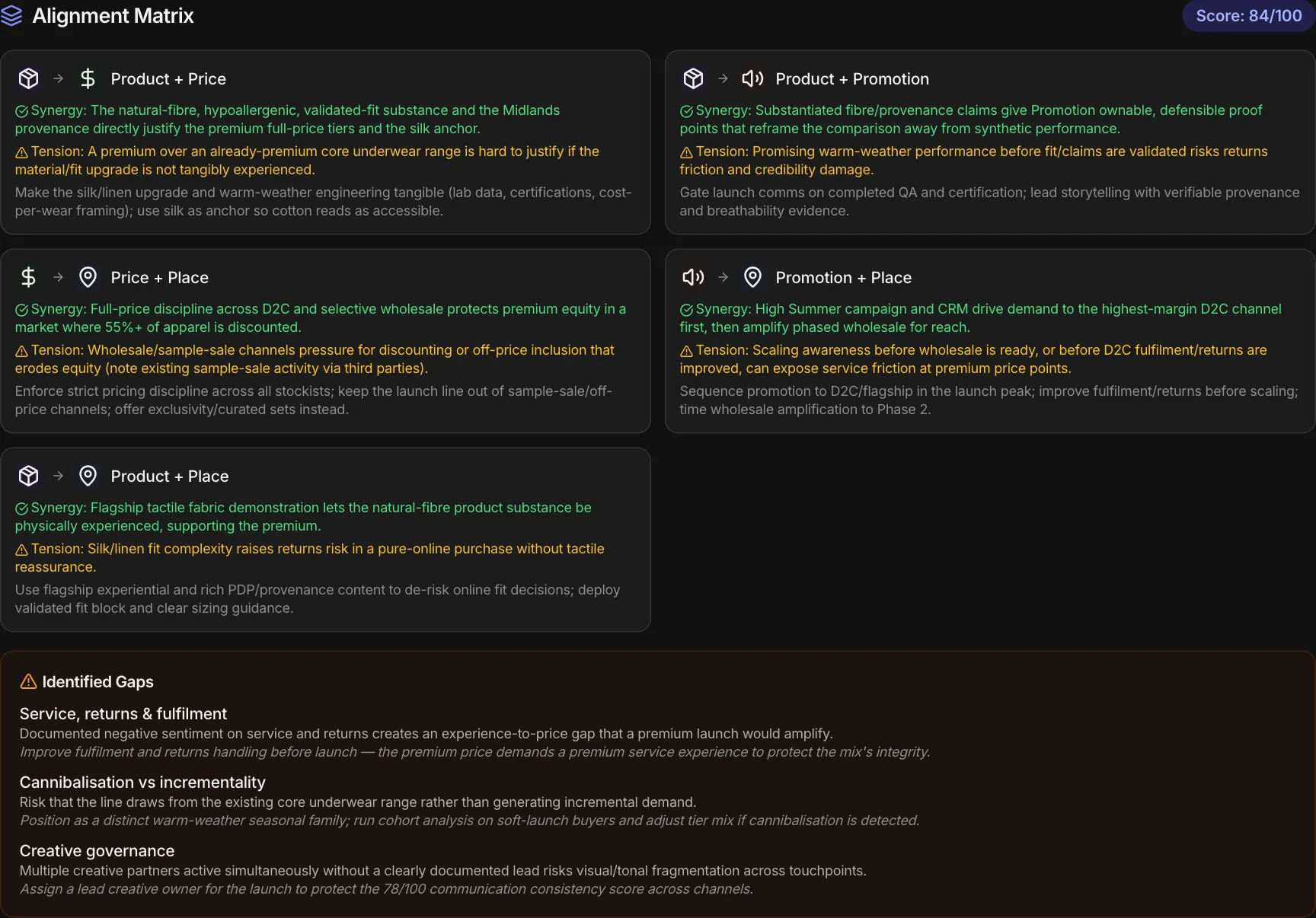
In MAPS, the Marketing Mix Planner is the fifth step of “From Idea to Campaign” and works on the four Ps: product, price, place, promotion — each with its recommendations, and promotion with the media mix and the calendar. It reads what comes upstream (concept, features, price, go-to-market). Then the alignment matrix: for each pair of Ps, where they reinforce and where they contradict each other, with a consistency score and the gaps to close. The mix pre-fills the Campaign Planner, the final step.

The alignment matrix of the four Ps: synergies, tensions, gaps

Frequently asked questions

What are the 4Ps of marketing?

Product, price, place and promotion: the four levers the company controls to reach its market objectives.

What are the 7Ps?

The 4Ps plus people, process and physical evidence. They’re used mainly for services, where who delivers and how they do it are part of what the customer buys.

Are the 4Ps outdated?

Other models have built on them, but they remain useful as a checklist of decisions. The risk isn’t using them, it’s using them as four separate plans.

Who invented the marketing mix?

The term “marketing mix” is associated with Neil Borden; the 4P classification is due to E. Jerome McCarthy (1960); the 7Ps to Bernard Booms and Mary Jo Bitner (1981).

Origin and references

The term “marketing mix” is associated with Neil H. Borden; the 4Ps were proposed by E. Jerome McCarthy in Basic Marketing (1960); the 7Ps for services by Bernard H. Booms and Mary Jo Bitner (1981).

Written by the MAPS editorial team with the help of AI, checked and reviewed by the team.

Related articles
Strategic Tools·10 min di lettura

Pricing strategy: how to decide what to charge

Costs, perceived value, competitors and objective: the methods for setting price, the architecture of offer tiers, the break-even point and what to do if a competitor responds.

Read →
Strategic Tools·9 min di lettura

Planning a marketing campaign: the plan, step by step

Objective, audience, message, channels, budget, KPIs, creative brief and timeline: how to write a campaign plan that the creative team and the media team can actually use.

Read →
Glossary·10 min di lettura

Glossary of strategic marketing

The vocabulary of strategy, explained in a few lines: from competitive advantage to go-to-market, with links to the articles that go deeper.

Read →