
MAPS Intelligence
Resources/Strategic Tools
Strategic Tools · 9 min read

Planning a marketing campaign: the plan, step by step

Objective, audience, message, channels, budget, KPIs, creative brief and timeline: how to write a campaign plan that the creative team and the media team can actually use.

Updated October 6, 2026 · MAPS editorial team
In brief

A campaign plan turns a marketing objective into a set of coordinated actions over a defined period: who to talk to, what to say and how it changes on each channel, where and with how much budget, which KPIs to measure, the creative brief, the timeline and the risks. It’s the document that lets creative, media and sales work on the same campaign.

What a campaign plan contains

  • Type and objective — launch, awareness, consideration, conversion, loyalty. One main objective, measurable.
  • Audience — who needs to receive the message, in enough detail to choose channels and tone.
  • Message — the core idea, and how it adapts to each channel.
  • Channel plan — where, in what role, with how much budget and which KPIs.
  • Creative brief — what the people producing the content need.
  • Timeline and budget — what happens when, and what it costs.
  • Risks — what can go wrong and how to spot it early.

How to write it

1. One objective, one metric

A campaign that wants everything — awareness, sales, sign-ups — ends up achieving nothing measurable. Choose the main objective and the metric you’ll judge it by.

2. The audience, from what you already know

Use research, personas, customer data. An audience described by age and city isn’t enough to write a message: you need needs, objections, moments.

3. The message, and its versions

The idea stays the same; format, length and tone change from channel to channel. Writing the versions into the plan keeps each channel from inventing its own campaign.

4. Channels with a role

Every channel has a job: build awareness, persuade, convert, bring people back. Budget follows the role, and each channel has its own KPIs. For allocation across paid media, see media planning.

5. The creative brief

Objective, audience, insight, message, tone, constraints, formats, what to avoid. A clear brief is the difference between a usable creative proposal and three rounds of revisions.

6. Timeline, budget and risks

Production and release dates, budget by line item, and the checkpoints where you decide whether to course-correct.

An example. “Bottega Saponi,” a fictional natural cosmetics brand, plans its Christmas campaign. Objective: online sales of gift boxes. Audience: people buying gifts for others, short on time. Message: “the ready-made gift, made by hand.” Instagram to make the gift boxes known, a newsletter to customers to convert, paid search to catch people looking for gifts. KPIs per channel, launch in mid-November, a check after ten days to shift budget to what converts.

The most common mistakes

  • Multiple, vague objectives. “Increase visibility” can’t be measured.
  • The same message pasted everywhere. Every channel has its own grammar.
  • Channels chosen out of habit. Every channel must have a role and a KPI.
  • No checkpoint. You find out what didn’t work once the campaign is over.
How MAPS does it

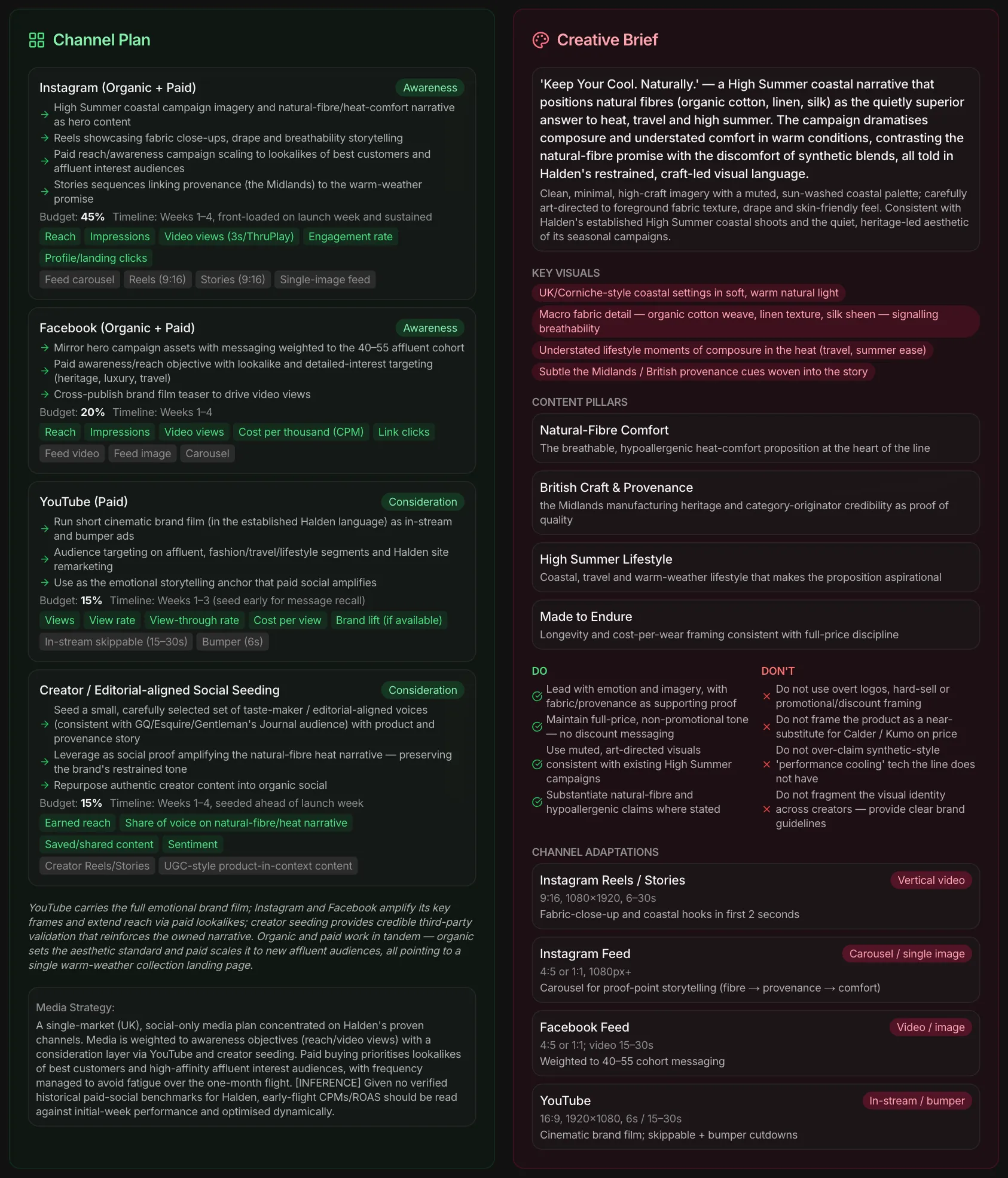
In MAPS, the Campaign Planner is the last of the six tools in “From Idea to Campaign.” You set campaign type, objective, audience, channels, duration, budget; MAPS reads the whole upstream path — concept, features, price, go-to-market, marketing mix — and writes the plan: the audience, the message and how it changes on each channel, the channel plan with budget and KPIs, the creative brief, the timeline, the budget, the risks. Then “Develop Creative” takes the brief into the Campaign Lab: pick one of the eight creative methodologies — archetypes, benefit laddering, cultural tension, jobs to be done, semiotics, insight, ideas from other industries, scenarios — and MAPS generates the concepts.

The channel plan with budget and KPIs, and the creative brief

Frequently asked questions

What should a campaign plan contain?

Objective and metric, audience, message with versions per channel, a channel plan with budget and KPIs, creative brief, timeline, budget and risks.

What’s the difference between a campaign plan and a creative brief?

The creative brief is one part of the plan: it tells the creatives what to produce and why. The plan also covers channels, budget, timing and measurement.

How many KPIs should you choose?

One main KPI for the campaign objective, and one or two per channel tied to its role. Too many KPIs make it impossible to tell whether the campaign worked.

Written by the MAPS editorial team with the help of AI, checked and reviewed by the team.

Related articles
Strategic Tools·9 min di lettura

Marketing mix: the 4Ps, the 7Ps and why they have to agree

Product, price, place and promotion — and, for services, people, process and physical evidence: what each lever decides and how to check that they don’t contradict each other.

Read →
Data & Measurement·9 min di lettura

Media planning: media mix, seasonality and category benchmarks

How to spread an advertising budget across media and months, starting from what your category does: competitor spend, open windows, objectives and scenarios.

Read →
Strategic Tools·9 min di lettura

Go-to-market: how to bring a product to market

The first segment to win, the ideal customer, the channels, demand generation and a phased launch with go/no-go criteria: the strategy for not launching blind.

Read →