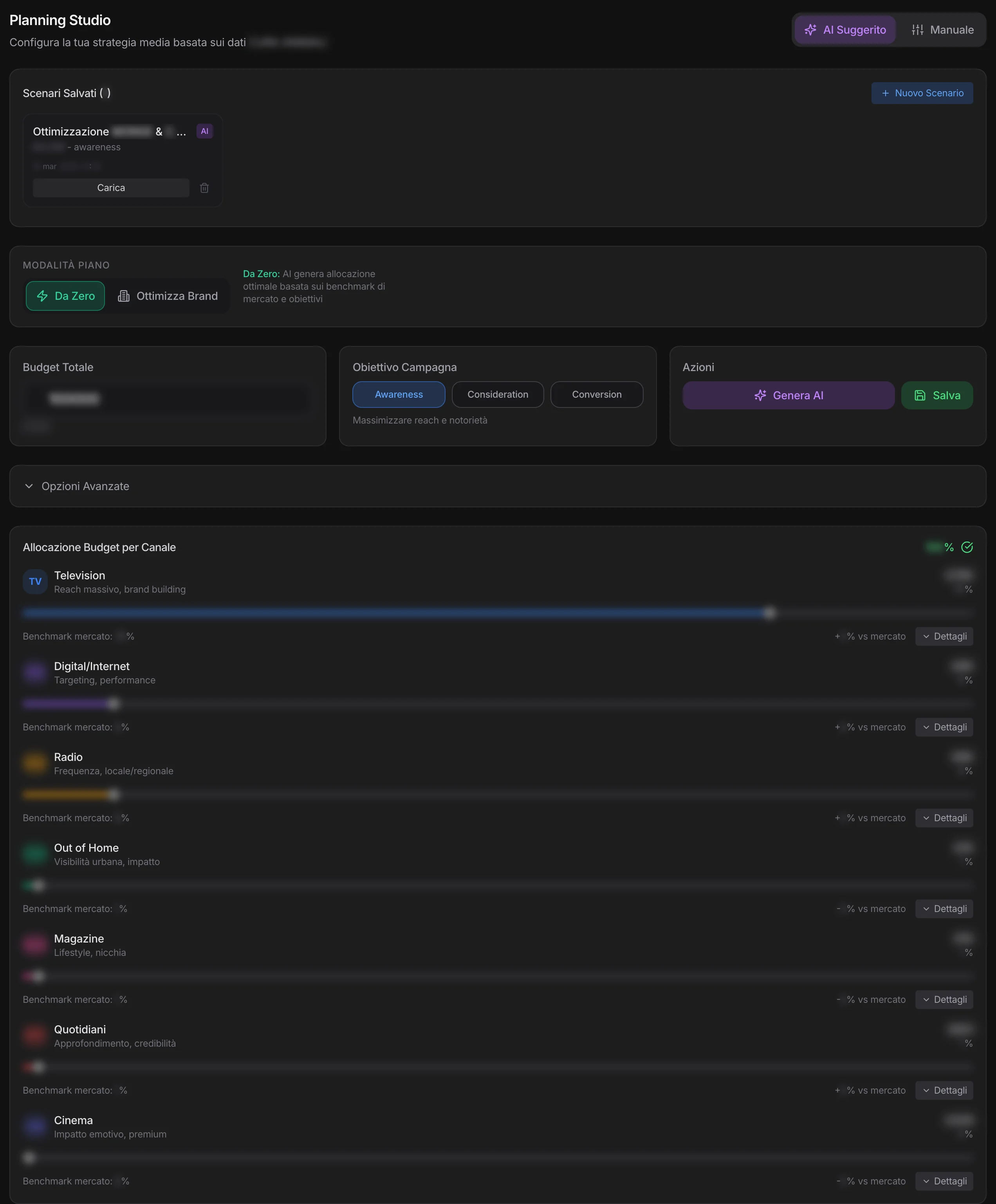
The questions of media planning
- How much — the total budget, and how it compares with what the category spends.
- Where — the media mix: how much on each, and why.
- When — the spread across months: continuity, concentration, peaks.
- What for — the objective, which changes the right media. Broad-reach media build awareness; more targeted ones drive action.
Two concepts keep coming up. Reach: how many people in the audience see the message at least once. Frequency: how many times, on average, they see it. GRPs (gross rating points) combine them: reach percentage × average frequency.
How to do it
1. Look at the category
How much it spends in total, how many advertisers, how concentrated the spend is, the weight of each medium. Comparing your share of spend (share of voice) with your market share tells you whether you’re investing more or less than your weight.
2. Look at competitors, one by one
Who puts everything on one medium, who has diversified, which media nobody holds. A medium left open can be an opportunity, or a medium that doesn’t work in the category: you need to figure out which.
3. Read the seasonality
Month by month, the category’s peaks and quiet periods. Investing in the peak means competing with everyone; investing in the quiet months can deliver more visibility for the same budget, if the demand is there.
4. Allocate the budget
By objective, medium by medium, with the category benchmark alongside. Then across the months: the calendar.
5. Simulate before deciding
What happens with a different budget, or by shifting share between media. Compare several scenarios before choosing.
The most common mistakes
- Copying the leader. Its mix makes sense for its budget, not yours.
- Ignoring seasonality. The same budget is worth much less in the months of peak pressure.
- Media chosen out of habit. Each medium should be chosen for the objective.
- Estimates presented as real data. If an estimate stands in for a missing figure, it has to be declared.
- No alternative scenario. A single plan doesn’t let you see how robust it is.