
Where you start
is up to you.
From a campaign — MAPS reads the concept and the brief —, from your own script, which the assistant adapts to the engine without rewriting it, or from a description in words, from which it proposes three treatments to choose from. Out comes the outline: the blocks, the shots, the lines.
And the notes of a director who knows the engine: what it won’t do well — hands working a fabric, too many faces in focus —, where the timing is tight, what is missing to keep the characters consistent. Before spending a single take.
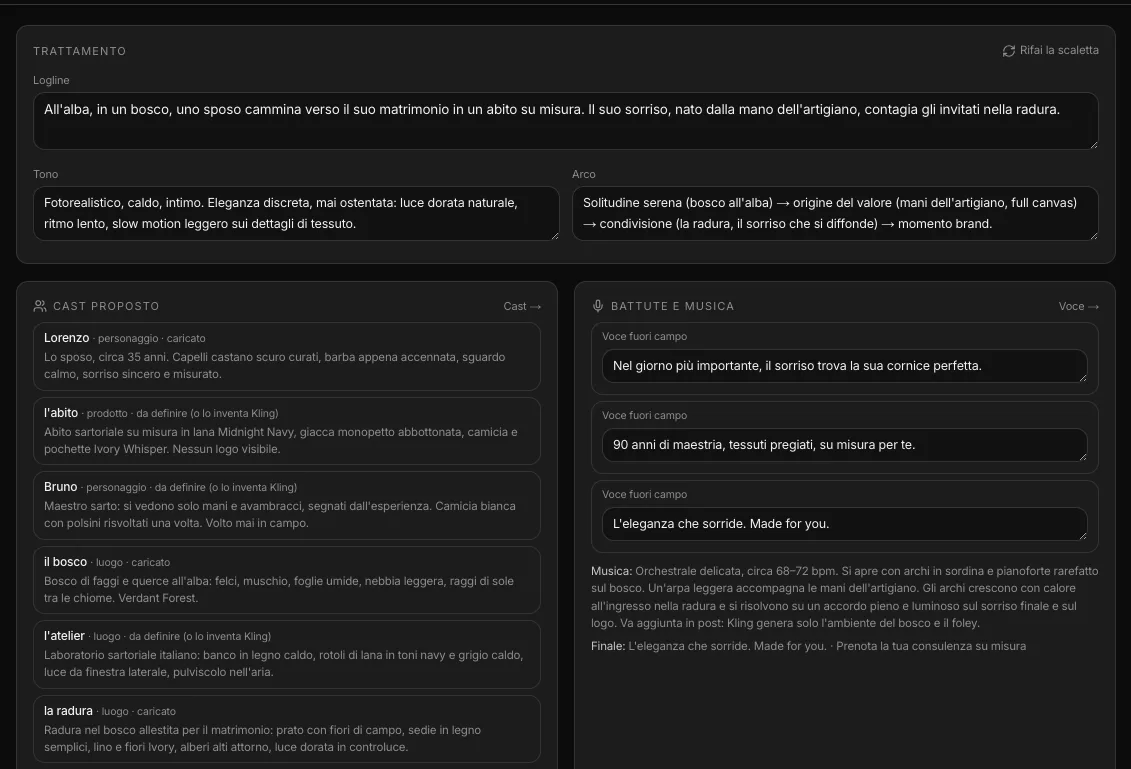
Always the same,
in every block.
Characters, garments, places: each with its reference image. You take it from the Studio Set, generate it here or upload it. Without an image the engine invents from the description — and from one block to the next the groom would change face.
Someone missing? Ask the assistant — “Lorenzo’s bride, for the final close-up” — and it creates her consistent with the spot. Synthetic characters only.
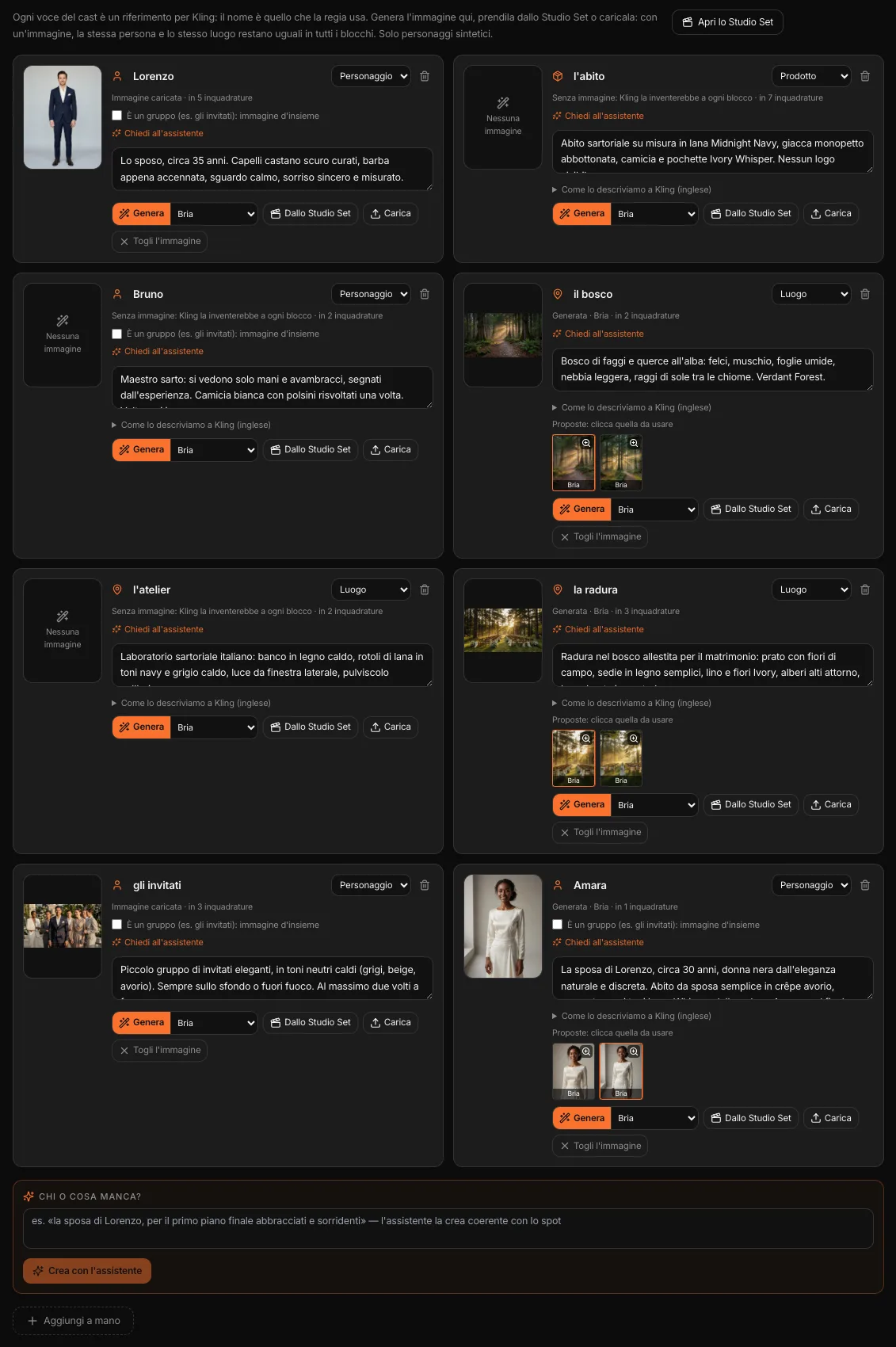
The contract
of the spot.
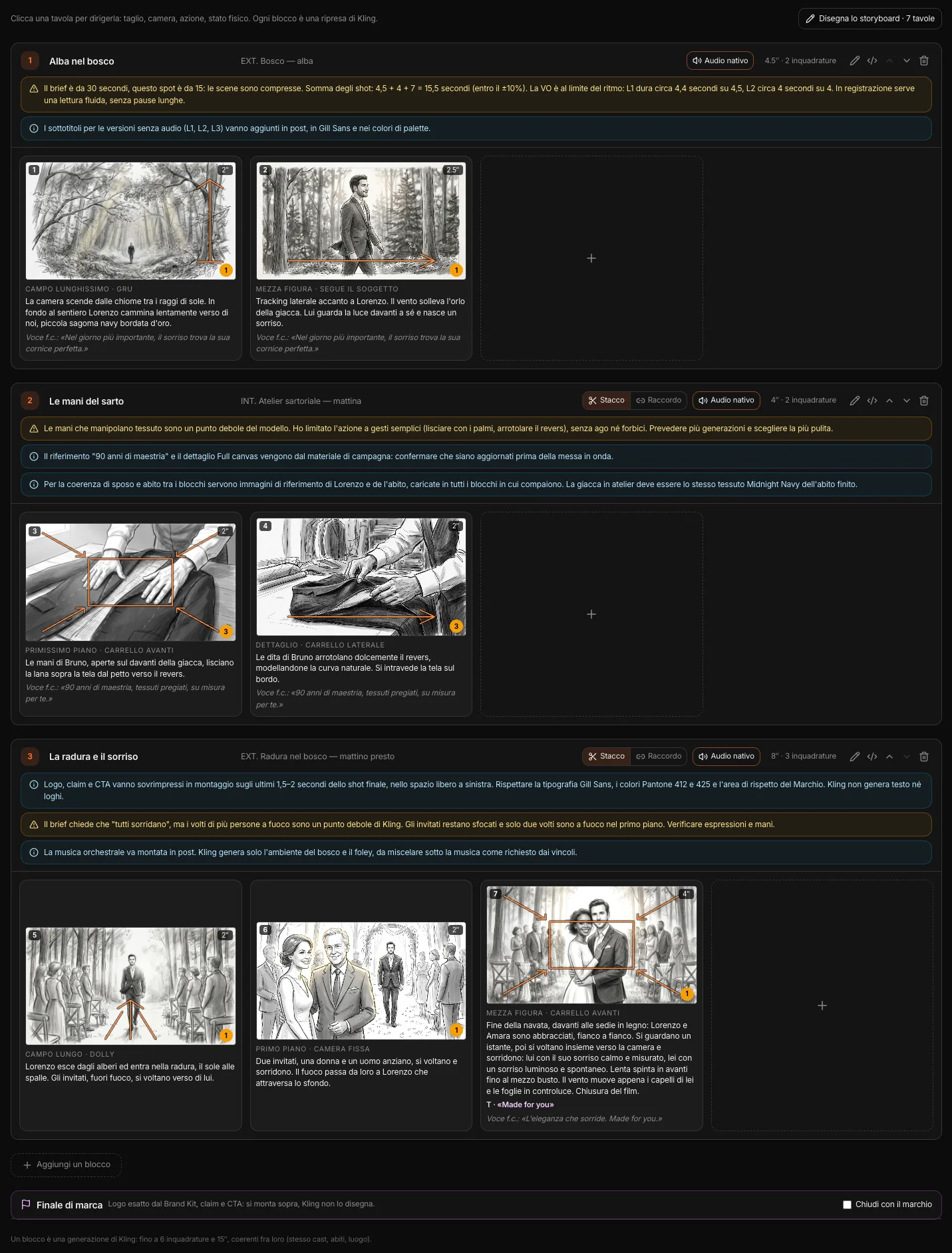
Every block is one take; every shot a pencil board, with the arrow of the camera move. Click a board and direct it: framing, camera, action, physical state — who holds what, what they wear —, who is in the scene, the on-screen text, the voice.
Between blocks you choose a cut or a match: the block starts again from the last frame of the one before, with no jump. And the takes are judged against the boards: if they follow the storyboard, they are right.
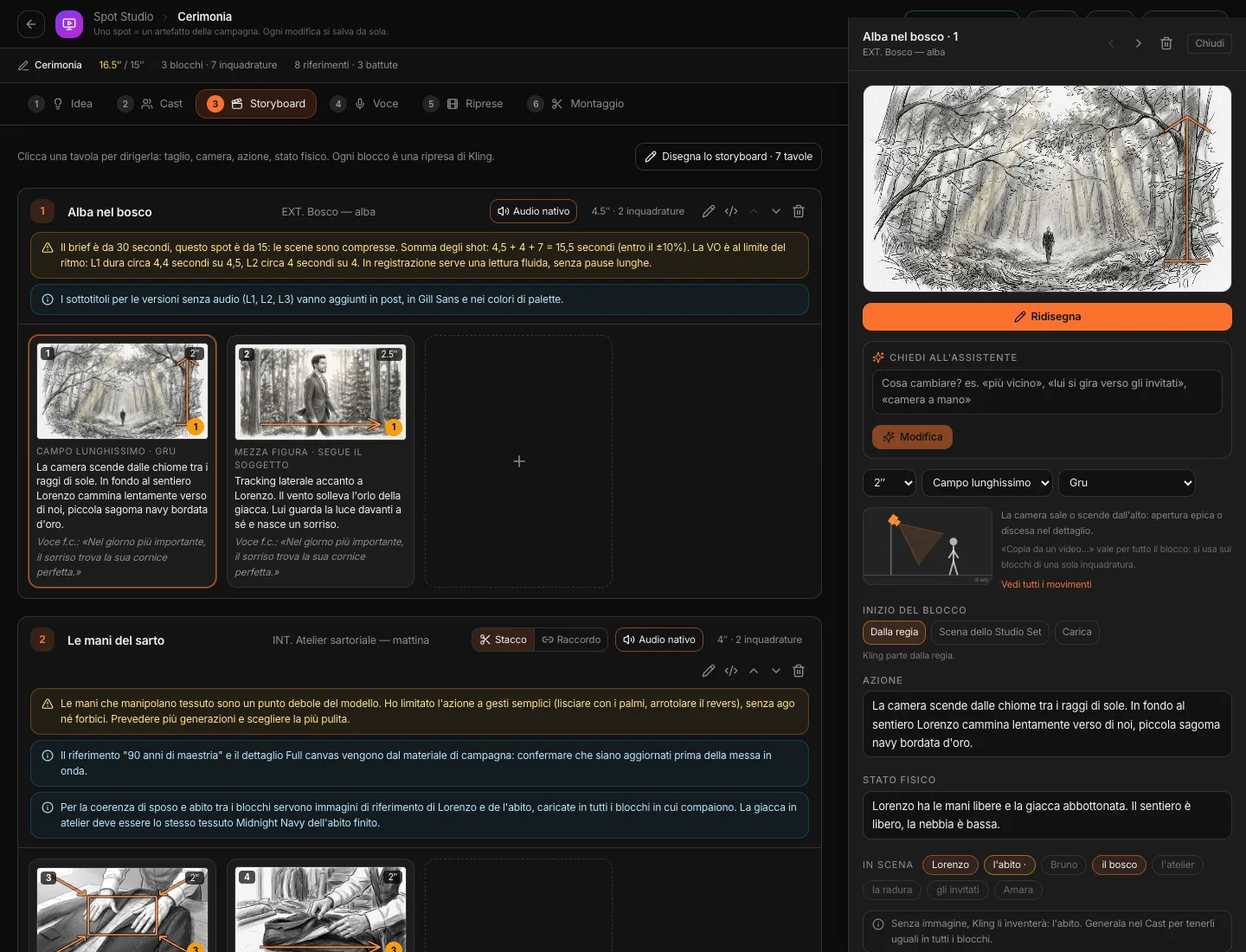
See the move
before you pick it.
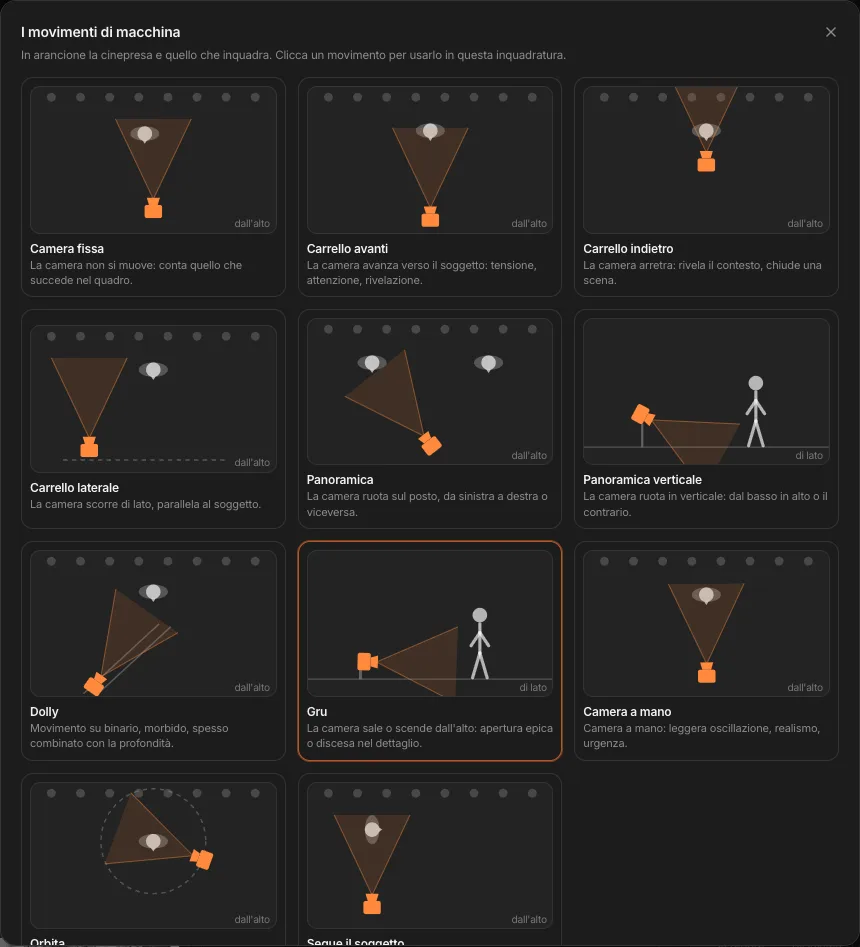
Eleven moves — dolly, pan, crane, orbit, handheld… — each with its animated diagram: the camera seen from above or from the side, with what it frames. If you don’t know what a crane shot is, you see it in a second.
In the first shot you choose how the block starts, in the last how it ends: from a Studio Set scene or an image. And with “Copy from a video…” the engine takes the camera move from a video of yours.
Voice first,
then the takes.
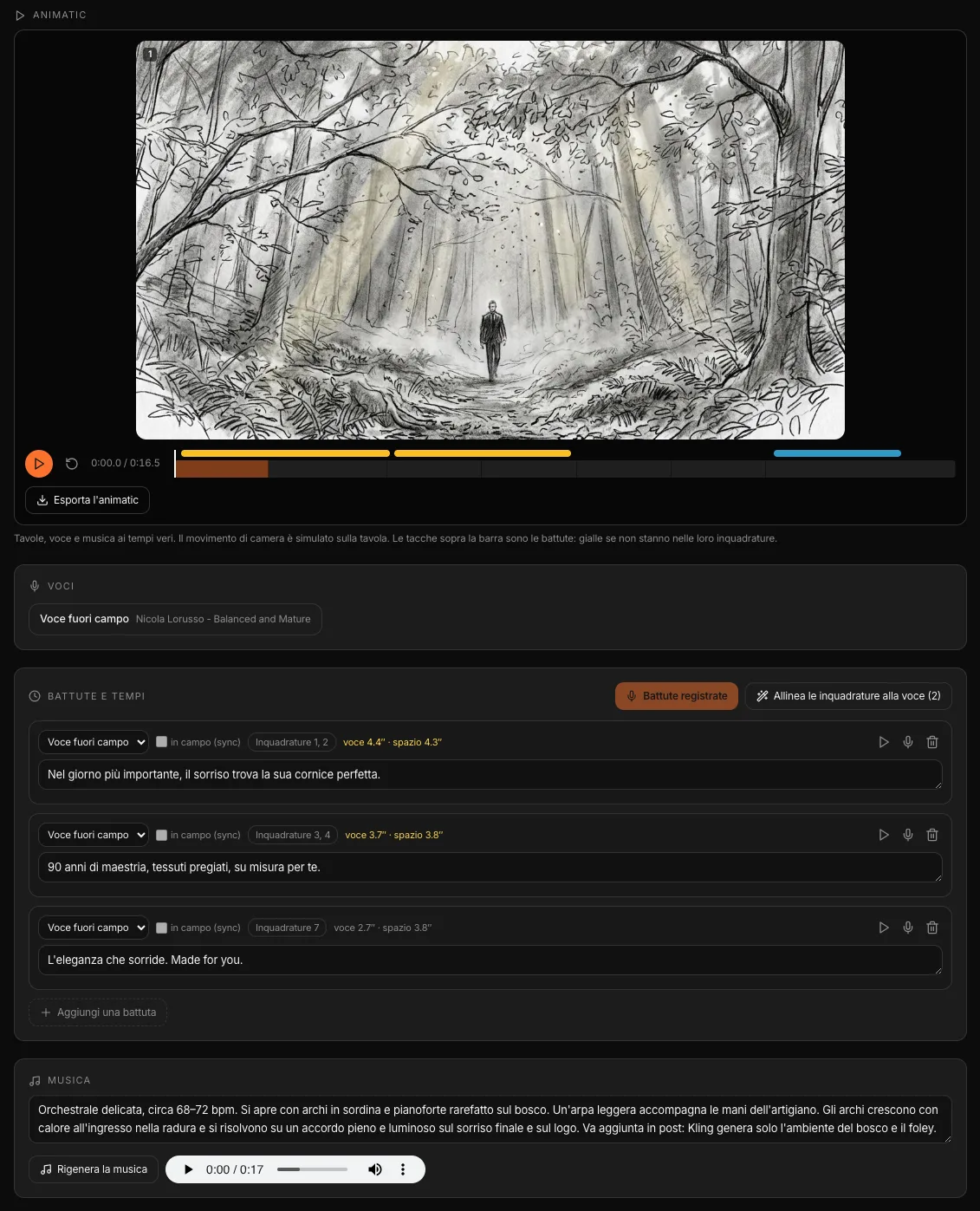
Every line is recorded with its voice, and its real duration says how long the shots must last: if it doesn’t fit, MAPS lengthens them. The music comes from the director’s brief, as long as the spot.
Boards, voice and music on the real timing make the animatic: the spot can be watched — and shown — before shooting.
Shot
block by block.
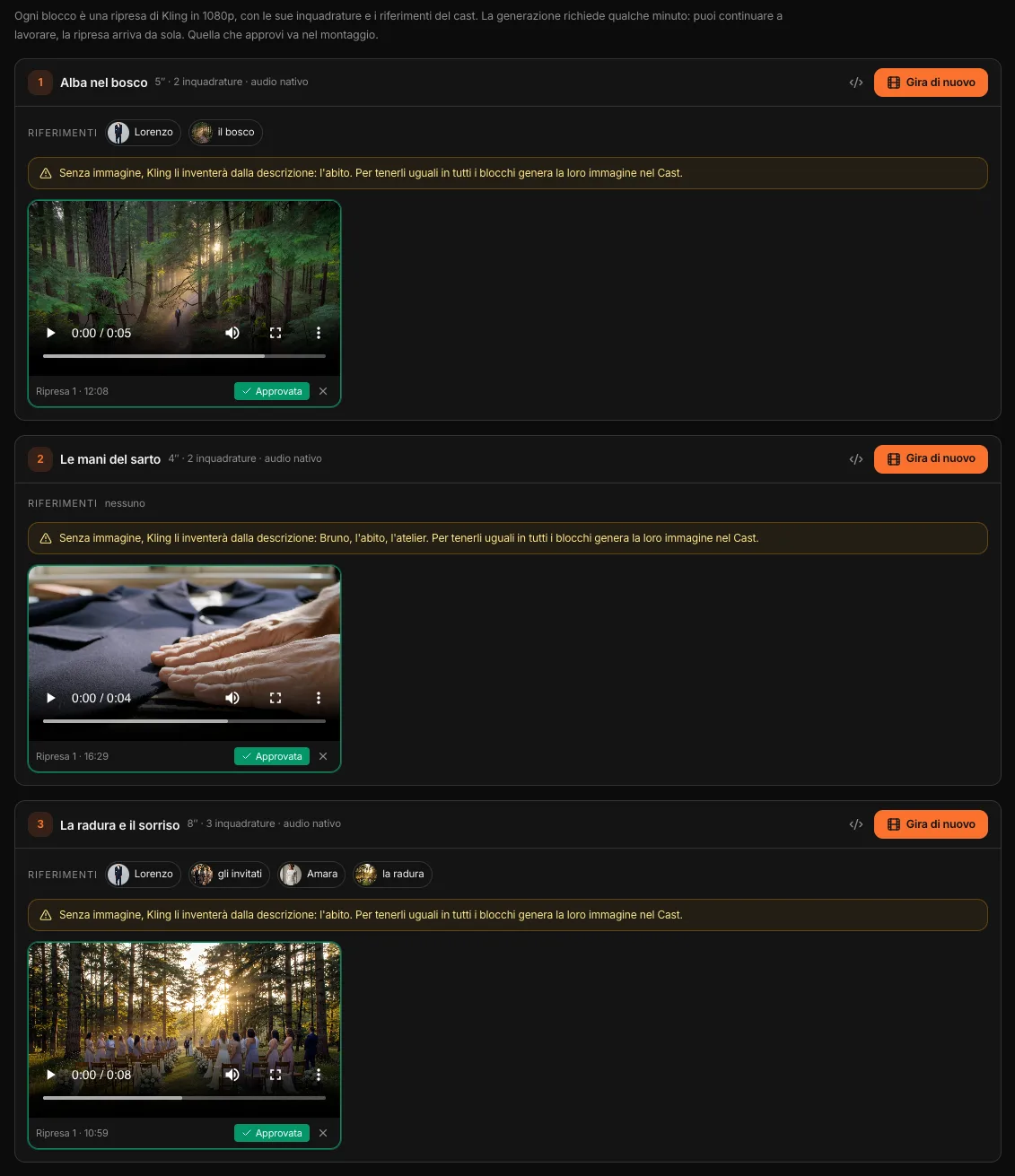
Each block goes to the engine — Kling, in 1080p — with the cast references: up to six shots and fifteen seconds in one take, consistent with each other. It takes a few minutes, and you keep working. You approve the right take; if it doesn’t convince you, you reshoot it.
If a character speaks on camera: in the languages Kling speaks, the line is born inside the take; in the others, Italian included, the voice is recorded and the lips are synced afterwards.
All together,
by ear.
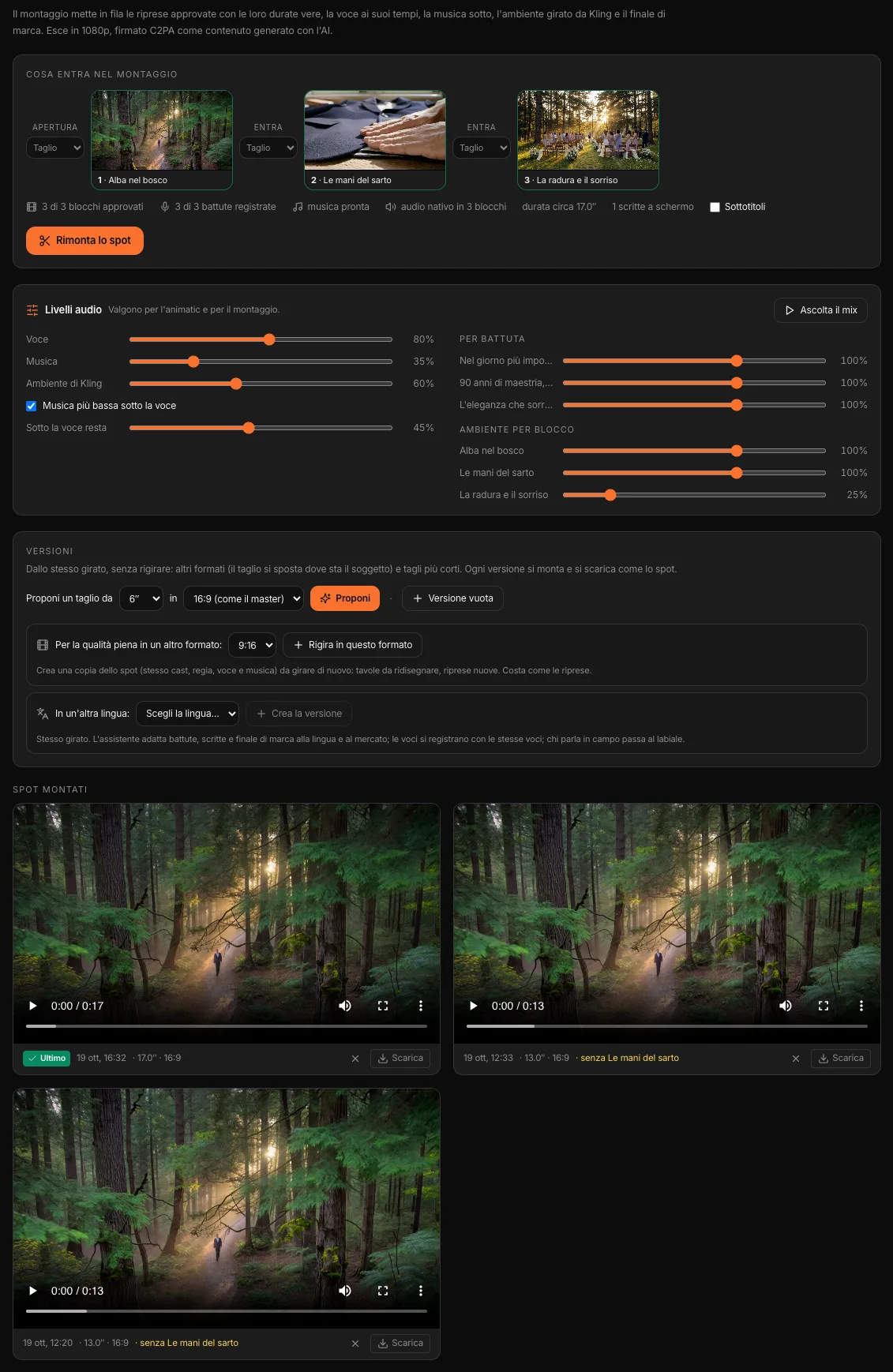
The approved takes in a row with their real durations, the voice on its timing, the music that dips under the voice and fades at the end, the ambience shot by the engine. You set the levels, listening to the mix.
Between blocks a cut, a dissolve or black; on-screen texts and subtitles in the Brand Kit font; the brand end card with logo, claim and CTA. It comes out in 1080p, signed as AI content, and goes to the client in Review.
From the same footage,
every output.
A spot never goes out in one format only.
Lengths and cuts
The spot lasts as long as it needs: 15, 30, even 60 seconds, shot in blocks of 15 with the same characters. From the same footage, the short cuts — a 6 or a 10 second —: the assistant picks the shots that hold the story, with the lines that fit.
The formats
Vertical and square from the same footage: the crop follows the subject shot by shot. For a full-quality vertical, the spot is reshot in 9:16 with the same cast, direction and voice.
The languages
The version for another market, with the same takes: lines, on-screen texts and end card adapted as a copywriter would, not translated; the voices redone in the new language; lip-sync redone for anyone speaking on camera.
Nothing is lost
Every take, every version, every edit stays in the history. And every file carries its C2PA signature.
What it does,
and what it doesn’t.
A spot for a brand has to know what it shows.
Synthetic characters only
No real people in the Spot Studio: no testimonials, no recognisable faces. The characters are born for the spot.
AI labelling
Every take and every edit carries the C2PA signature: content generated with AI, and with which engine.
One of the best engines, with its limits
Today the Spot Studio shoots with one of the best video engines available. We know its limits — the assistant tells you before shooting — and the engine keeps evolving: the Spot Studio grows with it.
MAPS doesn’t publish
The spot is downloaded and goes to the client in Review; publishing stays in the tools you use.