Where it comes from
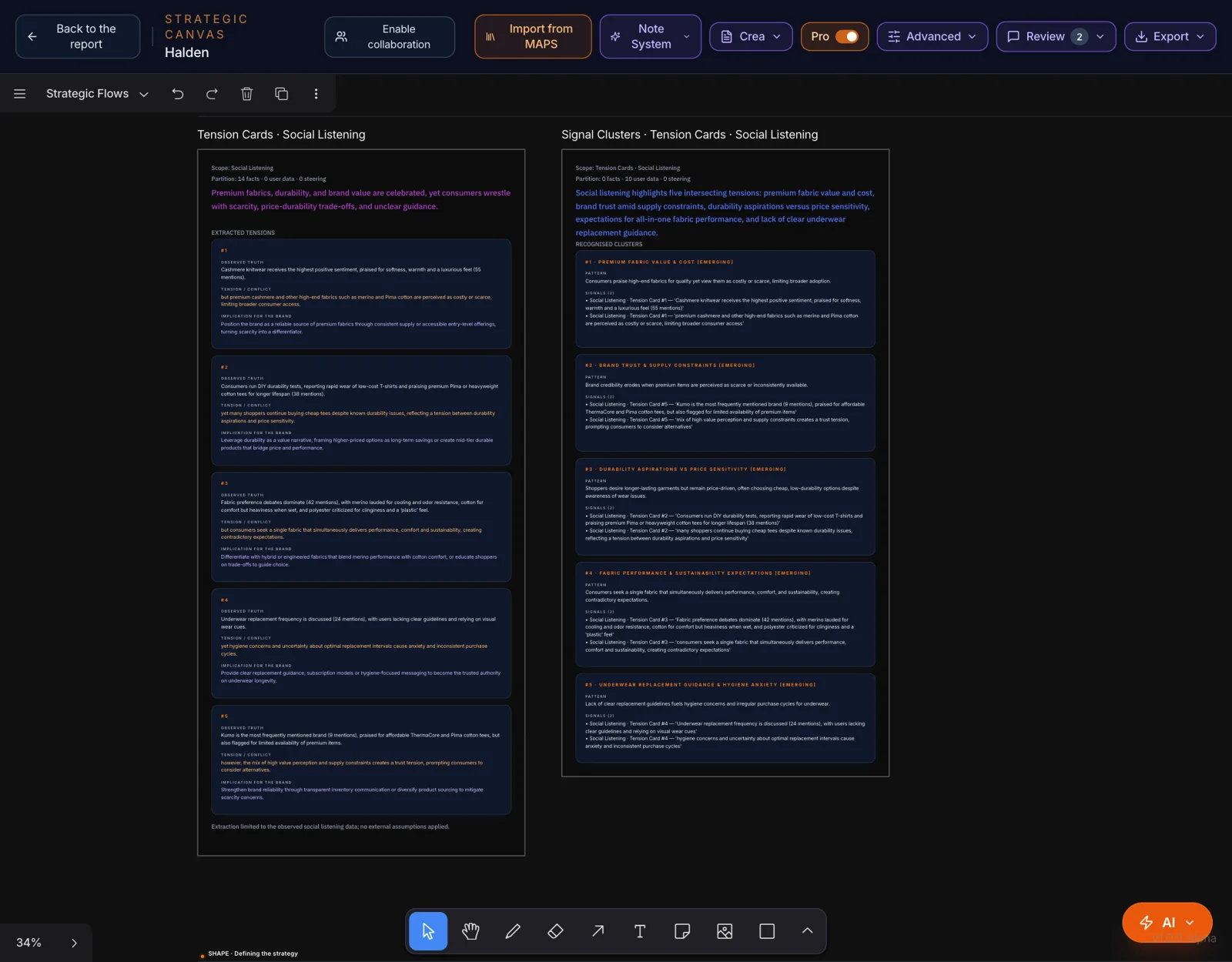
It’s the strategic version of affinity grouping, also known as the KJ method after the Japanese anthropologist Jiro Kawakita: you write each observation on a sticky note and move together the ones that “talk to each other,” until themes emerge. It works with ten signals as well as with hundreds.
How to do it
1. Bring different sources together
The value is in the mix: social conversations, customer profiles, market data, reviews. If all the signals come from the same source, you’ll find that source’s themes.
2. Group by meaning, not by word
Two comments using different words can say the same thing. Two using the same word can say opposite things.
3. Name each cluster
Two to four words that describe the theme, not a slogan. Then one sentence on the thread that ties the signals together.
4. Assess the intensity
Dominant if many signals converge; emerging if they’re few but consistent; weak if it rests on a single signal. Emerging themes are often the most interesting.
5. Keep the signals behind each theme
For each cluster, the signals it came from, with their source. That way anyone can check the reading.
6. Note what doesn’t fit
Isolated signals shouldn’t be forced into a cluster: they may be noise, or the start of something.
The most common mistakes
- Too many clusters. Beyond seven, you’re not grouping: you’re listing.
- Clusters that are too broad. “Quality” contains everything and says nothing.
- Confusing volume with importance. An emerging theme can matter more than a dominant one.
- Losing the sources. A theme without its signals can’t be verified.