
MAPS Intelligence
Resources/Strategic Thinking
Strategic Thinking · 8 min read

Strategic tensions: finding the conflict behind the signals

An observed truth, the contradiction it hides, what it means for the brand: how to write tension cards that open paths instead of summarizing.

Updated October 6, 2026 · MAPS editorial team
In brief

A strategic tension is a contradiction in people’s lives or culture that a brand can help resolve. A tension card writes it up in three parts: the truth observed in the signals, the conflict it hides — there’s always a “but” — and the implication for the brand. Tensions are the most fertile starting point for positionings and campaigns.

What a tension is

A data point says what’s happening; a tension explains why it’s hard. “People are looking for sustainable products” is a data point. “I’d like to buy sustainable, but I can’t pay double for everything” is a tension: two desires pulling in opposite directions. That’s where a brand can play a role.

The three parts of a tension card

  • Truth — what the signals say clearly: a behavior, a recurring opinion, a data point.
  • Conflict — the contradiction behind that truth. It isn’t a rephrasing: it has to contain a “but,” a “yet,” a “despite.”
  • Implication for the brand — the angle, the territory, the pressure point the tension opens up. Not an action yet.

How to find them

1. Gather signals close to people

Comments, reviews, interview quotes, social conversations. Tensions come through better in people’s own words than in charts.

2. Look for contradictions

Where do people say one thing and do another? Where do they want two incompatible things? Where do they complain about something they keep doing?

3. Write the truth and the conflict separately

If the conflict repeats the truth in other words, you haven’t found the tension yet.

4. Keep only the ones that differentiate

A tension that applies to every brand in the category is context, not an opportunity. Look for the ones where your brand has something credible to say.

An example. A furniture company, “Casa Lenta,” reads the category’s reviews. Truth: renters buy cheap furniture. Conflict: they want a home that feels like theirs, but they don’t want to invest in furniture they won’t be able to take with them. Implication: there’s room for a furniture brand designed to move, not to last in a single place.

The most common mistakes

  • Summarizing instead of extracting. A tension is a fault line, not a summary of the signals.
  • Made-up tensions. Every truth has to point back to something you observed.
  • Jumping to action. The implication points a direction; actions come later.
  • Too many tensions. Three to six are enough to choose from; twenty is a list.
How MAPS does it

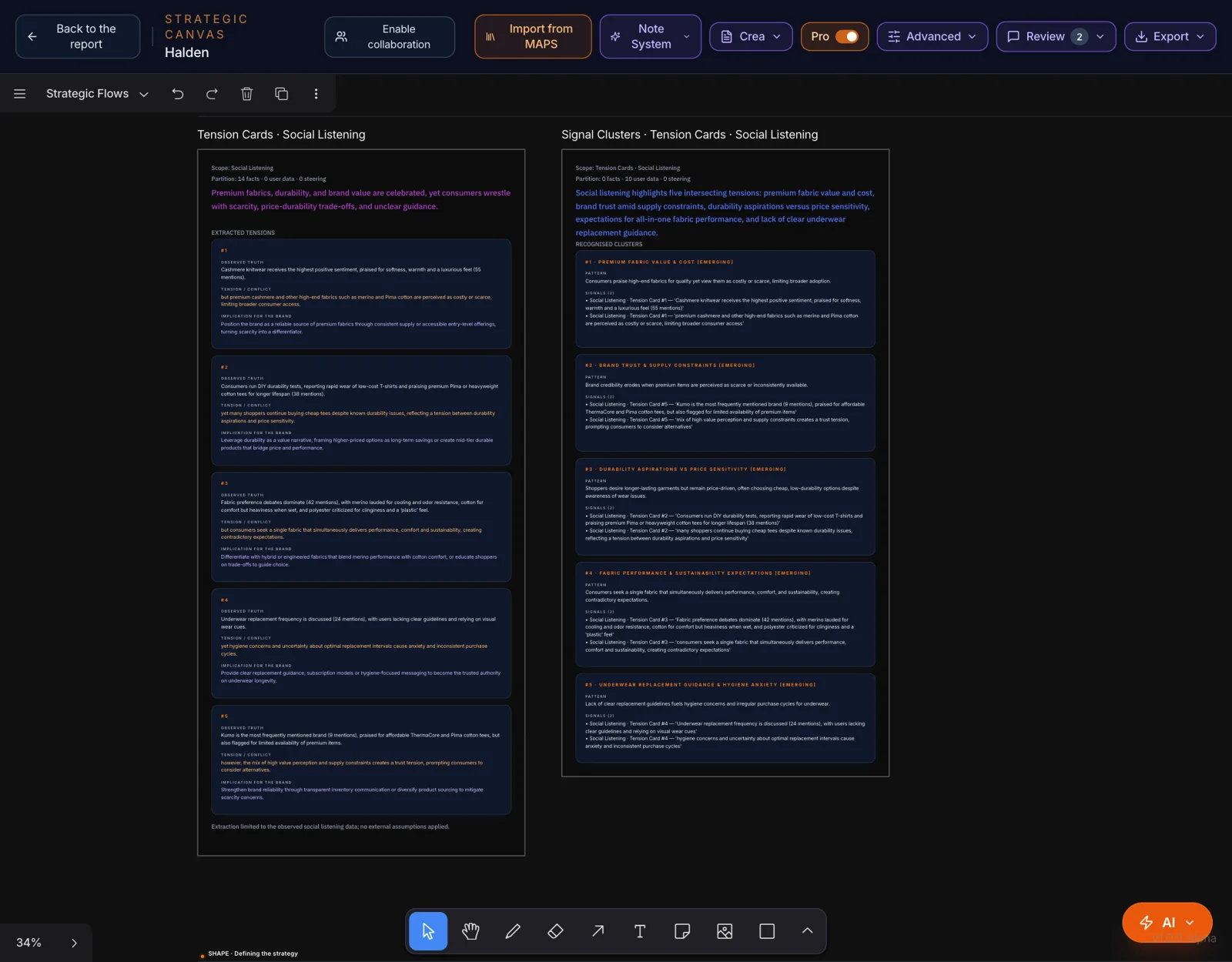
In MAPS Tension Cards is the first of the thirteen Strategic Flows in Pro Mode, in the Sense phase: “from social signals to Tension Cards.” It works on what you select on the canvas — sections imported from MAPS such as Social Listening, cards, notes, even images — or on a suggested scope that you can widen. Each card has the truth, the conflict and the implication for the brand. The flows are chained: Tension Cards feed the positioning variants, which feed the Message House, which leads to the Kill Matrix. With “Promote to canvas” they land on the Strategic Flows page.

The Strategic Flows page: three Tension Cards and a Signal Clustering from market signals

Frequently asked questions

What’s the difference between an insight and a tension?

A good insight often contains a tension: the contradiction is what makes it useful. Making the tension explicit helps you see where the brand can step in.

Where do you find tensions?

In people’s own words: reviews, comments, interviews, forums. More rarely in aggregate numbers.

How many tension cards do you need?

Three to six: enough to give you a choice, few enough to force a decision.

What do you do next?

Use them to propose alternative positionings, or as the starting insight for a campaign brief.

Written by the MAPS editorial team with the help of AI, checked and reviewed by the team.

Related articles
Methodology·9 min di lettura

Social Listening: how to listen to the market and turn it into insight

Don’t count mentions: understand what the market is saying, in which language, on which platforms. How to set up your searches, read themes and sentiment, and put what you find to use.

Read →
Strategic Thinking·8 min di lettura

Signal clustering: from scattered signals to themes

Comments, data, reviews, observations: how to group them by affinity, name the themes, and tell the dominant ones from the ones still emerging.

Read →
Strategic Thinking·9 min di lettura

Campaign brief: how to write a brief that works

Challenge, insight, idea, role of the brand, role of media, KPIs: the skeleton of a creative brief and the questions each section has to settle.

Read →