MAPS Intelligence
Resources/Methodology
Methodology · 8 min read

The MAPS protocol: Monitor, Analyze, Prove, Scale

Four phases, in the order the work actually happens: understand the market, decide the strategy, put it to the test, turn it into work. Why the order matters.

Updated October 6, 2026 · MAPS editorial team
In brief

The MAPS protocol organizes marketing work into four phases: Monitor (understand the market), Analyze (decide the strategy), Prove (test it before spending) and Scale (turn it into campaigns and content). Each phase works on what the previous ones produced, with the same memory: that is why the order matters.

The four phases

Monitor · understand the market

Competitors, customers, channels, communication, conversations, news, your own materials. It is the fact base, each fact with its source and date, that everything else rests on.

Analyze · decide the strategy

The strategy tools work on the facts from Monitor: SWOT, positioning, identity, value proposition, journey, scenarios. They don’t start from a blank page, and they don’t stop at the snapshot: they let you explore different routes.

Prove · put it to the test

Before spending, the strategy goes in front of synthetic personas built on market data and, in B2B, the client’s buying committee. Weak assumptions get discarded while it’s still cheap.

Scale · turn it into work

Ideas, campaigns, content — posts, emails, pages, videos, presentations — consistent with the brand and the chosen strategy, ready for client approval.

Why the order matters

  • A strategy without Monitor rests on opinions.
  • A campaign without Analyze is creativity without direction.
  • A launch without Prove discovers its problems when they cost the most.
  • An analysis without Scale stays in a slide deck.

The order isn’t rigid: you go back when a test disproves an assumption, or when the market changes. But every step forward builds on the ones taken before.

One protocol, different profiles

The phases are the same for a consumer brand, a B2B company, a startup or a retailer; what changes is what you look for within each phase. In B2B, Monitor looks at decision-makers, trade shows and sales channels; for a startup, research starts from the founder’s materials and looks outward to put them to the test.

The mistakes the protocol prevents

  • Skipping phases in a hurry, and paying for it later.
  • Losing the thread from one step to the next, across different tools and documents.
  • Deciding without memory: six months on, no longer knowing why a choice was made.
How MAPS does it

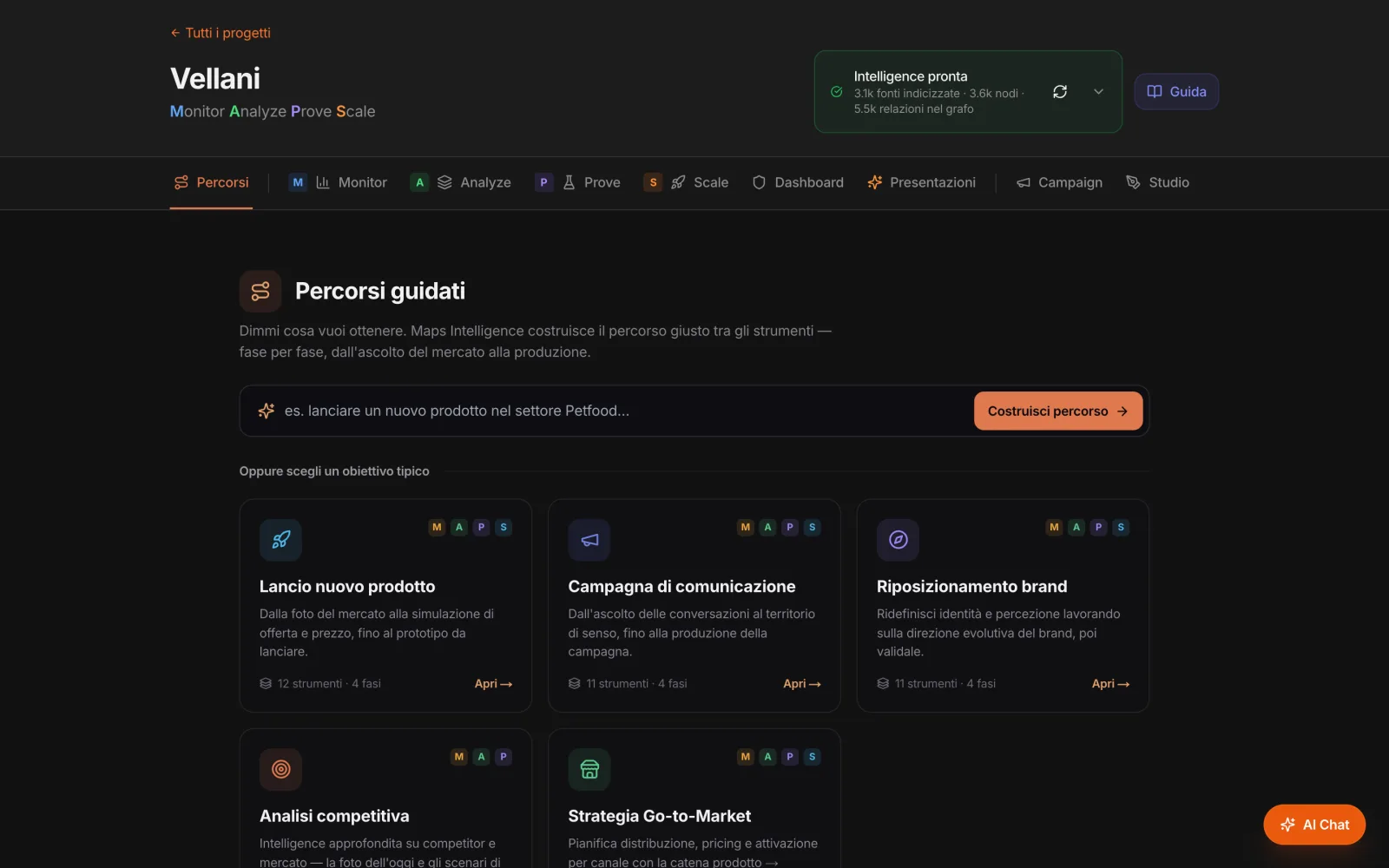
The four phases are the very structure of MAPS: every project has its own Monitor, Analyze, Prove and Scale, linked by a single memory. Monitor starts on its own when you create the project; the Analyze tools reason on what it found; “Test with Users” is built into the strategy tools and the production Studios; and the chat answers about everything, saying for every piece of information where it comes from and when it dates from. If you don’t know where to start, guided paths start from your goal and line up the tools for you.

MAPS guided paths: write your goal, MAPS lines up the tools
How it works →

Frequently asked questions

Do I have to follow the four phases in order?

No, but it pays to. You can start from Scale when something is urgent, but content without strategy and without testing is a gamble. The order keeps you from skipping the steps that cost little up front and a lot later on.

How much time does it take?

It depends on the project. With MAPS, the first reading of the market arrives in about 15-20 minutes; the real time goes into the choices and the tests.

Does it work for B2B and startups too?

Yes: the phases stay the same, what you look for changes. In B2B, decision-makers, supply chains and buying committees matter; for startups, the founder’s assumptions to be tested.

How is it different from a regular marketing plan?

A plan describes what to do. The protocol describes how to get there: with facts, explicit choices, tests and a memory that keeps the reasons behind decisions.

Written by the MAPS editorial team with the help of AI, checked and reviewed by the team.

Related articles
Practical Guides·9 min di lettura

From research to strategy: a complete path, with an example

A brand that wants to grow online: how you move from market facts to choices, to testing, to content — and how you keep the reason behind every decision.

Read →
Methodology·10 min di lettura

Strategic validation: putting an idea to the test before you invest

Find the riskiest assumptions, choose the right test, decide up front what counts as evidence: a method for failing small instead of failing big.

Read →
Methodology·9 min di lettura

Market research with AI: speed without losing depth

What AI does well in market research, where it goes wrong, and the rules for using it without being fooled: sources, dates, the market’s language, estimates flagged as estimates.

Read →