The method, in four stages
1. The picture, fast
Competitors, channels, customers, communication, conversations — in the market’s own language. With the client’s materials — briefs, research, decks — inside the same project. The goal for day one is to know what you’re talking about.
2. The tensions
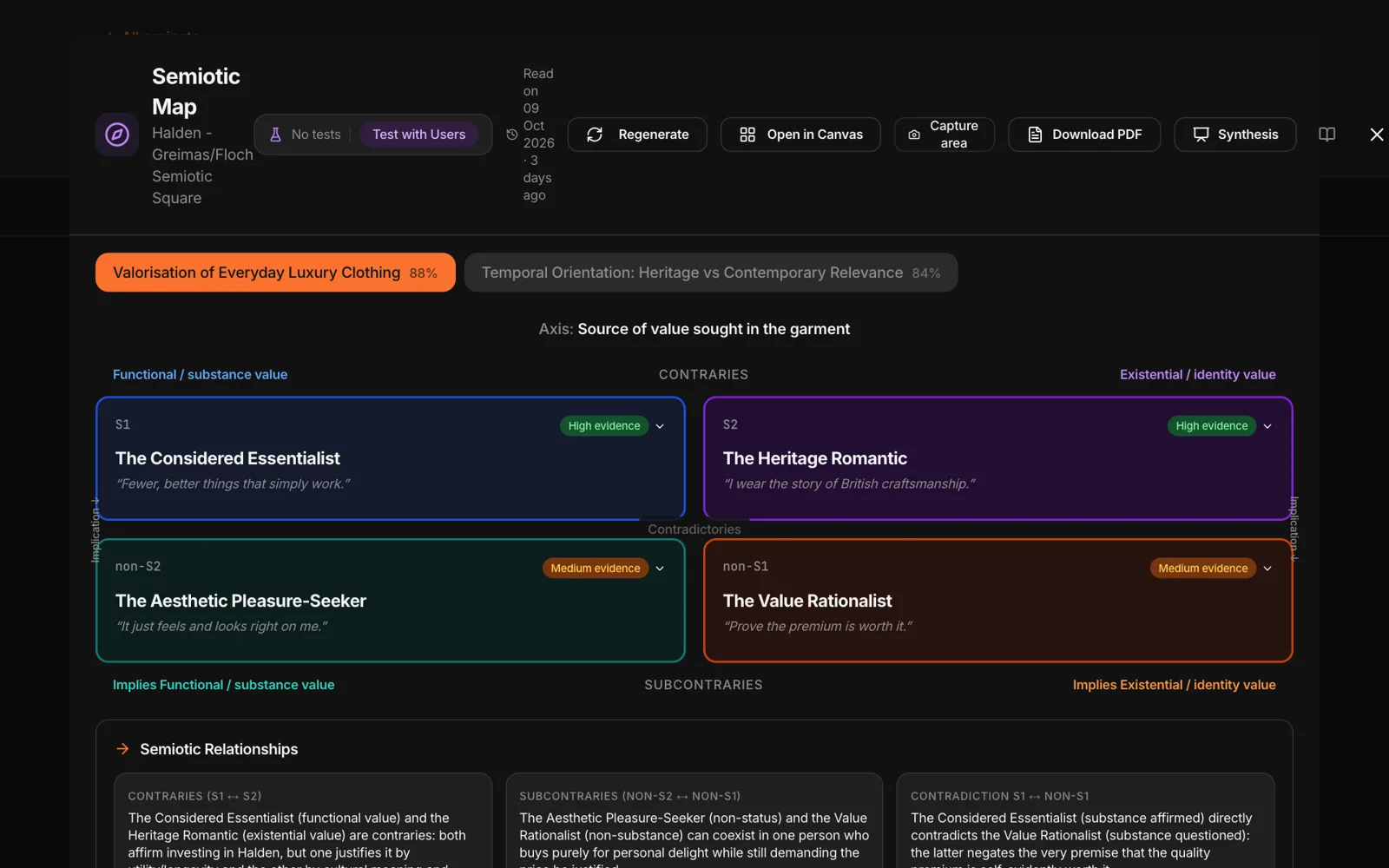
Where the category is moving, where competitors are crowding together, what customers can’t find. Tools like the SWOT, the semiotic square or the positioning map help you see what a linear reading misses.
3. The thesis
A thesis is a reasoned choice: “growth is in channel X, and the client can get there with Y, because Z.” It should be written down with its evidence and with the alternatives that were ruled out.
4. The test and the presentation
Before you present it, put the thesis to the test: in front of simulated people built on the market, and in a debate between different points of view. Then it becomes a deck for the client.
What clients value
- Sources. Every claim with its origin and its date.
- Change over time. What’s different since the last reading.
- Alternatives. Not a single answer, but the possible paths and why one is preferred.
- Confidentiality. One client’s information never ends up in work for another.
The most common mistakes
- Showing up with a summary instead of a thesis. The client pays for judgment, not for collection.
- Reading a country through sources in another language. You end up seeing the market from the outside.
- Mixing clients. Even just in your notes, it’s a risk.