
MAPS Intelligence
Resources/Strategic Tools
Strategic Tools · 9 min read

Competitive map: competitors split into arenas

You don’t compete with everyone the same way: how to divide the market into arenas, see who leads and who follows in each, and find the needs nobody serves well.

Updated October 6, 2026 · MAPS editorial team
In brief

A competitive map describes who a brand competes with and on what. Instead of a flat list of competitors, it divides the market into competitive arenas — the spaces where a distinct game is played, by need, tier or occasion — and for each one says who leads, who follows, how intense the contest is and what it means for the brand. The picture is completed by a dimension-by-dimension comparison and the white spaces.

Why arenas and not a list

A tailoring brand competes with the big fashion houses when a customer chooses a ceremony suit, with business-wear brands when they choose a work suit, and with digital made-to-measure services when they buy online. Those are three different games, with different opponents and rules. Putting them all in one list hides exactly what you need to know: where you’re strong and where you’re not.

An arena is defined from the customer’s side: a need, an occasion, a price tier, a channel. The same competitor can show up in several arenas, in different roles.

How to build it

1. Gather competitors, indirect ones included

Direct (same product, same customer), indirect (different product, same need) and substitutes. For the gathering method, see competitive intelligence.

2. Draw the arenas

Group the situations in which the customer chooses between similar alternatives. Three to six arenas are usually enough: too many and the map fragments, too few and you’re back to a list.

3. For each arena, the roles

Who leads it, who holds it, who’s chasing, who’s coming in. How intense the competition is. And above all the implication: for your brand, is that arena one to defend, to attack, or to leave?

4. Compare dimension by dimension

Brand equity, quality, price-value ratio, distribution, digital experience, sustainability: where you’re ahead and where you’re behind, and against whom. Choose the dimensions based on what matters to the customer in that category.

5. Look for the white spaces

The needs nobody serves well. For each: how much it’s worth, how feasible it is for you, and who already serves it in part. A white space with no demand isn’t an opportunity.

An example. “Corte Lana,” a fictional knitwear brand, finds it plays in three arenas: premium gifting, where it trails two heritage brands; the sustainable wardrobe, where it’s one of the leading players; and technical sportswear, where it’s marginal. The map says: defend the second, attack the first with the personalization service, and stop chasing the third.

The most common mistakes

  • Direct competitors only. The real threat often comes from a substitute.
  • Arenas defined by the company, not the customer. Internal product lines aren’t arenas.
  • Dimensions chosen to win. If you only pick the ones where you’re strong, the map reassures you instead of informing you.
  • No implication. A map that doesn’t say what to do in each arena is just a snapshot.
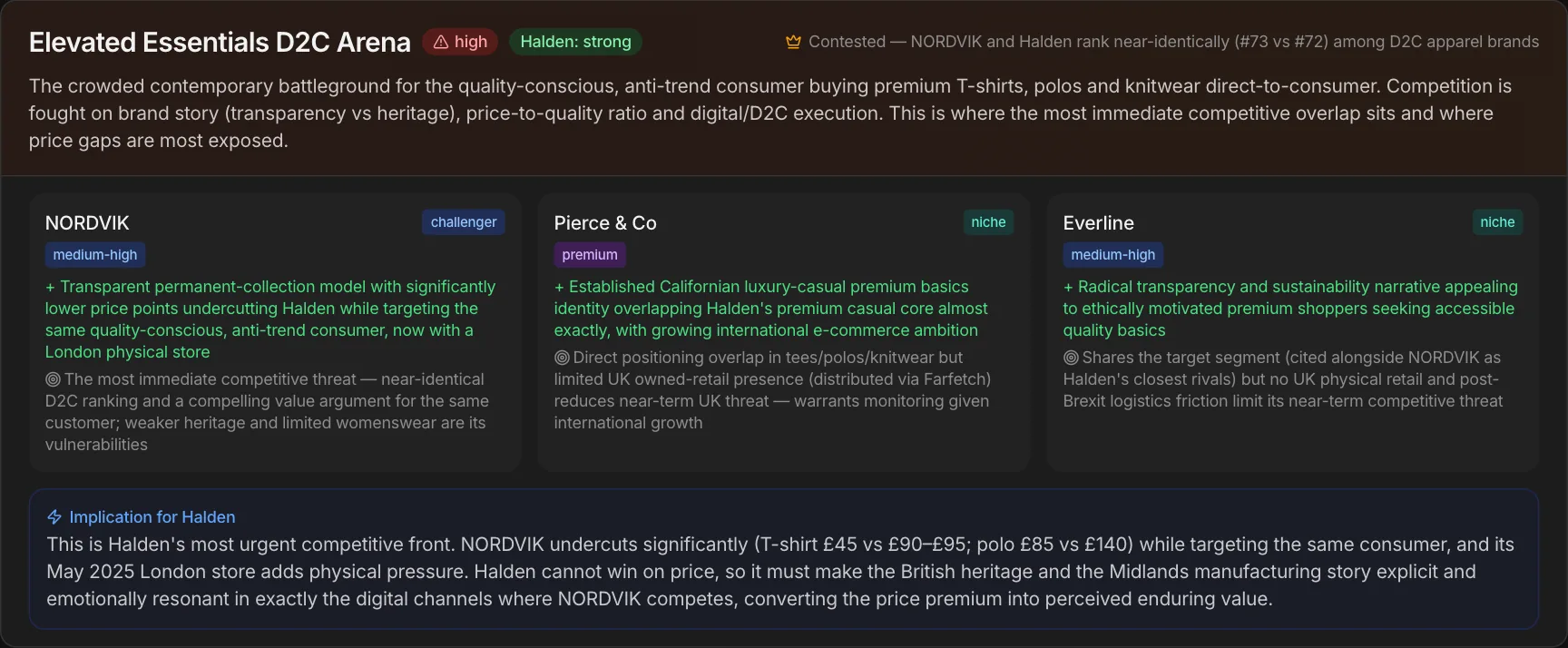
How MAPS does it

In MAPS, Competitor Mapping divides the market into arenas and for each one says who leads, who follows, how intense the contest is and what it means for the brand. Alongside: the brand with its competitive advantage, strengths and weaknesses; the side-by-side, dimension-by-dimension comparison — brand equity, quality, price-value ratio, distribution, digital experience, sustainability —; and the white spaces, the needs nobody serves well, with how much they’re worth, how feasible they are and who already serves them in part. It’s built from what the project already knows, regenerates with version history, and exports to PDF or to the Canvas.

A competitive arena: who leads it, who holds it, the implication for the brand

Frequently asked questions

What is a competitive arena?

A space in the market where the customer chooses between similar alternatives: a need, an occasion, a tier or a channel. Each arena has its own players and its own rules.

What’s the difference between a competitive map and a positioning map?

The competitive map describes who competes with whom and on what; the positioning map places brands on two perceived axes to find white space in the customer’s mind. They’re used together.

How many competitors should you include?

All the ones the customer actually considers, direct and indirect. A well-chosen ten usually tells you more than thirty names with no role.

Written by the MAPS editorial team with the help of AI, checked and reviewed by the team.

Related articles
Strategic Tools·9 min di lettura

Market analysis: size, growth, segments

How much a market is worth, how it grows, how it breaks down and where the opportunities are: the method, TAM, SAM and SOM reasoning, and how not to be fooled by the numbers.

Read →
Methodology·9 min di lettura

Competitive Intelligence: a method for gathering data that matters

From questions to decisions: how to plan, gather, verify and interpret information on competitors and the market — ethically, with sources and dates.

Read →
Strategic Tools·9 min di lettura

Positioning map: how to build it and read it

The brand and its competitors on two perceived axes: how to choose the right axes, find the white spaces and tell whether they’re worth it.

Read →