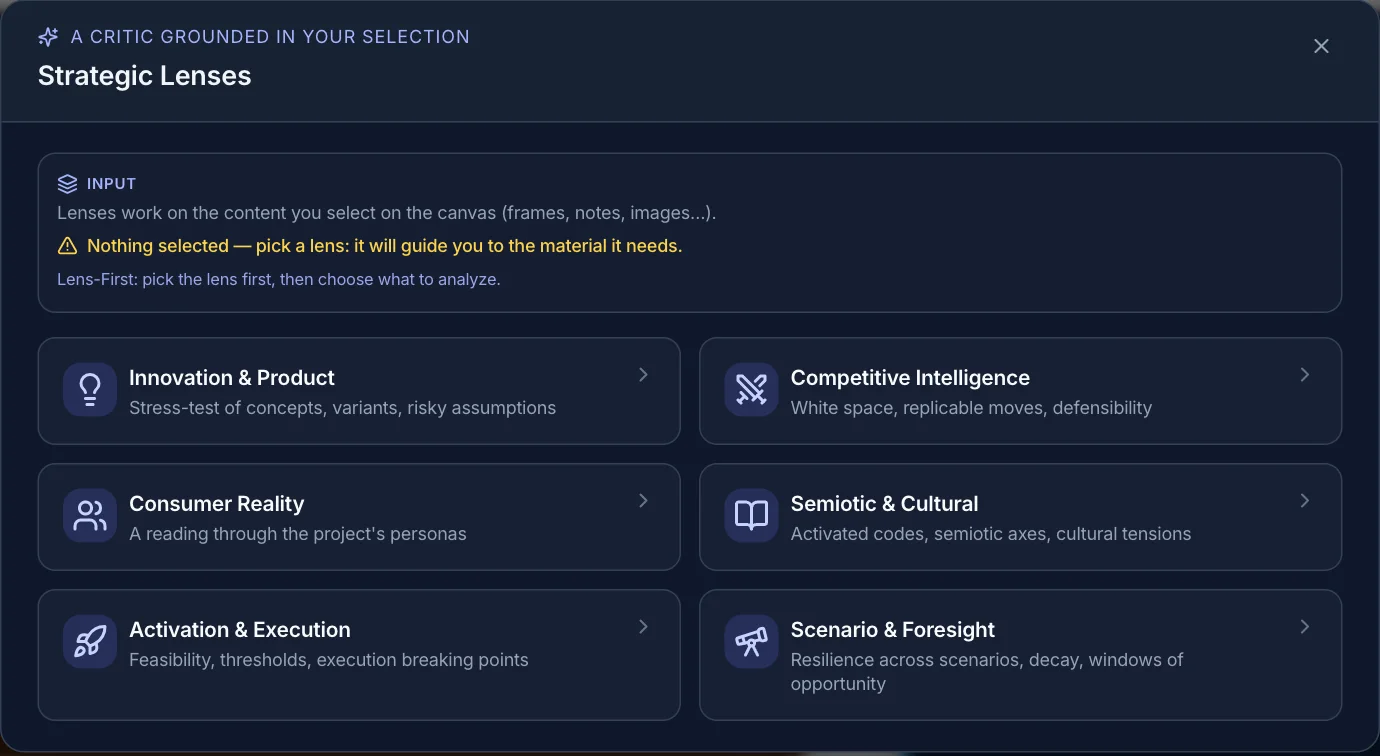
Why several points of view
Whoever came up with an idea always looks at it from the same side. A lens forces you to change position: who would sell it, who would copy it, who would buy it, what it means culturally, what it takes to make it happen, how it will age. Each of these questions brings to light problems the others don’t see.
The six lenses and their questions
1. Innovation and product
Is the idea internally consistent? Which variants would improve it without distorting it? Which risky assumptions does it rest on, perhaps without saying so?
2. Competition
Are there white spaces nobody owns? What can competitors copy, and at what cost? How defensible is the position, and for how long? See also the positioning map.
3. Consumer
What would a real person think reading it today? Would they buy it, and on what terms? How does it fit into their day? Here it pays to listen to different people, one by one, rather than to an “average customer.”
4. Culture and meaning
Which cultural codes does the idea activate, knowingly or not? Which oppositions of meaning hold it up — the territory of the semiotic square? Which cultural currents reinforce it and which erode it?
5. Execution
What does it really take to bring it to market? Which channels, and what minimum investment? What’s the critical sequence, and where can it break?
6. Scenarios and the future
How does it hold up across three or four plausible futures? When and how will it lose strength? Which windows of opportunity open up if you act now?
How to use them
- One lens at a time. Mixing points of view produces generic criticism.
- Choose the lens based on your doubt. If you fear being copied, competition; if you fear rejection, the consumer; if you fear timing, execution.
- Ask for a verdict. Each lens should close with one sentence: from that point of view, does the idea hold up or not?
- Weigh the criticisms. How serious it is, how feasible it is to fix, what impact it has.
The most common mistakes
- Using only the lens that agrees with you. The useful lens is the one that makes you uncomfortable.
- Unweighted criticism. Ten objections that all look the same don’t help you decide.
- The average consumer. Different people react differently: listen to them separately.
- Critiquing without material. Each lens needs the right data: competitors for competition, customer profiles for the consumer.