MAPS Intelligence
Resources/AI & Marketing
AI & Marketing · 8 min read

Marketing knowledge base: the memory that doesn’t get lost

Research, analyses, materials and decisions in one place, searchable in plain language: how to build it so it stays useful, and what changes when an AI reads it.

Updated October 6, 2026 · MAPS editorial team
In brief

A marketing knowledge base brings together in one place what a team knows about a brand and its market — research, analyses, materials, data, decisions — so it can be found and queried. When an AI reads it, it stops being an archive to browse and becomes a memory you can ask questions of, with sources.

The problem it solves

A marketing team’s knowledge is scattered: reports in shared folders, presentations in email, analyses in different tools, decisions in the heads of whoever was there. When someone changes roles, or a client comes back after a year, you start from scratch. A knowledge base keeps you from losing what you have already paid to learn.

What goes in it

  • Research — market, consumer and competitor research, in-house or purchased.
  • Analyses — SWOT, positioning, journey, scenarios.
  • Data — sales, panel, CRM, campaign performance.
  • Materials — briefs, presentations, brand guidelines.
  • Decisions — what was decided, why, on what evidence, what was ruled out.

How to build it so it stays useful

1. One per client, or per brand

Information from different clients must stay separate. When you need to look at it together, every piece of information must say where it comes from.

2. Every document with a source, a date and a nature

A panel figure, an internal analysis and an opinion picked up on social media don’t carry the same weight. Recording the nature and date of every piece of material lets you weigh them.

3. Updated without effort

If keeping it up to date takes separate work, nobody does it. Material should go in as you work: saving an analysis should be enough.

4. Decisions, not just documents

Six months from now, the most valuable question will be “why did we decide that?”. Recording decisions along with their reasons is the part most often forgotten.

5. Searchable in plain language

With search by meaning (embeddings) and a RAG, the knowledge base answers questions: you don’t need to remember where a file lives.
How MAPS does it

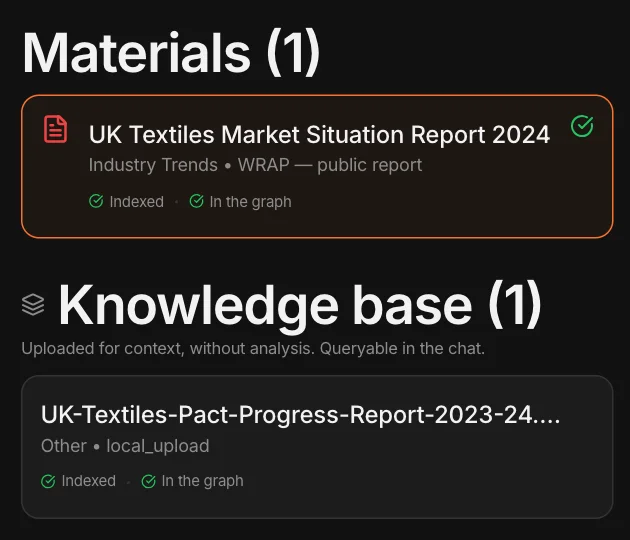
In MAPS every project has its own memory, and everything you produce goes in automatically: research, analyses, personas, campaigns, content. In the Smart Archive you upload your materials — PDFs, including scanned ones, presentations, spreadsheets, images, files from Google Drive — and choose what type they are; MAPS indexes them and links them to the graph. Strategic Memory records what you decided, why, on what evidence and what you ruled out. Projects stay separate; the Workspace also has a shared archive, and the Strategist reasons across several projects at once, labeling where each piece of information comes from.

A project’s Smart Archive in MAPS: materials indexed and linked to the graph

Frequently asked questions

What’s the difference between a knowledge base and a file archive?

An archive stores documents; a knowledge base makes them findable and connected, with a source, a date and a nature. With an AI, it becomes searchable in plain language.

Who should feed it?

Ideally no one as a dedicated task: material should go in as you work, by saving analyses and documents. Decisions, on the other hand, need to be recorded on purpose.

How do you keep it from going stale?

By dating every piece of material, keeping previous versions instead of overwriting them, and flagging when information is old.

Is it safe for client data?

It must keep clients separate, control who can access what, and handle personal data with care, for example by using only aggregates.

Origin and references

On how organizations create and share knowledge: Ikujiro Nonaka and Hirotaka Takeuchi, The Knowledge-Creating Company (1995).

Written by the MAPS editorial team with the help of AI, checked and reviewed by the team.

Related articles
AI & Marketing·9 min di lettura

RAG and Graph RAG in marketing: what they are and why they matter

How an AI answers from your documents instead of “from memory”, why classic RAG falls short when the answer lies in the connections, and what a graph adds.

Read →
AI & Marketing·8 min di lettura

Vector embeddings: search by meaning, explained simply

What embeddings are, why they let you find information even without the right words, and where they reach their limits.

Read →
Methodology·9 min di lettura

Competitive Intelligence: a method for gathering data that matters

From questions to decisions: how to plan, gather, verify and interpret information on competitors and the market — ethically, with sources and dates.

Read →