
MAPS Intelligence
Resources/Strategic Tools
Strategic Tools · 8 min read

Brand Identity Matrix: the brand identity grid

Nine elements, from the outside of the company to the inside, with the brand core at the center: how to fill it in and how to use it to spot where the identity isn’t consistent.

Updated October 6, 2026 · MAPS editorial team
In brief

The Brand Identity Matrix describes a brand through nine elements arranged on three levels: the ones the market sees from the outside, the ones inside the company, and the ones in between, with the brand core at the center. Its purpose is to check that the identity is consistent: that what the brand promises outside matches what it is inside.

The nine elements

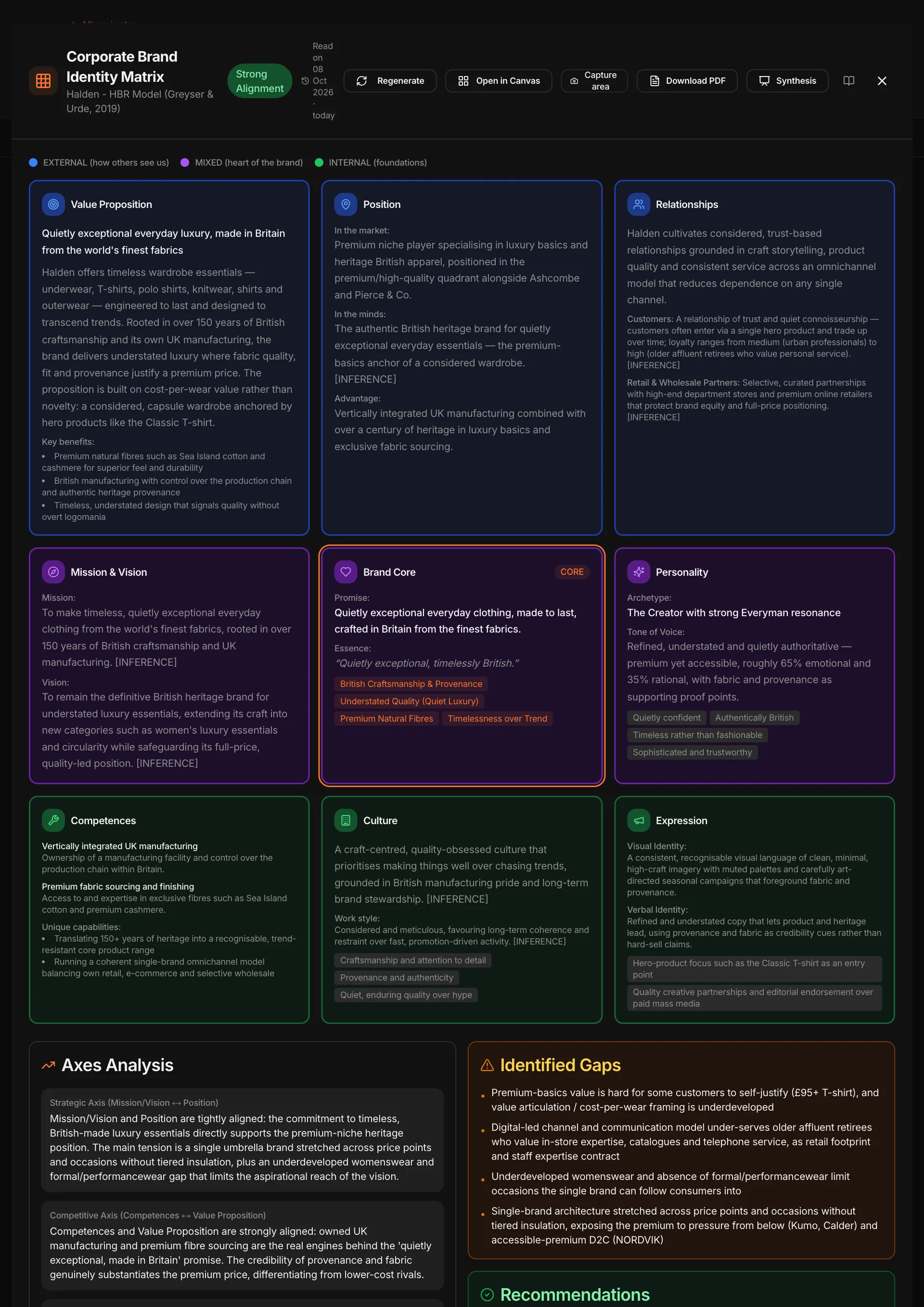
In the version used in MAPS, the elements are these, from the outside in:

  • External — the value proposition (what you offer and why choose you), the position (where you sit in the market), the relationships (what kind of bond you build with customers and stakeholders).
  • In between — mission and vision, the brand core (its essence, the underlying promise) and the personality.
  • Internal — the competences (what the company does best), the culture (how people work and what’s valued) and the expression (how the brand presents itself: signs, style, tone).

The matrix can also be read along the axes that run through the center: every internal element has an external counterpart. Competences must support the value proposition; mission and vision the position; culture the personality; expression the relationships. Where a pair doesn’t hold, there’s a promise the company can’t keep, or a strength it isn’t communicating.

How to use it

1. Fill in the core first

In a few words, what’s left of the brand if you strip everything else away. If the core can’t be written in one sentence, the rest of the matrix will be inconsistent.

2. Then internal and external, separately

For the internal side you need the company’s people and documents; for the external side, the voice of the market: customers, reviews, competitors. Filling them in together leads you to write what you’d like to be, not what is.

3. Check the pairs

For each axis, one question: does this internal element really support the external one? Mark the alignments and the gaps.

4. Turn the gaps into recommendations

Every gap can be closed in two ways: by changing the external promise or by strengthening the internal side. Choosing which is a strategic decision, not a stylistic one.

An example. “Vetreria Aurelia,” a fictional glassware brand, communicates craftsmanship and one-of-a-kind pieces (value proposition), but its core competence is high-quality series production. The competences–proposition pair doesn’t hold: either the communication shifts to consistent quality, or the company invests in a genuinely handmade line.

The most common mistakes

  • Filling the boxes with generic values. “Quality” and “passion” fit any brand, so they say nothing.
  • Only the internal point of view. The whole point of the matrix is to compare it with the market’s.
  • Reading the boxes one by one. The value is in the relationships between the elements, not in the elements.
  • Stopping at the diagnosis. A gap without a choice about how to close it just stays there.
How MAPS does it

In MAPS, the Brand Matrix is one of the six tools in Brand Strategy and Positioning: the brand identity matrix presented in Harvard Business Review, with nine elements, from what the market sees to what lies inside the company, and the brand core at the center. MAPS judges how aligned they are and where they aren’t, with the gaps identified and the recommendations. Like identity, value proposition, positioning and the map, the matrix can be tested with the project’s synthetic users (“Test with Users”), and the tests stay in the history; every regeneration archives the previous version with its date.

The nine-element matrix: external, in between, internal

Frequently asked questions

What are the nine elements of the Brand Identity Matrix?

Value proposition, position and relationships on the outside; mission and vision, brand core and personality in between; competences, culture and expression on the inside.

How is it different from the classic brand identity framework?

The classic framework lists the elements of identity (mission, values, personality, tone). The matrix arranges them between inside and outside and relates them to each other, to check that they’re consistent.

When is it worth using?

When you suspect a gap between what the brand promises and what the company is: before a repositioning, after a merger, when the communication isn’t landing.

Origin and references

The brand identity matrix was presented in Harvard Business Review.

Written by the MAPS editorial team with the help of AI, checked and reviewed by the team.

Related articles
Strategic Tools·10 min di lettura

Brand identity: mission, values, personality and archetypes

What makes up a brand’s identity, how archetypes help give it a consistent voice, and how to evolve it without losing who you are.

Read →
Strategic Tools·9 min di lettura

Positioning map: how to build it and read it

The brand and its competitors on two perceived axes: how to choose the right axes, find the white spaces and tell whether they’re worth it.

Read →
Methodology·10 min di lettura

Brand positioning: a four-phase process

Understand, choose, test, activate: how to arrive at a defensible positioning, capture it in one sentence and turn it into concrete choices.

Read →