
MAPS Intelligence
Resources/Strategic Tools
Strategic Tools · 9 min read

Trend forecasting: scenarios and early-warning signals

You can’t predict the future; you can prepare for several. How to build three scenarios, read weak signals and choose the indicators that tell you which one is arriving.

Updated October 6, 2026 · MAPS editorial team
In brief

Trend forecasting applied to strategy doesn’t try to guess the future: it builds several plausible scenarios — usually three — for a defined horizon, ties them to the signals that make them credible today, and sets the early-warning indicators that will tell you which one is arriving. The useful output is the strategies that hold up in every scenario.

Trends, signals and scenarios

  • Signal — a fact you can observe today: a data point, a news item, a new behavior, a patent, a regulation under discussion.
  • Trend — a direction that several signals confirm over time.
  • Scenario — a coherent story of what the market could look like at a given horizon, if certain uncertainties resolve in a certain way.
  • Early-warning indicator — a measure with a threshold: if it crosses it, the corresponding scenario is getting closer.

How to do it

1. Choose what to look ahead at, and how many years out

The market, customers, competition, technology. And the horizon: three years for commercial decisions, five for investments, ten for fundamental positioning choices.

2. Gather the signals

Use different sources, and note how solid each one is. A signal cited by many articles that all point back to the same source counts as one.

3. Identify the critical uncertainties

Among all the forces at play, the ones that weigh heavily and whose outcome is unknown. They’re what distinguishes one scenario from another.

4. Build three scenarios

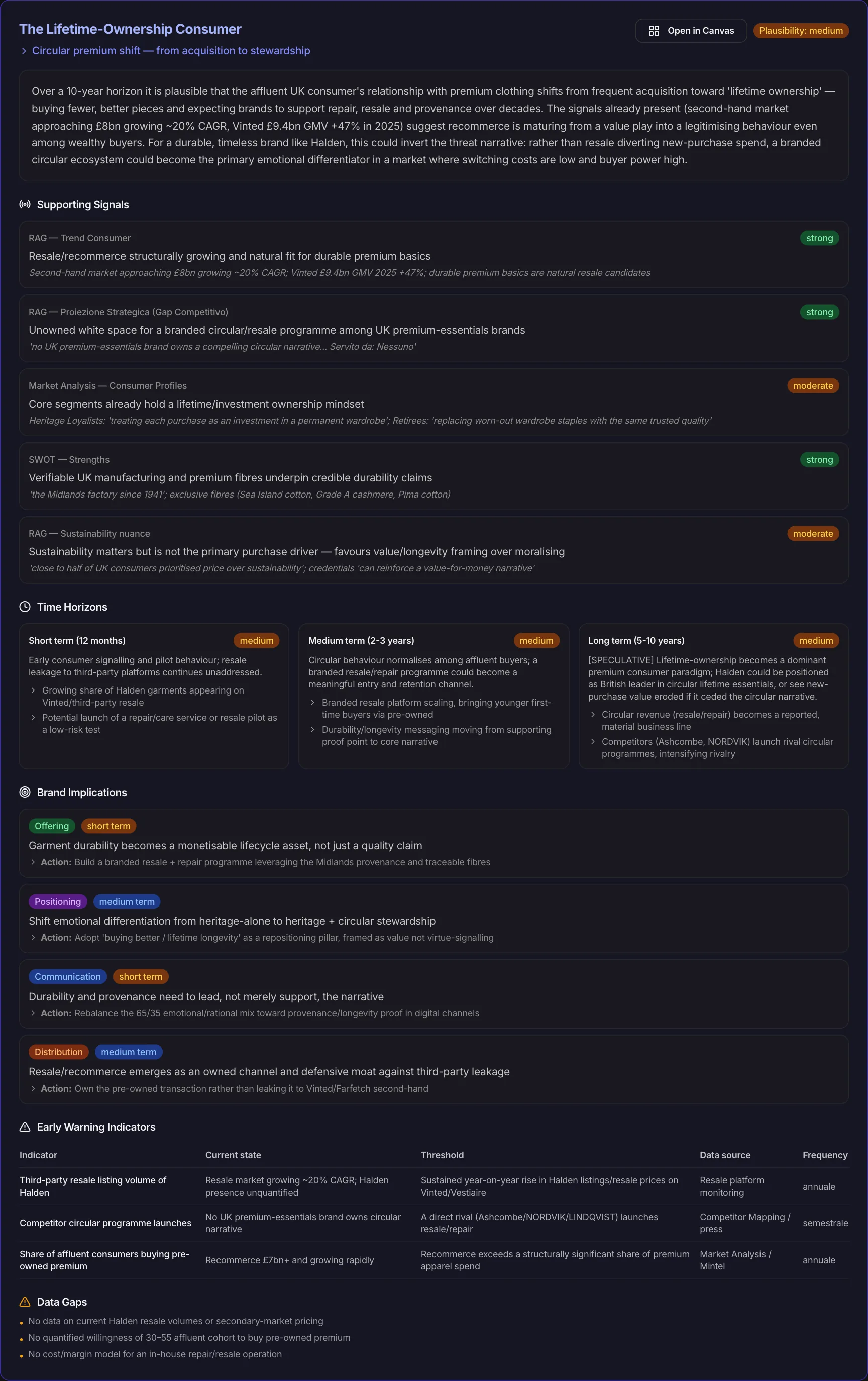
Each with its plausibility, the signals that support it, and what happens in the short, medium and long term. Avoid the “optimistic, pessimistic, middle” template: different scenarios should describe different worlds, not the same world with different numbers.

5. Set the early-warning indicators

For each indicator: the threshold beyond which to worry, where to find the data, how often to check it. Without those three things, the indicator will never get checked.

6. Look for robust strategies

What the three scenarios have in common, where they diverge, and which moves pay off in all of them. Those come first; the others are prepared and triggered when the indicators say so.

An example. “Brenta Ricambi,” a fictional maker of automotive aftermarket components, looks five years out. Three scenarios: the network of independent repair shops consolidates around a few groups; marketplaces become the main channel; EVs cut demand for some parts families faster than expected. Early-warning indicator for the third: the share of electric vehicles in the vehicle fleet in its area, checked every quarter, against a threshold set in advance.

The most common mistakes

  • A single scenario, called a forecast. You plan for one future and stay exposed to the others.
  • Scenarios that differ only in the numbers. They don’t prepare you for anything different.
  • Unweighted sources. A trend built on weak signals should be declared as such.
  • Indicators with no threshold or owner. Nobody will look at them.
  • Scenarios that don’t change decisions. If no choice depends on the scenarios, the exercise was pointless.
How MAPS does it

In MAPS, Trend Forecasting starts from a choice: what to look ahead at — market, customers, competition — and how many years out, three, five or ten. MAPS builds three scenarios, each with its plausibility, the signals that support it, and what happens in the short, medium and long term, and it declares how solid the sources are. Then the early-warning indicators: the threshold beyond which to worry, where to find the data, how often to check it. Finally, the cross-analysis: what the three scenarios have in common, where they diverge, the critical uncertainties, and the strategies that hold up in all three.

Early-warning indicators: status, threshold, source, frequency

Frequently asked questions

What’s the difference between a forecast and a scenario?

A forecast points to a probable future; a scenario is one of the possible futures. You work with several scenarios precisely because critical uncertainties can’t be predicted.

How many scenarios do you need?

Usually three: enough to cover different futures, few enough to be discussed and used.

What is an early-warning indicator?

A measure with a threshold, a source and a check frequency: when it crosses the threshold, it signals that a scenario is getting closer and it’s time to trigger the prepared moves.

What horizon should you choose?

It depends on the decision: three years for commercial choices, five for product or channel investments, ten for fundamental positioning.

Origin and references

Scenario planning spread through business from the 1970s on, notably through the work of Royal Dutch Shell’s planning group led by Pierre Wack.

Written by the MAPS editorial team with the help of AI, checked and reviewed by the team.

Related articles
Strategic Tools·9 min di lettura

Market analysis: size, growth, segments

How much a market is worth, how it grows, how it breaks down and where the opportunities are: the method, TAM, SAM and SOM reasoning, and how not to be fooled by the numbers.

Read →
Methodology·9 min di lettura

Social Listening: how to listen to the market and turn it into insight

Don’t count mentions: understand what the market is saying, in which language, on which platforms. How to set up your searches, read themes and sentiment, and put what you find to use.

Read →
Strategic Tools·9 min di lettura

SWOT analysis and the TOWS matrix: how to do it right

Strengths, weaknesses, opportunities and threats: how to gather them with evidence, tell internal from external, and turn the SWOT into action with the TOWS matrix.

Read →