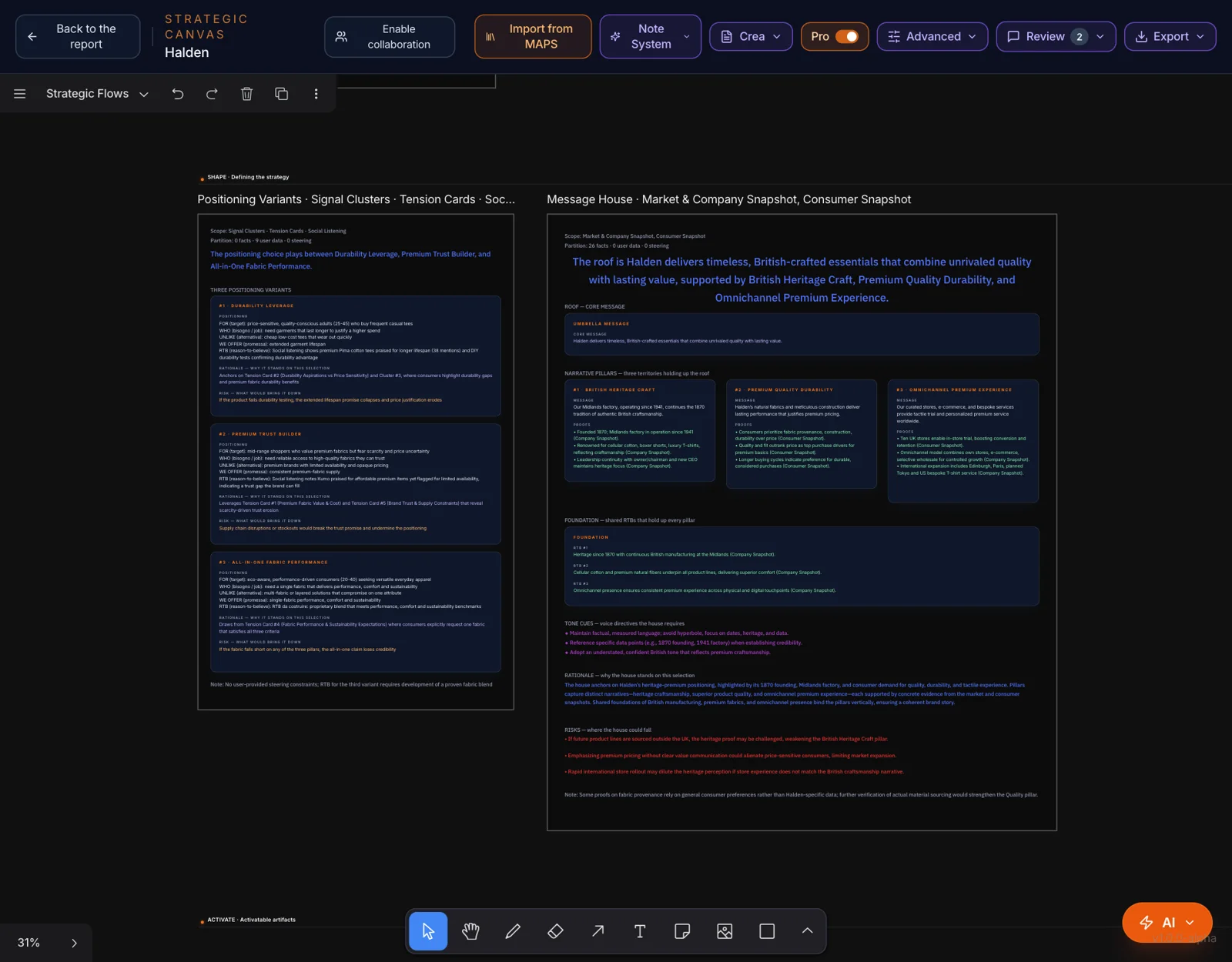
How it’s built
- The roof — the core message: a single sentence that sums up what the brand wants people to remember.
- The pillars — three or four themes that unpack the core message. Each has a name and a sentence that explains it.
- The proof points — for each pillar, verifiable facts: data, features, testimonials, awards.
- The foundation — what applies to every pillar: the story, cross-cutting proof, the tone of voice.
When to use it
After positioning, before production. Positioning says where the brand wants to stand; the message house turns that choice into messages everyone can use. It’s most useful when many people speak for the brand: PR, social, sales, customer service.
How to build one
1. Start from a choice already made
The message house doesn’t decide the positioning: it puts it into words. If the brand hasn’t yet chosen where to stand, the roof will become a compromise that says nothing.
2. Write the roof in one sentence
A short sentence that someone who doesn’t know the brand can understand. It isn’t a tagline: it’s the thesis. The tagline, if any, comes later.
3. Pick three pillars that differ from one another
Each pillar opens a distinct territory — for example the product, the experience, the value for whoever chooses it. If two pillars overlap, one is redundant.
4. Put the proof under each pillar
Two or three facts per pillar. A pillar without proof is just a claim: strengthen it or drop it.
5. Set the tone
A few pointers on how to speak: dos and don’ts. That way, whoever writes a post and whoever writes a sales proposal sound like the same brand.
The most common mistakes
- Too many pillars. Beyond four, nobody remembers them and nobody uses them.
- The roof as a tagline. A clever but vague line gives no direction to the people who have to write.
- Made-up or generic proof. “Superior quality” isn’t proof; a number or a fact is.
- Pillars that don’t hang from the roof. Each pillar has to explain one part of the core message.
- Writing it and locking it in a drawer. It has to be shared with the people who produce content, and updated when the proof changes.