
MAPS Intelligence
Resources/Strategic Thinking
Strategic Thinking · 8 min read

Kill matrix: how to drop ideas (and which ones to keep)

Fit with the strategy and supporting evidence: two criteria to decide what to scale, what to strengthen, what to challenge and what to kill.

Updated October 6, 2026 · MAPS editorial team
In brief

The kill matrix is a two-by-two matrix for deciding which ideas or initiatives to keep and which to drop. Each bet is assessed on two criteria: how consistent it is with the strategy and how much evidence supports it. Four decisions come out of it: scale, strengthen, challenge or kill.

Why you need it

Strategies fill up with initiatives: each has a champion, none gets shut down. The result is a diluted portfolio. The kill matrix forces you to classify, not just to rank: one decision for every idea.

The four quadrants

  • Scale — consistent and proven: it works and confirms the strategy. Invest more.
  • Strengthen — consistent but unproven: it’s right, but it hasn’t shown signals yet. Invest in execution and measurement before deciding.
  • Challenge — proven but off-strategy: it works, but it leads you off course. Either the market is telling you something and the strategy needs revisiting, or it has to be stopped before it changes the brand.
  • Kill — neither consistent nor proven. Stop it, and move the resources elsewhere.

How to use it

1. List the bets

Alternative positionings, content pillars, channels, campaign ideas, segments: everything you’re investing in or thinking of investing in. Each item with a clear name.

2. Assess fit with the strategy

Against written choices — positioning, the choice cascade — not against the preferences of the moment. For each assessment, one line of rationale.

3. Assess the evidence

Data, results, signals from the market. Internal enthusiasm isn’t evidence.

4. Decide one move for each bet

Not “to be evaluated”: a concrete move with a timeframe. For ideas to kill, the move is to stop, not to wait.

5. Read the portfolio as a whole

Everything in “scale” usually means the assessment was too lenient. Lots of ideas in “challenge” tell you the market is pulling in a different direction from the written strategy.

An example. A tea brand, “Foglia Alta,” has five initiatives. The compostable tea bag format is on-strategy and selling: scale it. The subscriber club is on-strategy but just launched: strengthen it, with a three-month test. The tea recipe videos do great but are about cooking, not tea: challenge them. The personalized mugs are off-strategy and not selling: kill them.

The most common mistakes

  • Lenient assessments. If no idea gets killed, the matrix didn’t do its job.
  • Confusing “strengthen” with “kill.” A right idea without evidence deserves a test, not a shutdown.
  • Ignoring the uncomfortable quadrant. Ideas that work off-strategy are the riskiest, and the most instructive.
  • No reference strategy. Without written choices, consistency becomes a matter of opinion.
How MAPS does it

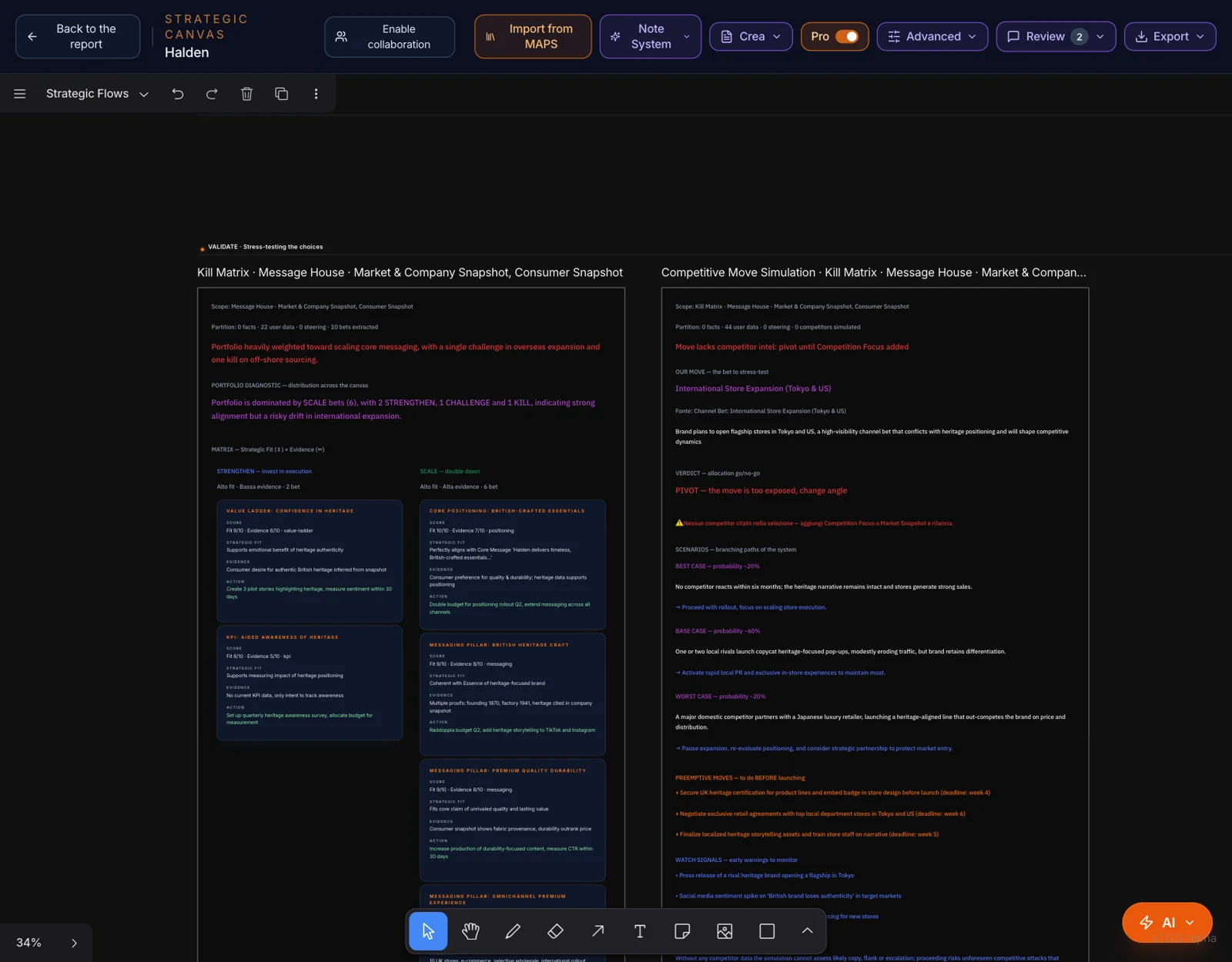
In MAPS the Kill Matrix is one of the thirteen Strategic Flows in Pro Mode, in the Validate phase: for each bet on the canvas it decides whether to scale, strengthen, challenge or kill, assessing its fit with the strategy and the supporting evidence. It’s the last link in a chain: Tension Cards feed the positioning variants, which feed the Message House, which leads to the Kill Matrix. It works on what you select or on a suggested scope, and with “Promote to canvas” it lands on the Strategic Flows page, in its phase’s band.

The Validate phase: a Kill Matrix on the positioning variants and a simulation of competitive moves

Frequently asked questions

What is a kill matrix?

A two-by-two matrix that classifies ideas or initiatives by fit with the strategy and supporting evidence, to decide which to scale, strengthen, challenge or kill.

How often should you do it?

At every plan review, and whenever open initiatives start multiplying. It’s an exercise to repeat, not to do once.

What do you do with an idea that works but is off-strategy?

Decide explicitly: either revise the strategy, because the market is telling you something, or stop the idea before it takes the brand somewhere else.

Who should take part in the assessment?

People who know the strategy and people who know the data. Ideally, whoever proposed an idea isn’t the only one assessing it.

Written by the MAPS editorial team with the help of AI, checked and reviewed by the team.

Related articles
Methodology·10 min di lettura

Strategic validation: putting an idea to the test before you invest

Find the riskiest assumptions, choose the right test, decide up front what counts as evidence: a method for failing small instead of failing big.

Read →
Strategic Thinking·9 min di lettura

Strategic choice cascade: the five choices of Playing to Win

Winning aspiration, where to play, how to win, capabilities, management systems: strategy as a sequence of linked choices, and how to find the weak link.

Read →
Strategic Thinking·9 min di lettura

Simulating a competitor’s move before you launch

Before you move, ask how the others will respond: a lightweight wargaming method to anticipate reactions, prepare countermoves and decide whether to go.

Read →