Why do it
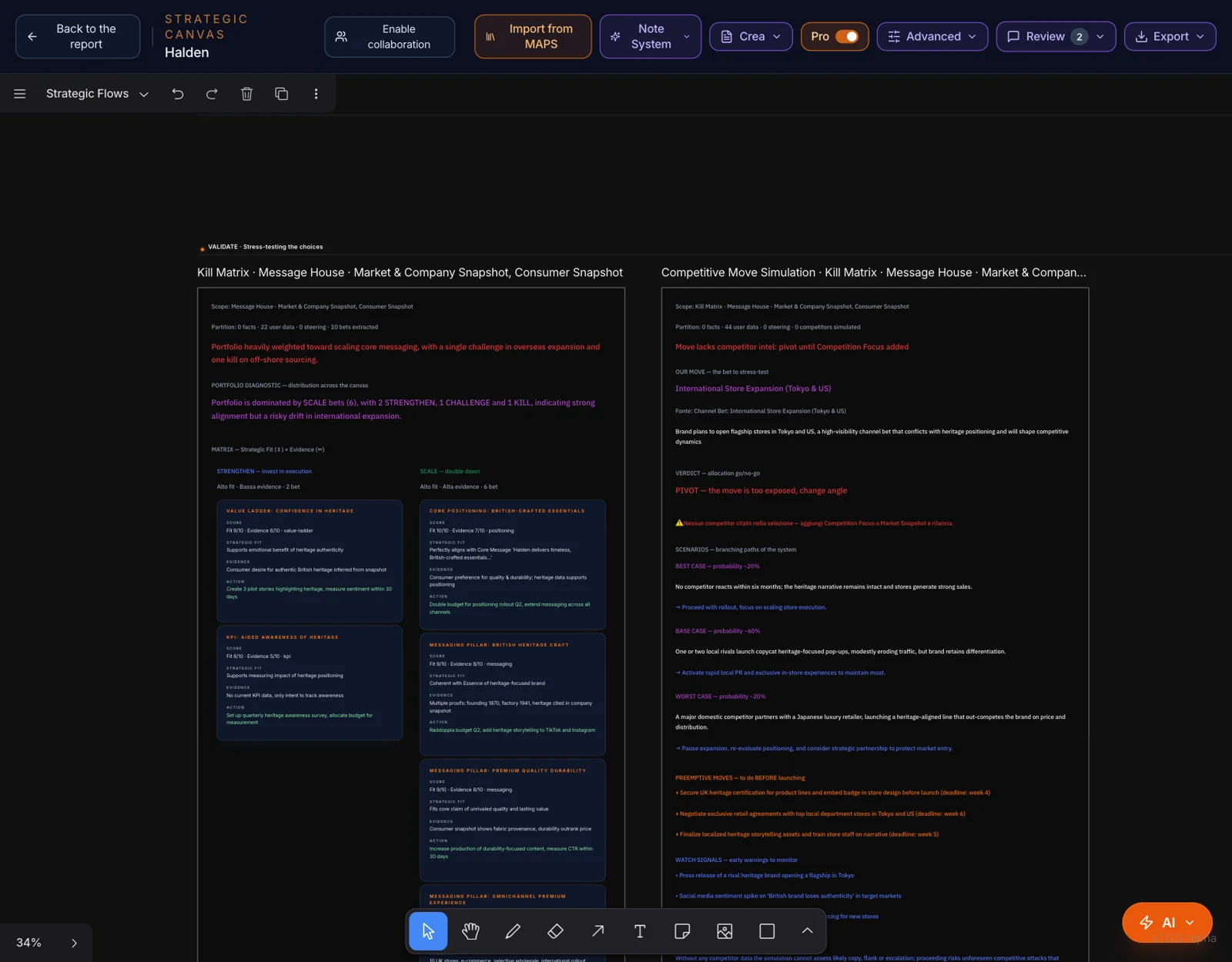
Many plans describe their own move as if the market would stand still. But a new price, a new product or a new positioning triggers reactions. Simulating them in advance costs little and often changes the decision: the launch timing, the defenses to prepare, or the move itself.
A competitor’s typical responses
- Copy — replicate your move, often faster than you think.
- Counterattack — respond on the same ground: price, promotion, communication.
- Outflank — shift to a segment or channel you’ve left uncovered.
- Raise the stakes — respond with a bigger move.
- Ignore or retreat — leave you room, by choice or for lack of resources.
- Acquire or partner — buy or strike deals to close the gap.
How to do it
1. Describe your move in one sentence
What you’re doing, for whom, starting when. A vague move produces vague reactions.
2. Pick the competitors that matter
Three to five at most. For each, their habitual behavior: how they’ve reacted in the past, what they can afford. This is where you need competitive intelligence, not impressions.
3. Hypothesize the likely response and its timing
For each competitor: what kind of response, how many weeks out, with what confidence. Write down what would trigger the reaction.
4. Build two or three scenarios
Plausible combinations of responses, each with a short story and what it means for you.
5. Prepare countermoves and signals to watch
What to do before launch to reduce your exposure, and which signals will tell you a reaction is coming.
6. Decide
Go, go with your defenses ready, postpone to a better moment, or change the move if it’s too easy to copy.
The most common mistakes
- Imagining passive competitors. The assumption “they won’t react” has to be proven.
- Competitors without a history. Past reactions are the best predictor.
- Ignoring timing. A move that can be copied in a few weeks is worth less than it looks.
- No signals to watch. Without them, you notice the response when it has already arrived.