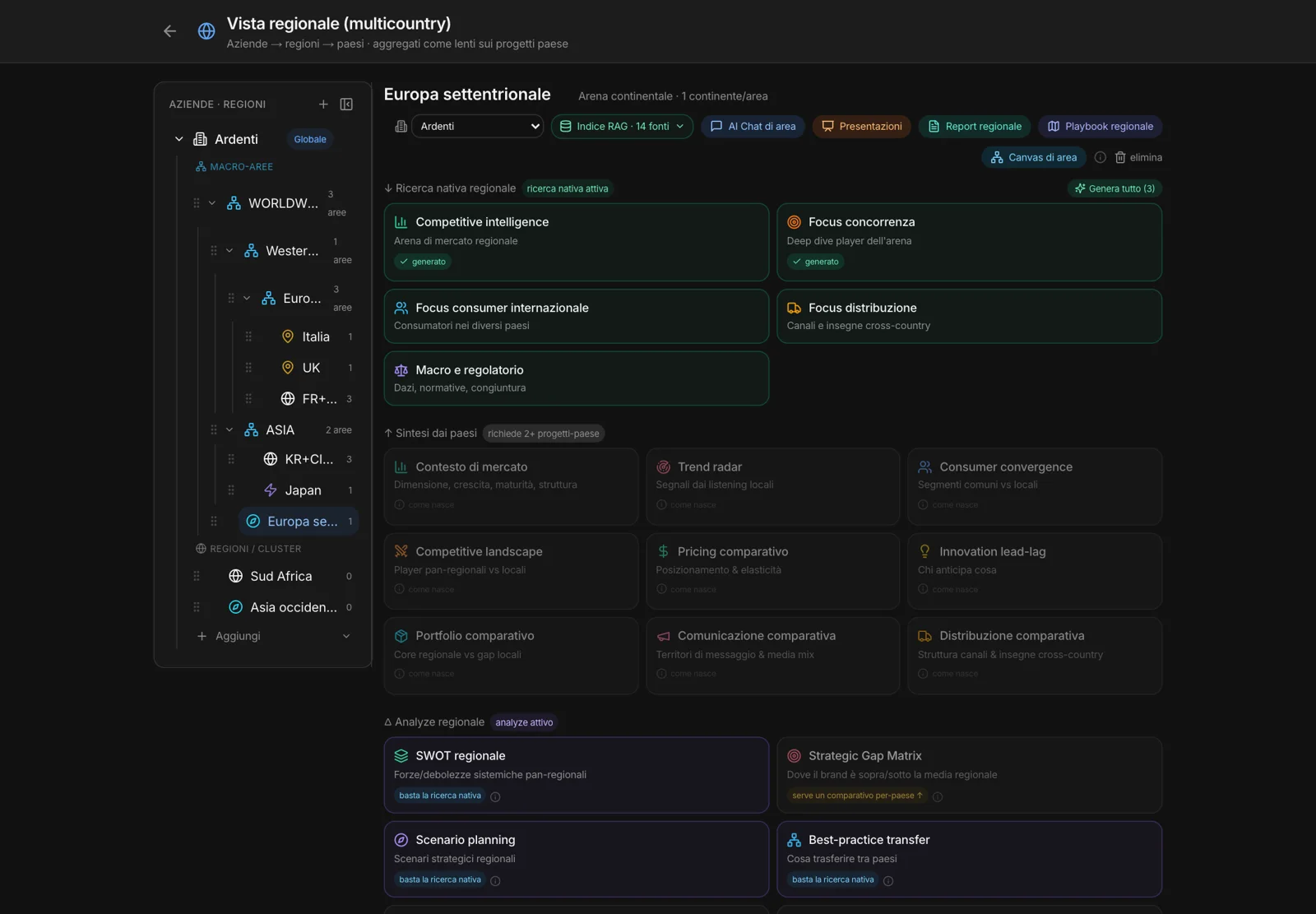
The area,
as a single arena.
Native research doesn’t add countries up: it examines the whole area as a single market. It searches the web, then a senior analyst puts what it finds in order — telling pan-regional players apart from national champions, and convergences from each country’s specifics.
The subject is the market, not the brand: the brand is one of the players, and its position is a finding. Where a figure is missing for a country, you see “n/a”, not a made-up number.
Everything
you need to know about the area.
Each module has its own questions and its own grid.
Competitive intelligence
The regional arena: structure, competition, consumers, distribution, prices, innovation.
Competition Focus
The arena’s players, in depth: who is strong where.
International Consumer Focus
Consumers in the different countries: what they share, and what they don’t.
Distribution Focus
Channels and retail banners from one country to the next.
Macro & regulatory
Tariffs, regulations, the economic cycle.
Three readings
for each module.
The same format for every module, so areas can be compared.
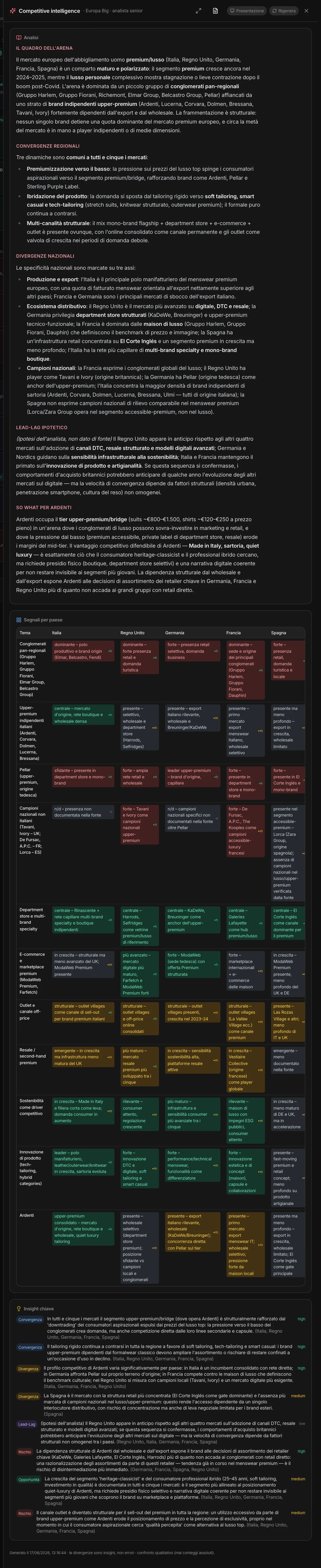
Analysis
The analyst’s reading, split into sections: the overview, the convergences, the specifics, the “so what” for the brand.
Signals by country
A theme × country matrix: for each cell, the value, whether it’s a positive or negative signal, and how reliable it is.
Key insights
Convergences, divergences, who leads whom, risks and opportunities — with the countries involved and the confidence level.
If the research found little for a country, the panel says so: sparse data, lower confidence. Every reading can be regenerated, stays in the version history, and can be exported as a PDF or turned into a presentation.
It takes
very little to start.
All it takes is two countries — even picked from a list, without a project for each — and one of the company’s country projects, from which MAPS derives the industry and the brand. A continental arena can start even sooner: you study the continent from above.
On a macro-area the research looks at every country it contains, at every level. “Generate all” runs the missing modules in the background, with progress shown and a button to stop. What comes out goes into the area’s memory: the area chat uses it.