
MAPS Intelligence
Resources/Practical Guides
Practical Guides · 9 min read

Many countries, kept apart: how to work across international markets

Research in each market’s own language, areas built the way you need them, cross-country comparisons, and content adapted to the local culture.

Updated October 6, 2026 · MAPS editorial team
In brief

Working across several countries means reading each market through its own sources and its own language, then comparing them without mixing them: what they have in common, where they diverge, where it makes sense to play first. And adapting content to each country’s culture, rather than translating it.

A five-step method

1. One country at a time, in its own language

Every market has its own press, its own forums, its own local competitors, its own words. Research should be done in the country’s language; the reading can happen in yours.

2. Areas built around the decision

Areas don’t have to be continents: they can be the markets for a launch, a group of similar countries, a distributor’s countries. You build them around what you need to decide.

3. The comparison

Competition, prices, channels, communication, consumers, compared across countries: where the brand is strong, where it’s weak, where the market is moving fastest.

4. Area-level choices

Where to play first, with what proposition, with what risks, and what to adapt country by country.

5. Content adapted, not translated

A message that works in Italy can be misunderstood elsewhere. Every piece of content should be reread through the country’s culture: references, tone, images, words.

The most common mistakes

  • Reading every country from Italy. With Italian sources you only see the market from the outside.
  • Mixing countries’ data. A number from Germany ends up in the plan for France.
  • Translating instead of adapting.
  • Areas chosen for convenience. The right area is the one that fits the decision.
How MAPS does it

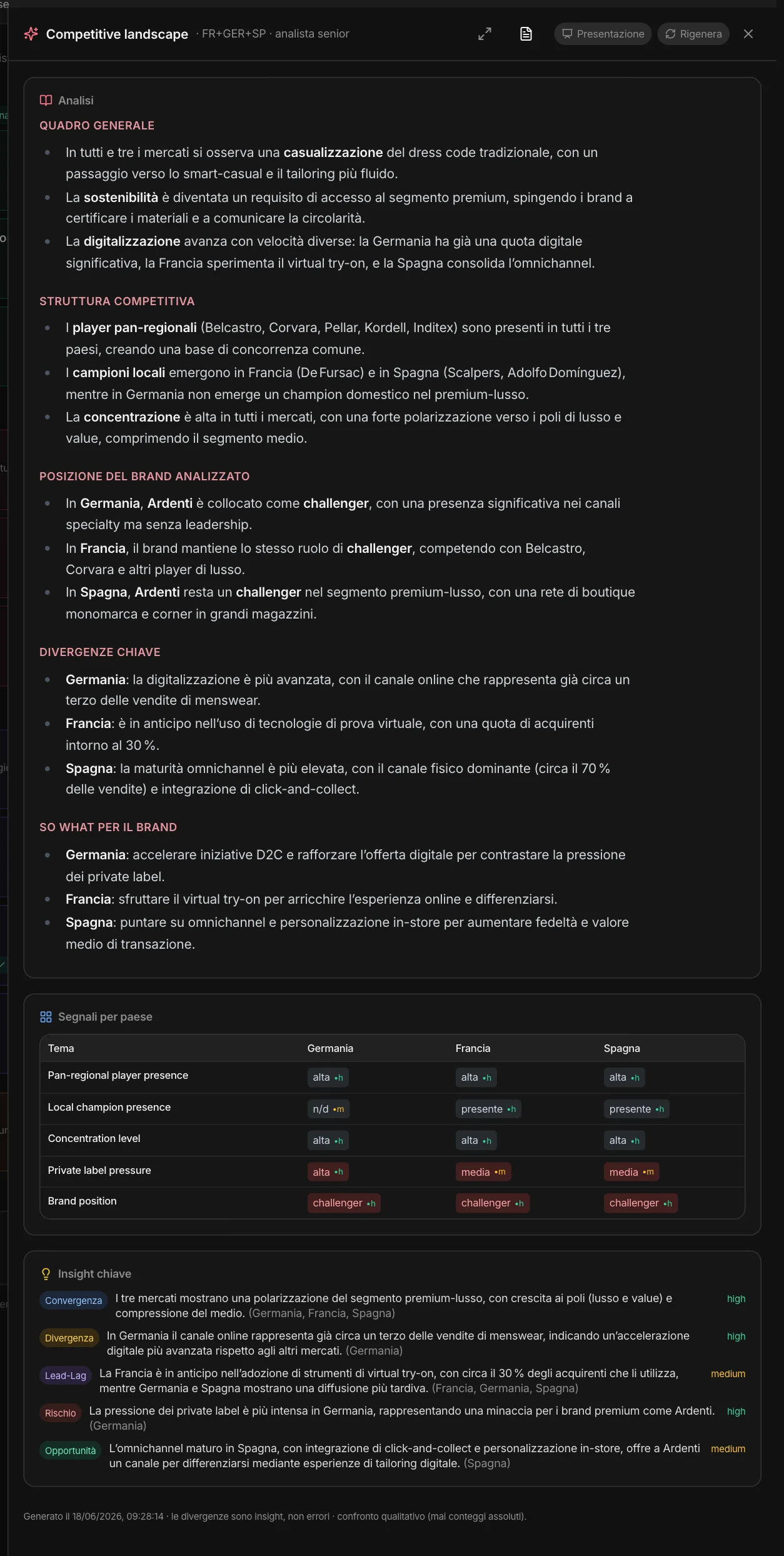
In MAPS each country is a project, with research in the market’s language and “Translate” to read it in yours. On top of the countries you build areas however you need them, and for a first look there’s a country Quick Overview. With at least two countries, area syntheses compare competition, prices, channels, communication and consumers; the area canvas helps you choose where to play, with roadmap and risks. In the area chat every piece of information carries its country, and the culture judge rereads content with the risks for that country and the suggested tweaks.

An area synthesis in MAPS: the competitive landscape across France, Germany and Spain, the divergences and the so what

Frequently asked questions

Is research done in each country’s language?

Yes, for each country’s project: research and sources are in the market’s language, and you read in your working language.

Can I build areas other than continents?

Yes: areas are built however you need them — the markets for a launch, a group of similar countries, a distributor’s countries.

Can one country’s data end up in another country’s analysis?

No: when you reason across several countries at once, every piece of information carries the label of the country it comes from, and the AI doesn’t carry data over from one to another.

Is content adapted to each country’s culture?

Yes: the culture judge rereads it for the country, with the risks and the suggested tweaks, and presentations can be adapted into another language.

Written by the MAPS editorial team with the help of AI, checked and reviewed by the team.

Related articles
Methodology·9 min di lettura

Social Listening: how to listen to the market and turn it into insight

Don’t count mentions: understand what the market is saying, in which language, on which platforms. How to set up your searches, read themes and sentiment, and put what you find to use.

Read →
Methodology·9 min di lettura

Competitive Intelligence: a method for gathering data that matters

From questions to decisions: how to plan, gather, verify and interpret information on competitors and the market — ethically, with sources and dates.

Read →
Practical Guides·9 min di lettura

From research to strategy: a complete path, with an example

A brand that wants to grow online: how you move from market facts to choices, to testing, to content — and how you keep the reason behind every decision.

Read →